Nexon Games Increases R&D Expenses Amid Revenue Growth
Netmarble and NC Reduce Costs Due to Performance Impact
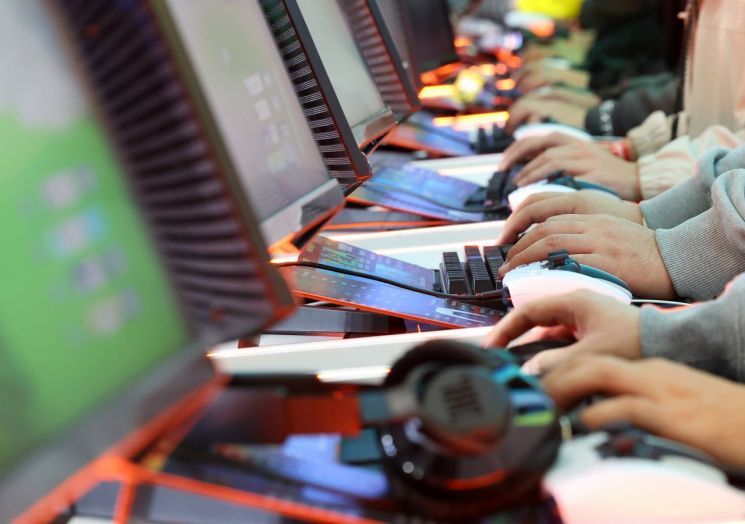 Last November, visitors enjoyed games at G-Star 2023 held at BEXCO in Busan.
 [Image source=Yonhap News]
Despite the game market facing a downturn, game companies that showed improved performance have increased their research and development (R&D) expenses. This is interpreted as a strategy to strengthen competitiveness by investing more in R&D, which plays a crucial role in launching new games in the future. On the other hand, game companies experiencing poor performance tightened their belts by reducing R&D expenses. It is expected that R&D investment will further widen the revenue gap among game companies.
According to the Financial Supervisory Service's electronic disclosure system on the 27th, Nexon Games' R&D expenses last year amounted to 62.2 billion KRW. This is an increase of 13.4 billion KRW compared to 48.8 billion KRW the previous year. The largest portion of R&D expenses was personnel costs, including hiring developers, with 47.3 billion KRW spent last year.
The increase in this company's R&D expenses is attributed to its supported performance. With the continued success of existing games such as V4 and Blue Archive, consolidated operating revenue (sales) showed an upward trend. Nexon Games' sales last year reached 193.2 billion KRW, rising more than 45% compared to the previous year. Operating profit also surged 135% to 12 billion KRW.
A Nexon Games representative stated, "We hired about 300 people last year, most of whom were R&D personnel," adding, "We are developing new titles through projects like Project DX, which utilizes the intellectual property (IP) of Wild Lands: Durango, and Project DW, which uses the Dungeon & Fighter IP, naturally increasing R&D expenses." They continued, "We plan to strengthen growth momentum through R&D."
Com2uS also increased its R&D budget to 138.8 billion KRW, supported by a roughly 10% increase in sales to 739.6 billion KRW. Wemade similarly expanded its R&D expenses from 53 billion KRW to 54.5 billion KRW as its sales rose from 463.5 billion KRW to 605.3 billion KRW within a year.
Conversely, Netmarble reduced its R&D expenses from 858.1 billion KRW to 670.8 billion KRW as its sales declined to 2.5021 trillion KRW last year, reflecting poor performance. NCSoft also saw a significant drop in sales from 2.5718 trillion KRW to 1.7798 trillion KRW due to the underperformance of new titles like Throne and Liberty (TL). However, its R&D expenses only slightly decreased from 473 billion KRW to 467.1 billion KRW. This reflects the necessity to maintain R&D expenses throughout the year as the release schedule for the major project TL was finalized in December last year.
An industry insider said, "A large portion of game companies' R&D expenses are personnel costs," adding, "If performance is good, the probability of more projects increases, naturally leading to hiring more developers, but if not, they reduce staff."
There is also a view that the reduction in R&D expenses by some companies last year is rather a normalization process. Game companies that enjoyed a boom during the COVID-19 period had expanded their scale, and now they are in a phase of removing the bubble. The Korea Creative Content Agency explained in the '2023 Game Industry Worker Labor Environment Survey' that "game businesses, expecting continuous growth in the game industry, excessively raised salaries or expanded personnel under the pretext of attracting talent during the COVID-19 pandemic," and "as daily life returns to normal, excessive hiring has become a hindrance to performance."
© The Asia Business Daily(www.asiae.co.kr). All rights reserved.
![Clutching a Stolen Dior Bag, Saying "I Hate Being Poor but Real"... The Grotesque Con of a "Human Knockoff" [Slate]](https://cwcontent.asiae.co.kr/asiaresize/183/2026021902243444107_1771435474.jpg)















