Once a Karaoke Favorite, It Maintains Steady Popularity
Singer Lee Young-hyun "Sometimes Earns 26 Million Won a Month"
"Karaoke Copyright Fees Are the Most Profitable"
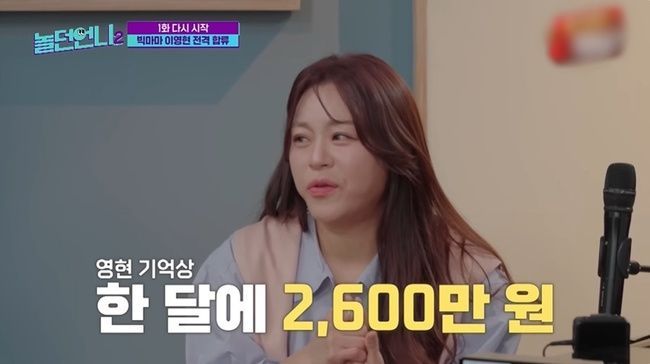 Group Big Mama's Lee Young-hyun appeared on a broadcast and revealed the karaoke copyright income from the song "Resignation," which became a hot topic.
 [Photo by E Channel·Channel S 'Noldun Unni 2']
Songwriter and singer-songwriter An Ye-eun, who gained public recognition with various hit songs including "Dream of an Octopus," appeared on KBS Cool FM radio's "Lee Eun-ji's Gayo Plaza" earlier this year and sparked attention by stating that "karaoke copyright fees are the most profitable" when asked about copyright-related questions. Living up to her title as a 'music genius,' she became a full member of the Korea Music Copyright Association this year and emerged as a rising figure in karaoke copyright fees.
Looking at data released by KB Kookmin Card in February, coin karaoke sales in 2023 increased by 60% compared to the previous year, accounting for the highest sales proportion among entertainment service sectors. General karaoke also grew by 13% year-on-year, and as the karaoke market showed signs of recovery, copyright fees increased accordingly. The Korea Music Copyright Association announced that performance royalties generated from karaoke, concerts, and other events reached 50.6 billion KRW last year, up 22.5% from the previous year.
As economic indicators related to karaoke rose, public interest naturally focused on copyright fee income from popular karaoke songs. Recently, singer Lee Young-hyun, formerly of Big Mama, appeared on E Channel and Channel S's "Noldeon Unni 2" and revealed that she once earned up to 26 million KRW per month solely from karaoke copyright fee settlements for her karaoke favorite "Resignation," drawing attention. Trot singer Jin Sung also appeared on KBS2's "Boss's Ears Are Donkey's Ears" earlier this month and surprised the cast by stating that many of his songs rank high in karaoke popularity charts and that he earns about the equivalent of a compact car's worth of copyright fees monthly.
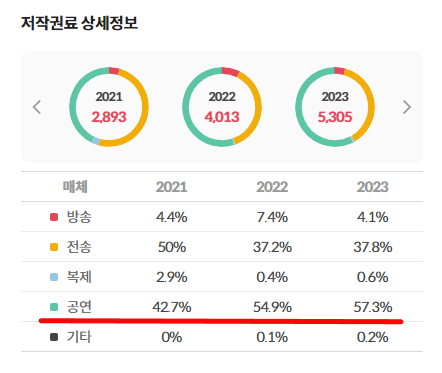 Detailed copyright royalty information for izi's 'Emergency Room' over the past 3 years. [Data = Musicow]
Examining the proportion of copyright fees by media for representative karaoke favorites, it is confirmed that the 'performance' media category, which includes karaoke copyright fees, holds a high proportion. According to annual copyright fee dividend information released by the music investment platform Musicow, the proportion of 'performance' media copyright fees for izi's "Emergency Room," a long-loved karaoke favorite, increased from 42.6% in 2021 to 54.9% in 2022 and 57.3% in 2023, surpassing transmission media (streaming). Similarly, Big Mama's "Resignation," mentioned by Lee Young-hyun, recorded 'performance' media copyright fee proportions of 39.6% in 2021, 44.7% in 2022, and 52.5% in 2023.
The reason karaoke copyright fees can be a substantial income source for singers lies in the characteristics of karaoke favorites. Songs that become known as a 'karaoke go-to' tend to be consistently sung and consumed over time.
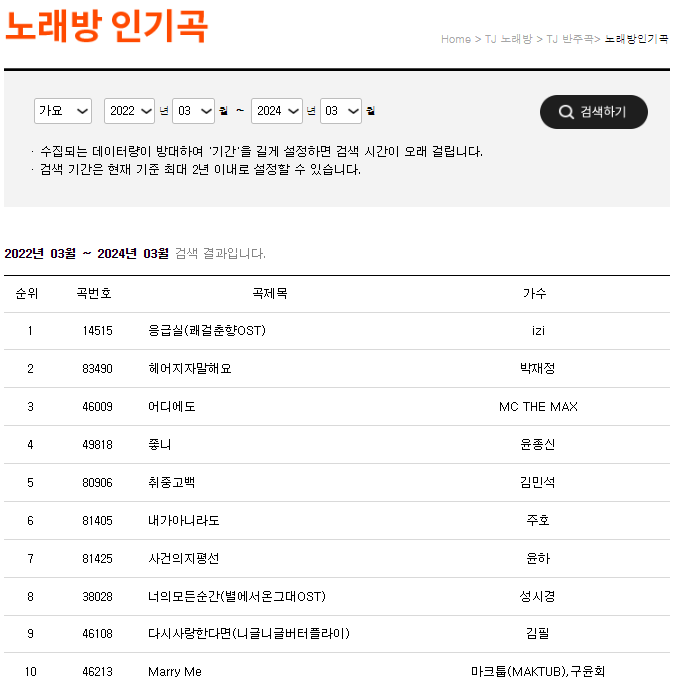 Karaoke equipment company TJ Media's ranking of popular karaoke songs in Korea. Based on data from the past two years, the top 10 rankings are mostly occupied by songs released more than five years ago. [Table = TJ Media]
For example, looking at karaoke popularity rankings during the year-end and New Year seasons, when karaoke consumption increases due to active gatherings such as year-end and New Year parties, songs released over 5 or 10 years ago hold a high proportion. According to the popular chart of TJ Media, a domestic karaoke equipment company, from November 2023 to February 2024, songs released more than 5 years ago accounted for 70% of the top 100 popular chart, and songs over 10 years old made up about 50%.
One of the representative karaoke favorites, izi's "Emergency Room," still ranked within the top 10 despite being released about 20 years ago. Other steady sellers holding their place for a long time include Position's "I Love You," Yada's "Already a Sad Love," Lim Chang-jung's "A Glass of Soju," Big Mama's "Resignation," and So Chan-hwi's "Tears."
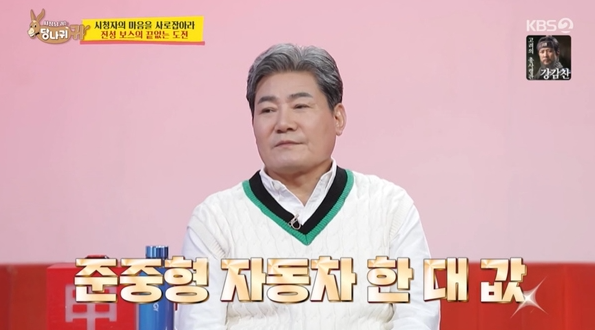 Singer Jinseong also revealed his monthly copyright royalty income, becoming a hot topic. [Photo by KBS 2TV 'Boss Ear is Donkey Ear']
Therefore, karaoke favorites inevitably generate steady copyright fee income. According to Musicow data, the annual copyright fee dividend per share (before tax) for izi's "Emergency Room" was 3,769 KRW in 2020, 2,893 KRW in 2021, 4,013 KRW in 2022, and 5,305 KRW in 2023, showing a trend of increasing copyright fees over time. Big Mama's "Resignation" recorded steady earnings with 2,552 KRW in 2020, 3,627 KRW in 2021, 4,646 KRW in 2022, and 3,869 KRW in 2023.
An interesting point is that if a song is stopped midway while singing in karaoke, copyright fees might not be paid. At least one full verse must be sung for the song to be counted for copyright fee payment. When are karaoke copyright fees settled with copyright holders? Currently, karaoke copyright fees collected over two months are distributed in the following two months. For example, amounts collected in January and February are distributed in March and April, and amounts collected in March and April are distributed in May and June.
© The Asia Business Daily(www.asiae.co.kr). All rights reserved.
![Clutching a Stolen Dior Bag, Saying "I Hate Being Poor but Real"... The Grotesque Con of a "Human Knockoff" [Slate]](https://cwcontent.asiae.co.kr/asiaresize/183/2026021902243444107_1771435474.jpg)

















