Global Advisory Firms Influence Foreign Investors' Voting Rights
Powerful Impact with Fewer Than 10 Staff
Expertise and Fairness Controversies... "Domestic Advisory Firms Must Be Developed"
Since the emergence of activist funds, shareholder proposals have increased, and proxy advisory firms have long risen as the "power of general meetings." Companies cannot help but be tense about what opinions these firms will express on issues involving sharp conflicts of interest. However, controversies over the fairness and expertise of global proxy advisory firms, which exert absolute influence over foreign investors, continue unabated.
Fewer than 10 Staff Reviewing 1,000 Companies: "Lack of Expertise"
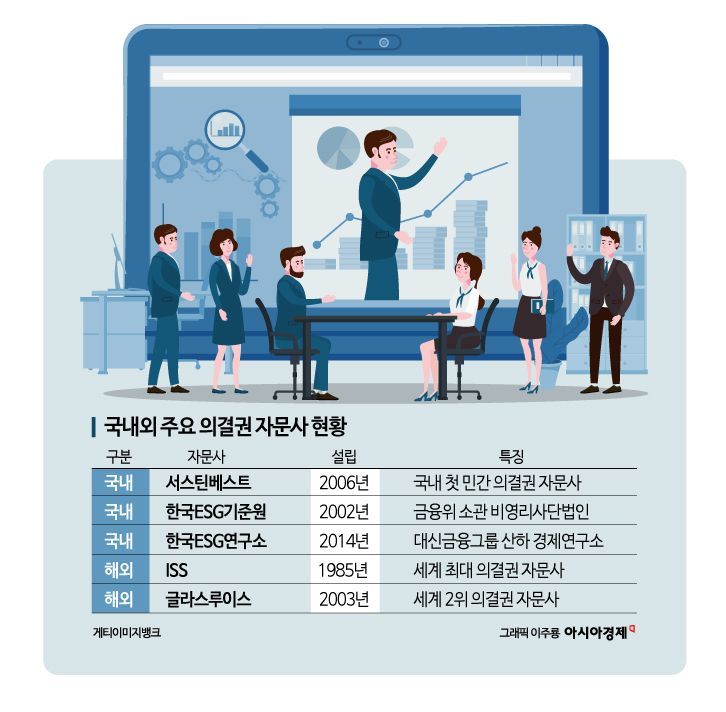
According to the financial investment industry on the 22nd, the US-based ISS and Glass Lewis, as well as Korea ESG Standards Institute, Sustainvest, and Korea ESG Research Institute in Korea, are presenting opinions for or against major agenda items at this week's shareholder meetings. In particular, foreign investors often exercise their voting rights based on the opinions of ISS, the world's No. 1 advisory firm, and Glass Lewis, the No. 2. A recent representative case is Samsung C&T. Both advisory firms recommended 'support' for the shareholder return agenda proposed by activist funds. Although it was ultimately rejected with a 23% approval rate, considering Samsung C&T's foreign ownership was about 25%, it can be seen that virtually most foreign investors voted in favor. According to a report by the Korea Capital Market Institute, among the proposals BlackRock, the world's largest institutional investor, supported at shareholder meetings, 87.9% were those ISS supported, and among the proposals opposed, 69.2% were those ISS opposed.
The problem is that global advisory firms have very few employees responsible for Korean companies, inevitably leading to a lack of expertise. An industry insider said, "ISS is known to have fewer than 10 staff members dedicated to Korea," adding, "Glass Lewis is likely at a similar level." Fewer than 10 staff members are in charge of around 1,000 Korean companies. Domestic advisory firms have three to five times more personnel than this.
As a result, cases raising doubts about expertise are emerging one after another. ISS recently held a meeting with KT&G and inquired about profitability based on data provided by activist fund Flashlight Capital Partners (FCP). KT&G requested the original data, stating the data was inaccurate, but received no response. Without giving a proper opportunity for explanation, ISS opposed the candidacy of Bang Kyung-man for the next CEO, citing poor operating profit and other reasons. Coincidentally, ISS's opinion came right after FCP's online briefing pointing out profitability issues.
KT&G is raising the possibility of collusion between FCP and ISS. It is rare for ISS to oppose a CEO, and critics point out inconsistencies compared to past cases. In fact, when Yoon Kyung-rim was appointed KT CEO amid controversy last year, ISS supported the appointment, stating, "There is responsibility for governance issues, but management vacuum should be avoided." KT&G would also face a management vacuum if Bang's appointment fails. Meanwhile, Glass Lewis, which shares the advisory market, expressed support for Bang Kyung-man's candidacy, intensifying suspicions about ISS.
"Provide Accurate Information to Foreigners... Foster Domestic Advisory Firms"
The proxy advisory market operates on a 'low margin, high volume' structure. The advisory fee per company received from institutional investors is at the level of around 100,000 KRW. This is far from sufficient to review increasingly complex agenda items due to the rise in shareholder proposals. Global advisory firms like ISS and Glass Lewis can profit with such fees because they cover tens of thousands of companies worldwide, but domestic advisory firms handling only Korean companies struggle to cover operating costs. Providing advisory services to foreign investors, including English-language services, is nearly impossible. Therefore, there are calls to nurture domestic advisory firms so they can provide accurate information about Korean companies to foreign investors.
Oh Seung-jae, Vice President of Sustainvest, said, "Domestic advisory firms know Korean companies best and have the most Korean experts," adding, "Not only should advisory fees be made more realistic, but even companies themselves should carefully review reports from advisory firms covering them, which would greatly help market growth." Financial authorities are trending toward empowering proxy advisory firms. The Financial Supervisory Service and the Korea Financial Investment Association last year established the 'Asset Management Voting Guidelines,' which specify procedures for recording and maintaining the basis for final decisions when opinions differ between advisory firms and asset managers. An industry insider said, "The guideline means that one cannot oppose advisory firm recommendations without clear grounds," adding, "As a result, the influence of advisory firms has increased."
© The Asia Business Daily(www.asiae.co.kr). All rights reserved.
![Clutching a Stolen Dior Bag, Saying "I Hate Being Poor but Real"... The Grotesque Con of a "Human Knockoff" [Slate]](https://cwcontent.asiae.co.kr/asiaresize/183/2026021902243444107_1771435474.jpg)















