At the Cabinet Meeting: "Some Doctors Regrettably Fail to Fulfill Their Duties"
"Medical Licenses Should Not Be Used as a Means to Threaten the Public"
"Presidential Medical Reform Committee Established to Discuss Reform Tasks"
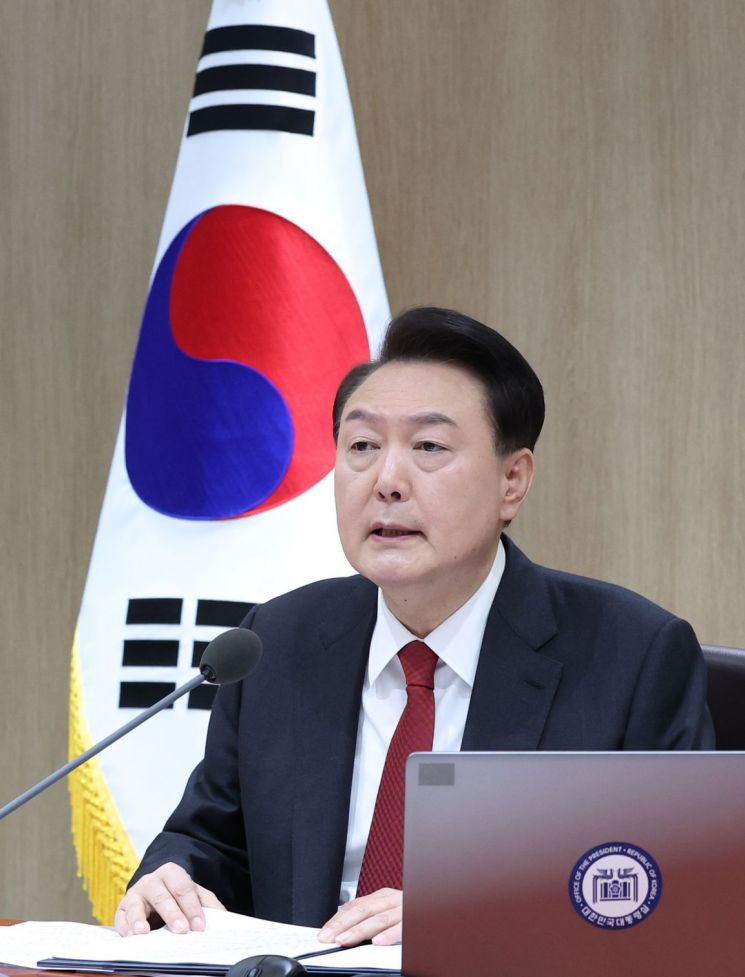 President Yoon Suk-yeol is speaking at the Cabinet meeting held on the 19th at the Yongsan Presidential Office Building in Seoul. [Image source=Yonhap News]
President Yoon Suk-yeol stated on the 19th, "The medical reform before us is a task for the people and a mandate from the people," adding, "The government will significantly allocate the increase of 2,000 medical school quotas next year primarily to medical schools in non-metropolitan areas to strengthen essential regional healthcare." Despite growing concerns over medical service gaps as resident doctors and professors have resigned en masse and private practitioners are showing signs of joining collective actions, this reflects his strong determination to push forward with medical reform centered on increasing medical school quotas and to proceed with the quota allocation as planned.
In his opening remarks at the Cabinet meeting held at the Yongsan Presidential Office on the same day, President Yoon emphasized, "Medical licenses granted to save lives must not be used as a means to threaten or unsettle the public." While expressing deep concern over the ongoing mass resignation of resident doctors for a month, he indicated that there would be no retreat from medical reform.
President Yoon expressed regret that some doctors, who should be by patients' sides and persuading resident doctors, are betraying the public's desire for medical reform and failing to fulfill their duties as physicians and mentors. However, he stressed, "If it benefits the people, no matter how difficult or challenging, we must focus solely on the people and see it through to the end."
He underscored the necessity of increasing medical school quotas by presenting specific data. Over the past 20 years since the early 2000s, the United States increased its medical school quotas from 16,000 to 23,000, an increase of 7,000; France from 3,850 to 10,000, an increase of 6,150; and Japan from 7,625 to 9,384, an increase of 1,759, continuously expanding quotas every year. In contrast, South Korea's quotas have remained unchanged for 27 years. Currently, South Korea has 112,000 doctors, which is 80,000 fewer than the average among OECD countries. He also pointed out the issue of doctors' average income in South Korea, which far exceeds the OECD average. President Yoon noted, "According to a healthcare workforce survey, South Korean doctors have the highest average income among OECD countries, approximately five times that of nurses, and the income gap among healthcare professionals is also the highest in the OECD."
He clearly stated that the call from some in the medical community to reconsider the increase in medical school quotas from scratch is unacceptable. President Yoon said, "Some in the medical community continue to demand a reconsideration of the quota increase, making claims that the public cannot agree with. However, a phased approach or postponement of the increase will never accomplish the medical reform needed to save lives and prevent the collapse of regional and essential healthcare." He added, "Since medical school quotas have been maintained at a reduced level for about 27 years, this is a story far removed from the urgent medical reality given the pace of increasing medical demand. The longer the increase is delayed, the greater the harm will ultimately be to all citizens." In this context, President Yoon raised his voice, saying, "It would be a miracle if essential healthcare does not collapse."
Accordingly, the government plans to allocate the increase of 2,000 medical school quotas next year primarily to medical schools in non-metropolitan areas to strengthen essential regional healthcare. The increased quotas will first be distributed by region, considering factors such as population, medical demand, the necessity to expand essential healthcare, and educational conditions of each university, and then allocated to individual medical schools within each region.
President Yoon also appealed to the medical community to come to the dialogue table. He said, "Since doctors' cooperation is most needed, we must come together and discuss candidly," adding, "In April, we will establish a Presidential Medical Reform Special Committee to deeply discuss medical reform tasks with representatives from the medical community, various sectors, and experts." He further stated, "I hope that resident doctors and medical associations will participate and create concrete implementation plans for medical reform through discussion rather than protests outside hospitals."
© The Asia Business Daily(www.asiae.co.kr). All rights reserved.
![Clutching a Stolen Dior Bag, Saying "I Hate Being Poor but Real"... The Grotesque Con of a "Human Knockoff" [Slate]](https://cwcontent.asiae.co.kr/asiaresize/183/2026021902243444107_1771435474.jpg)















