The Korea Research Institute of Bioscience and Biotechnology (KRIBB, President Jang-Sung Kim) announced on the 19th that a joint research team consisting of Dr. Hong Jeong-ju from the National Primate Center, Professor Kwon Oh-seok from Sungkyunkwan University, and Dr. Song Hyun-seok from the Korea Institute of Science and Technology (KIST) has succeeded in developing a platform capable of rapidly detecting multiple respiratory viruses on-site.
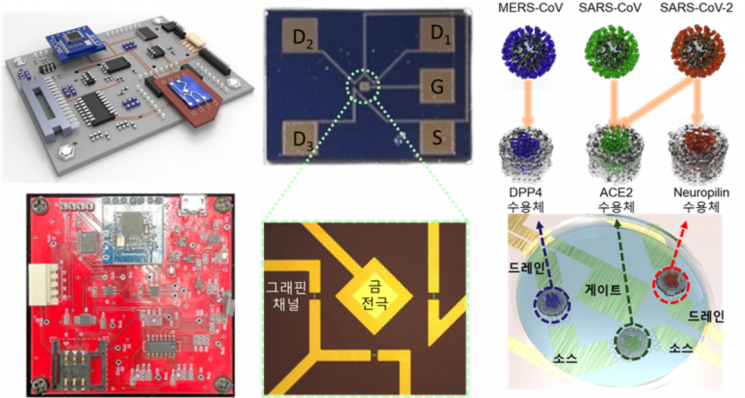 Field rapid diagnostic sensor for new and variant respiratory viruses and surface image of graphene transistor.
When emerging respiratory infectious diseases such as Severe Acute Respiratory Syndrome (SARS) in 2002, Middle East Respiratory Syndrome (MERS) in 2012, and Coronavirus Disease 2019 (COVID-19) in 2019 occur, diagnostic devices that can quickly and accurately diagnose are essential. However, existing diagnostic devices have low sensitivity and specificity, limiting their use for on-site diagnosis in daily life.
Although on-site diagnostic devices have made remarkable progress during the COVID-19 pandemic, separate tests such as PCR are still required for accurate diagnosis.
Accordingly, the research team developed an on-site diagnostic platform using graphene material that can simultaneously and highly sensitively screen multiple respiratory viruses within tens of seconds.
The sensor developed by the research team allows diagnosis of saliva without any preprocessing, ensuring convenience, and its effectiveness was validated through primate models infected with Delta and Omicron variants, increasing the potential for on-site application.
Dr. Hong Jeong-ju, the principal investigator at KRIBB, stated, “Since we developed an on-site rapid diagnostic platform validated through primates, it will also be helpful in preparing for future outbreaks of emerging respiratory infectious diseases.”
This study was published in the latest issue of Advanced Materials (IF 29.4), a world-renowned journal in the field of nanoscience, on March 1. (Paper title: Synchronous diagnosis of respiratory viruses variants via receptonics based on modeling receptor?ligand dynamics)
© The Asia Business Daily(www.asiae.co.kr). All rights reserved.
![Clutching a Stolen Dior Bag, Saying "I Hate Being Poor but Real"... The Grotesque Con of a "Human Knockoff" [Slate]](https://cwcontent.asiae.co.kr/asiaresize/183/2026021902243444107_1771435474.jpg)















