Hana Bank Adds KPI for High-Risk Products
Revamp KPIs Starting 2022
Reduced High-Risk Product Share for Super-Aged and Elderly
KB Kookmin and Shinhan Also Revised
Following Woori Bank, 'DLF Sales Leader'
Financial Authorities to Form TF
Commercial banks are improving the Key Performance Indicators (KPIs) that were identified as the cause of the massive losses in Hong Kong H Index (Hang Seng China Enterprises Index·HSCEI) linked equity-linked securities (ELS). This move is similar to that of Woori Bank following the overseas interest rate-linked derivative-linked fund (DLF) loss incident. By improving KPIs, they managed to avoid the recent Hong Kong H Index ELS incident. Since KPIs influence employee personnel decisions and performance bonuses, financial authorities believe that excessive sales activities have taken place in banks.
According to the financial sector on the 18th, Hana Bank will add the item ‘Risk management of concentrated sales of specific high-risk products by sales channel’ to its KPIs starting from the first half of this year. This means continuously monitoring risky situations such as when the proportion of sales of a specific high-risk (grade 1-2) single product is excessively high among all investment product sales. A Hana Bank official said, “This was newly established to proactively manage risks so that the dependency on sales of specific products does not become excessively high when selling high-risk products exposed to financial market uncertainties.”
Hana Bank has already introduced KPIs for financial consumer protection. In the second half of 2022, it excluded sales performance of investment products targeted at the ultra-elderly (aged 80 and above) from KPIs. In the first half of last year, it also included the reduction in the number of customers exposed to high-risk product concentration risk as a KPI.
Hana Bank explains that this KPI revision has reduced the proportion of high-risk product holdings among the elderly. Looking at the status of high-risk product holdings by ultra-elderly and elderly customers at Hana Bank, the amount of equity-linked trusts (ELT) held by the ultra-elderly decreased by 54.3%, from 525.8 billion KRW in July 2022 to 240.3 billion KRW as of December last year. For the elderly (aged 65 and above), it decreased by 23.8%, from 1.7009 trillion KRW to 1.2957 trillion KRW. The same applies to high-risk funds. During the same period, the ultra-elderly’s holdings decreased from 263.1 billion KRW to 229.9 billion KRW, and the elderly’s holdings decreased from 1.057 trillion KRW to 968.5 billion KRW.
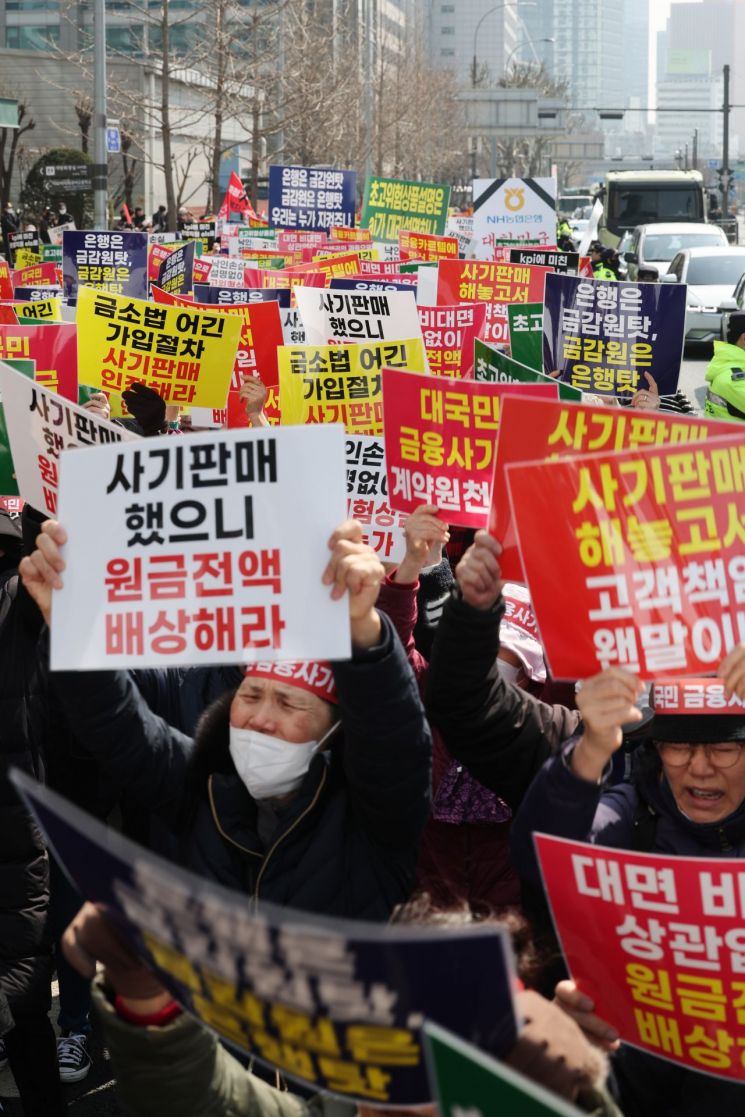
KB Kookmin Bank, which has the largest sales volume of Hong Kong H Index ELS, also revised its KPIs to prevent sales from concentrating on principal non-guaranteed structured products. If the proportion of sales of structured products with principal loss among the total new sales amount of funds and trusts exceeds a certain threshold, points are deducted in the KPI evaluation. In other words, excessive sales lead to disadvantages in evaluation. Shinhan Bank, which ranked second in sales, does not recognize sales performance of non-interest products to ultra-elderly customers. While not stopping product sales, it excluded sales performance from KPIs.
This move is similar to the approach of Woori Bank, which had the lowest ELS sales among the four major banks. After the DLF incident, Woori Bank strengthened evaluation factors such as internal control and consumer protection in KPIs from 2020 to 2021. For example, it newly created items for customer aftercare and portfolio management. At that time, Woori Bank sold the most DLFs among commercial banks. Having also experienced the Lime Asset Management private equity fund incident, which caused a massive suspension of redemptions worth trillions of won, it had no choice but to take active measures such as a full revision of KPIs. This is reflected in the sales volume of Hong Kong H Index ELS by bank. Woori Bank recorded 40 billion KRW, which is less than 1% of the total sales amount.
Financial authorities are also expected to present guidelines related to KPIs within the year. On the 13th, after meeting with individual investors, Lee Bok-hyun, Governor of the Financial Supervisory Service, told reporters, “We will thoroughly review measures to link employees’ performance evaluations with customer benefits,” and “If possible, we will form a task force (TF) this month consisting of authorities, industry, academia, associations, and consumer experts.” He added, “We will strive to produce concrete results within the year.”
© The Asia Business Daily(www.asiae.co.kr). All rights reserved.