Ministry of Unification 2023 Unification Education Survey
Majority of Respondents Express Concern Over Potential Conflict with North Korea
The Ministry of Unification conducted a survey on the necessity of unification among elementary, middle, and high school students nationwide, revealing that 4 out of 10 students believe unification is unnecessary, and for the first time since observations began, the proportion of students who think unification is necessary fell below half.
According to the Ministry of Unification on the 16th, from October 20 to November 20 last year, in collaboration with the Ministry of Education, a '2023 School Unification Education Status Survey' was conducted targeting 73,991 students and 6,469 teachers and administrators from 756 elementary, middle, and high schools nationwide. The percentage of students who answered that 'unification is necessary' recorded 49.8%, falling below 50% for the first time since the survey began in 2014.
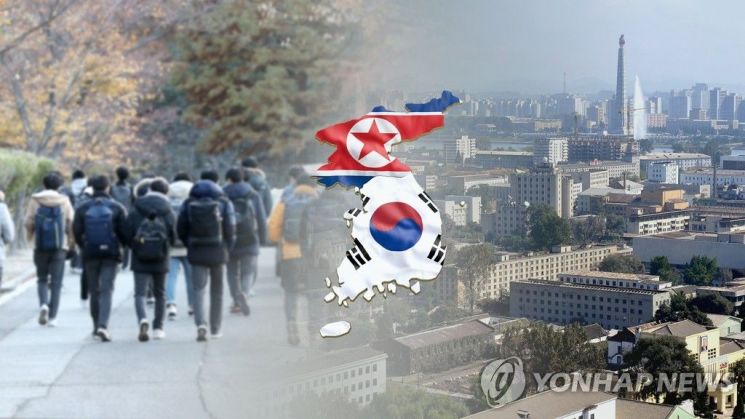 The Ministry of Unification announced on the 16th the results of the "2023 School Unification Education Survey," conducted from October 20 to November 20 last year in collaboration with the Ministry of Education. The survey targeted 73,991 students and 6,469 teachers and administrators from 756 elementary, middle, and high schools nationwide. (CG)
 [Photo by Yonhap News TV]
Teachers' perception of the 'necessity of unification' also decreased from 86.7% in 2022 to 82.5% last year.
On the other hand, the percentage of students who think 'unification is unnecessary' has been sharply rising every year, from 24.2% in 2020, 25% in 2021, 31.7% in 2022, to 38.9% in 2023.
Negative perceptions of North Korea have also intensified. When asked about the 'possibility of military conflict or disputes on the Korean Peninsula due to North Korea,' 56.5% of students and 50.6% of teachers responded 'somewhat likely.' Additionally, 24.1% of students and 15% of teachers answered 'very likely,' indicating that a majority of respondents are concerned about the possibility of conflict with North Korea.
In the same context, the number of respondents who view North Korea as a 'cooperation partner' decreased, while those who see North Korea as a 'subject of caution or hostility' or consider inter-Korean relations as 'not peaceful' increased among students and teachers.
The Ministry of Unification stated, "Due to North Korea's provocations, students' negative perceptions of unification and North Korea have strengthened," and added, "We will work to enhance the unification awareness of future generations."
To this end, the Ministry of Unification plans to increase the distribution of learning materials through the development of standard textbooks on unification and North Korean issues, as well as expand educational programs targeting students.
Meanwhile, from the 4th to the 14th of this month, South Korean and U.S. military authorities conducted a joint exercise called 'Freedom Shield' (FS), aimed at deterring North Korea's use of nuclear weapons in emergencies. Previously, North Korea had reacted sensitively by labeling the joint exercises as 'preemptive invasion war drills,' but this year, it refrained from military provocations.
During the training period, North Korea attempted to jam GPS signals directed at the South and conducted artillery drills on the 7th using dozens of multiple rocket launchers and self-propelled guns, but these actions were limited.
© The Asia Business Daily(www.asiae.co.kr). All rights reserved.
![Clutching a Stolen Dior Bag, Saying "I Hate Being Poor but Real"... The Grotesque Con of a "Human Knockoff" [Slate]](https://cwcontent.asiae.co.kr/asiaresize/183/2026021902243444107_1771435474.jpg)















