Bank of Korea Monetary and Credit Policy Report
Strengthened Synchronization with Global Funds
Clear Synchronization with Global Financial Cycle During Tightening Periods
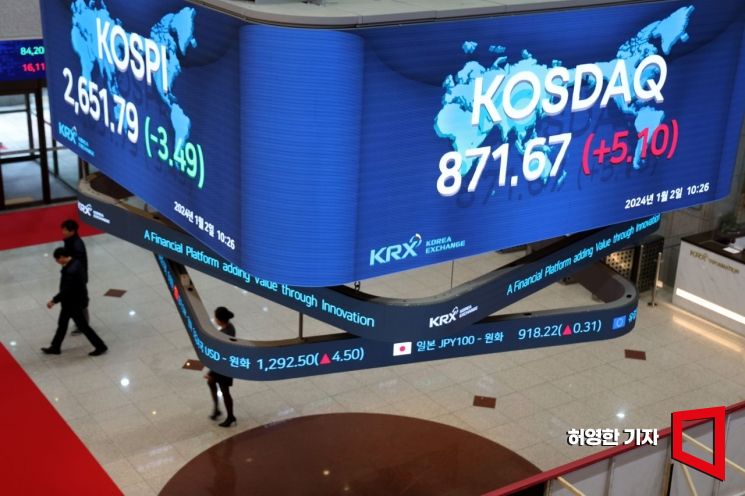
Domestic investment by global funds has significantly increased since the global financial crisis.
According to the "Monetary and Credit Policy Report" released by the Bank of Korea on the 14th, the balance of domestic investment global funds at the end of 2023 reached $258 billion, approximately 2.9 times higher than the $89.4 billion recorded at the end of 2009.
Domestic investment by global funds has expanded sharply, centered on equity and passive funds. Equity funds account for about 90% of domestic investment global funds. Additionally, the proportion of passive funds has steadily increased compared to the end of 2009.
Passive funds are funds that hold stocks comprising specific indices such as MSCI and WGBI, aiming to achieve returns equivalent to the index's growth rate.
The inflows and outflows of domestic investment global funds have shown a clear co-movement with overall global funds since the global financial crisis. From 2010 to 2023, the correlation coefficient between the inflows and outflows of domestic investment global funds and total global funds was 0.73. However, this rose to 0.84 after COVID-19, indicating a stronger correlation. In the past, there was strong co-movement with emerging market investment funds, but recently, co-movement with developed market investment funds has strengthened.
The volatility of domestic investment global funds is decreasing. Before 2020, domestic factors had a greater impact than external factors, causing the volatility of global funds to exceed twice the norm. However, after COVID-19, volatility in external factors such as global investors’ investment behavior increased. As a result, the volatility gap between domestic investment global funds and total global funds has narrowed.
The inflows and outflows of global funds have shown synchronization with the global financial cycle. A clear negative correlation with fluctuations in the US dollar index exemplifies this. Especially during tightening phases of the global financial cycle, this co-movement became more pronounced. This is because, during crisis periods, global capital inflows and outflows are mainly influenced by external factors, whereas during stable periods, they are generally affected by domestic factors.
The report positively evaluated the decreasing volatility of domestic investment global funds’ inflows and outflows and the strengthening co-movement with developed market investment funds.
However, it warned that the increasing proportion of passive funds and the strengthened co-movement during tightening phases of the global financial cycle could pose risk factors to the domestic financial market.
In particular, it pointed out that the strengthened co-movement of domestic investment global fund inflows and outflows during tightening phases of the global financial cycle could increase pressure on foreign investors to withdraw securities funds.
© The Asia Business Daily(www.asiae.co.kr). All rights reserved.
![Clutching a Stolen Dior Bag, Saying "I Hate Being Poor but Real"... The Grotesque Con of a "Human Knockoff" [Slate]](https://cwcontent.asiae.co.kr/asiaresize/183/2026021902243444107_1771435474.jpg)















