Pulmuone and Pulmuone Foods Accumulate 255.5 Billion Won in Issuance Over 3 Years
Debt Ratio Decreases but Borrowing Repayment Burden Increases
Major Shareholders Avoid Capital Increase Due to Heavy Financial Burden
Subsidiaries of the Pulmuone Group are consecutively issuing new types of capital securities (perpetual bonds). This is interpreted as a strategy to reduce the rapidly increasing debt ratio by issuing perpetual convertible bonds recognized as equity in accounting. However, despite continuous overseas investments, profitability has not significantly improved, raising concerns that the actual financial burden is rapidly increasing.
Accumulated Perpetual Bond Issuance of 255.5 Billion KRW Over 3 Years
According to the investment banking (IB) industry on the 14th, Pulmuone Foods recently issued perpetual bonds worth 50 billion KRW with Korea Investment & Securities as the lead manager. Although the bond maturity is over 30 years, there are plans to exercise a call option (early redemption right) in March 2026, two years later, for early redemption. If the call option is not exercised, interest will be paid at the existing rate of 6.40% plus an additional 2.50 percentage points.
In October last year, Pulmuone Foods issued perpetual bonds worth 20 billion KRW under the lead of NH Investment & Securities. At that time, the issuance interest rate was relatively high at 7.90%. If the call option is not exercised in October next year, an additional 2.50 percentage points will be added to the interest rate. If the bond interest rate remains at the current level, the annual interest rate will exceed 10% if the call option is not exercised.
Pulmuone Foods previously issued perpetual bonds worth 58.5 billion KRW in January 2021, 10 billion KRW in October of the same year, and 17 billion KRW in May 2022. In total, it has issued 155.5 billion KRW worth of perpetual bonds over the past three years. As of the end of September last year, this amount corresponds to 40% of the total equity capital of 397.9 billion KRW.
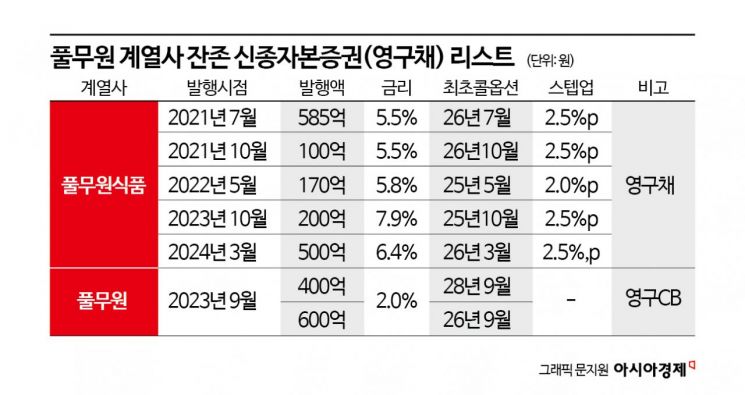
All of these are included in equity capital in accounting, thus helping to lower Pulmuone Foods' debt ratio. As of the end of the third quarter last year, the debt ratio stood at 243%, sustained in the 200% range for several years, thanks to the capital inclusion effect of perpetual bonds.
Pulmuone, the parent company of Pulmuone Foods and the group holding company, also issued perpetual bonds worth 100 billion KRW in September last year. Combined, the total perpetual bonds issued by Pulmuone Group subsidiaries over the past three years amount to 255.5 billion KRW.
Substantial Financial Burden... Side Effects of Overseas Investment
There are concerns that Pulmuone Foods' actual financial burden is much larger. If perpetual bonds, which have a high redemption obligation at the call option exercise date, are regarded as actual debt, Pulmuone Foods' debt ratio would increase to 460%.
The burden of loan repayments continues to rise. In the process of expanding overseas investments, borrowings increased from 406 billion KRW in 2019 to 627.3 billion KRW as of the third quarter last year. Net borrowings (borrowings minus cash equivalents) also rose from 294.2 billion KRW to 459.7 billion KRW during the same period.
The burden of short-term loan repayments is also significant. Short-term borrowings and current portions of long-term liabilities that must be repaid within one year amount to 317.4 billion KRW. More than half of the total borrowings must be repaid or refinanced within one year.
Despite aggressive overseas investments, cash flow has not significantly improved. Earnings before interest, taxes, depreciation, and amortization (EBITDA) increased from 83.5 billion KRW in 2019 to 102.3 billion KRW in 2022. Compared to the pace of borrowing increase, the profit improvement is considered slow.
A credit rating agency official analyzed, "Despite consecutive overseas facility investments, losses continue in the U.S., Japan, China, and other regions, preventing profitability improvement," adding, "Cost burdens such as rising international grain prices also act as factors limiting profitability."
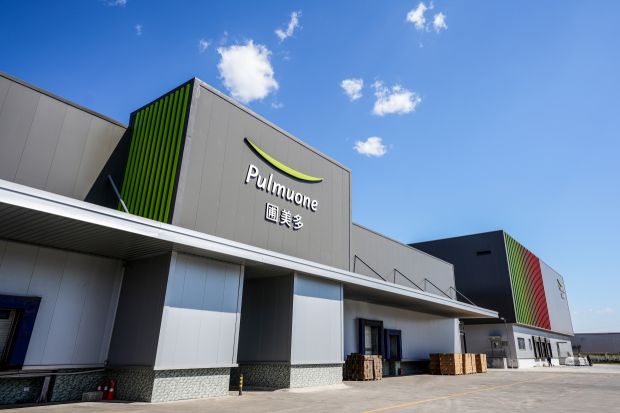 Panoramic view of Pulmuone China subsidiary Pumeiduo Beijing Plant 1, located on the factory site in Pinggu District, Beijing, China
Major Shareholders Avoid Large-Scale Paid-in Capital Increase Due to Financial Burden
The Pulmuone Group's ownership structure is also cited as a reason why subsidiaries improve their financial structure solely through perpetual bonds. If Pulmuone or Pulmuone Foods were to conduct a paid-in capital increase to fundamentally improve their financial structure, the financial input burden on major shareholders would be considerable.
Pulmuone holds 100% of the shares of its core business subsidiary, Pulmuone Foods. If Pulmuone Foods conducts a rights offering, Pulmuone must provide all the capital for the increase. Attracting external investors would dilute the shareholding ratio.
Pulmuone, as a holding company, does not have sufficient capacity for capital increase. If Pulmuone conducts a rights offering to improve its financial structure, special related parties including founder Nam Seung-woo, the largest shareholder, would have to provide 60% of the funds.
An IB industry official said, "It would be difficult for Pulmuone subsidiaries to carry out a large-scale paid-in capital increase that increases the financial burden on major shareholders," and predicted, "They will continue issuing perpetual bonds to reduce the debt ratio while avoiding capital increases."
© The Asia Business Daily(www.asiae.co.kr). All rights reserved.
![Clutching a Stolen Dior Bag, Saying "I Hate Being Poor but Real"... The Grotesque Con of a "Human Knockoff" [Slate]](https://cwcontent.asiae.co.kr/asiaresize/183/2026021902243444107_1771435474.jpg)

















