Symptoms Appeared Since Late December Last Year
Acute Hair Loss Caused by Autoimmune Disorder
A man who lost most of his hair within the past three months has gained attention by sharing his story. He revealed that he experienced acute hair loss due to an autoimmune disorder. On the 11th, a post titled "Review of Losing All My Hair in Three Months" was uploaded to an online community. The author, Mr. A, confessed, "I had never even experienced a hint of alopecia areata in my life, but suddenly all my hair fell out." Photos he shared showed his scalp fully visible due to complete hair loss, shocking many.
Mr. A first noticed hair loss symptoms at the end of December last year. Initially, he found a coin-sized circular bald patch on the back of his head. Alarmed, he visited a local dermatology clinic and received steroid injections. However, the following month, additional circular bald patches appeared and began to enlarge. Eventually, he was prescribed immunosuppressants at a university hospital.
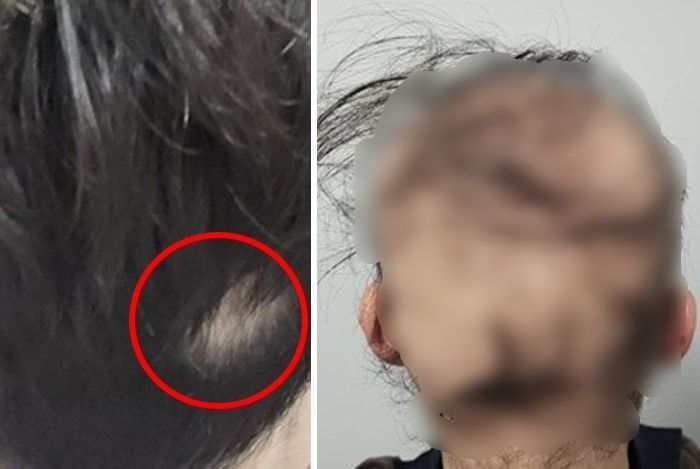 Mr. A began experiencing hair loss symptoms at the end of December last year. At first, he noticed a circular bald patch the size of a 500-won coin on the back of his head.
 [Photo source=Online community]
Mr. A said, "While taking immunosuppressants, I developed high blood pressure as a side effect, so I switched to a non-insurance-covered immunosuppressant." He added, "But the hair was already gone. It’s evolving into frontal hair loss." He lamented, "My life fell into ruin in an instant. It’s not like I didn’t seek treatment immediately, but it was relentless. At the worst, I lost about 300 hairs a day. After washing my hair, about 200 hairs fell out, and after sleeping, about 100 hairs." He also shared, "I broke up with my girlfriend. Just yesterday, I noticed a handful of pubic hair fell out. It seems to be progressing to total body hair loss."
One netizen mentioned "vaccine side effects" in response to the story. However, Mr. A clarified, "I believed in vaccine conspiracy theories at the time, so I didn’t even get the first dose." He explained, "The hair loss started before the immunosuppressant prescription. I had more than 10 circular bald patches. The doctor said injections wouldn’t work and advised me to go to a university hospital." Regarding the cause of hair loss, he said, "It’s an autoimmune disorder where my immune cells in the scalp mistakenly recognize hair follicles and roots as external viruses and attack them, causing all the hair to break off." He added, "The roots didn’t fall out. They say hair will regrow once the immune cells return to normal. But in severe cases like this, there is a high risk of relapse and permanent hair loss areas may develop."
Alopecia Areata: Stress Relief Is the Most Important
Hair loss refers to the absence of hair in areas where hair should normally exist. Among these, alopecia areata is a condition characterized by distinct circular or oval bald patches. It can start as small as 2 to 3 cm in diameter and, in severe cases, worsen to total body hair loss including eyebrows and pubic hair.
The exact cause of alopecia areata is currently unknown. However, stress is considered a major factor. When stressed, the immune system becomes confused and attacks healthy body tissues or cells as if they were enemies. Genetic factors, excessive drinking and smoking, nutritional imbalances, and other scalp diseases are also known to influence the condition.
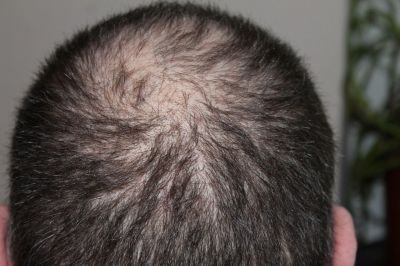 Hair loss refers to the condition where hair is absent from areas where it should normally be present. Among these, alopecia areata is a disease characterized by clearly defined round or oval patches of hair loss. It starts with small areas about 2 to 3 cm in diameter and, in severe cases, can progress to total body hair loss, including eyebrows and pubic hair.
 [Photo source=Pixabay]
When alopecia areata occurs, the affected area may appear reddish, sunken, and have increased sebum secretion. These symptoms often appear suddenly and may go unnoticed by the individual. Moreover, multiple lesions can occur simultaneously after initially having only one. This increases the risk of recurrence. If the hair loss area is small or limited, adrenal cortex hormones may be applied topically or injected into the scalp for treatment. If the hair loss is widespread and occurs in multiple areas, immune therapy or steroid administration may be used to prevent inflammatory reactions around hair follicles.
Additionally, ultraviolet light therapy, which directly exposes the scalp to UV rays to improve blood circulation, and cryotherapy are also used in combination.
To prevent alopecia areata, it is important to relieve stress promptly to stabilize the immune system. Avoiding excessive drinking and smoking, maintaining regular exercise, and having a balanced diet are also beneficial. Avoiding animal fats and sugary foods that can worsen symptoms and consuming seaweed such as miyeok (sea mustard) can help.
© The Asia Business Daily(www.asiae.co.kr). All rights reserved.
![Clutching a Stolen Dior Bag, Saying "I Hate Being Poor but Real"... The Grotesque Con of a "Human Knockoff" [Slate]](https://cwcontent.asiae.co.kr/asiaresize/183/2026021902243444107_1771435474.jpg)

















