Law School Tuition Admission Support
Expansion of Practical Training Institutions for North Korean Doctors
Establishment of a Free Democracy and Human Rights Unification Perspective
The Ministry of Unification will lower the admission barriers for North Korean defectors to law schools and assist defectors with medical backgrounds in obtaining domestic licenses, enabling them to work in professional fields. Additionally, it will promote mandatory unification education for teachers to raise awareness of North Korean human rights conditions both domestically and internationally, and to establish a unification perspective based on liberal democracy and human rights. This initiative aims to give hope to North Korean residents about South Korea and further strengthen the justification for unification under liberal democracy.
On the 8th, Minister of Unification Kim Young-ho announced the government's '2024 Major Task Implementation Plan,' which includes these three core tasks. This follows President Yoon Suk-yeol's March 1st Independence Movement Day commemorative speech earlier this year. In his speech, President Yoon stated, "The March 1st Movement is only complete with unification where everyone enjoys freedom and prosperity," and presented a new unification perspective based on liberal democracy, saying, "Now we must move toward a free unified Korean Peninsula where all citizens are owners."
The Ministry of Unification plans to establish legal grounds to support tuition fees for North Korean defectors attending law schools and will request the Ministry of Education to actively consider selecting defectors under the law school's special admission quota (7% of total seats). Although defectors are already eligible for special admission, only two lawyers have emerged among the 34,000 defectors who have entered South Korea so far. Furthermore, the ministry will expand practical training institutions to facilitate the smooth acquisition of relevant qualifications for defectors who worked as medical professionals such as doctors, dentists, and traditional Korean medicine doctors in North Korea.
Moreover, the Ministry of Unification plans to designate July 14 as North Korean Defectors' Day to widely publicize success stories and send messages of hope to North Korean residents, thereby strengthening unification capabilities. Particularly, the 4th Basic Plan for Supporting North Korean Defectors' Settlement (2024?2026) will shift policy direction from 'individual-centered' support to 'family-centered' support. Reflecting actual demand, the ministry will reorganize the intensive vocational training courses (currently 15 types), support job success package projects, and provide personalized employment and entrepreneurship assistance.
Additionally, to enable the public to understand the reality of North Korean human rights in daily life, the ministry has purchased land for the National North Korean Human Rights Center, aiming to open it by 2026, and has begun designing the facility. It will also develop content such as the 2024 North Korean Human Rights Report and talk concerts. To establish correct historical, national, security, and unification perspectives among future generations, the ministry plans to enhance basic unification education textbooks and expand public access to North Korean information materials.
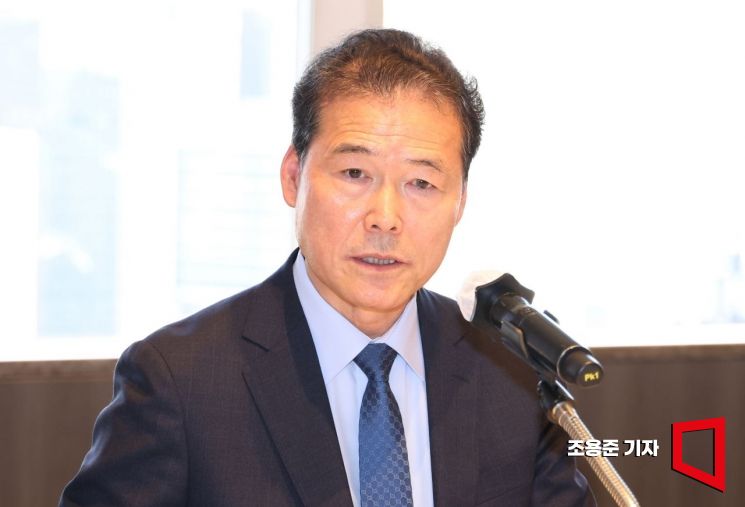 Kim Young-ho, Minister of Unification, is delivering a speech at the "New Year's Meeting Inviting Former Ministers of Unification" held on the 8th at Lotte Hotel in Jung-gu, Seoul. Photo by Jo Yong-jun jun21@
The ministry will also promote improvements in North Korean human rights and foster a unification atmosphere centered on South Korea. The 'International Dialogue on North Korean Human Rights,' first held in December last year, will be expanded to twice a year. The discourse that improving North Korean human rights will lead to resolving the North Korean nuclear issue and unification will be incorporated into unification and security education content and disseminated. Together with the international community, the ministry will highlight issues concerning abductees, detainees, and Korean War POWs, pressuring North Korea and spreading consensus domestically.
To create a liberal democratic unification atmosphere both domestically and internationally, the ministry will hold international cooperation dialogues on unification with value-sharing countries such as the United States, Japan, and Europe, establishing a foundation for unification led by South Korea and supported by the international community. Notably, the government will conduct the first-ever 'Global Unification Awareness Survey' to build international consensus on the necessity and importance of Korean Peninsula unification. It plans to actively carry out multifaceted unification public diplomacy projects targeting overseas research institutions, overseas Korean communities, and international students residing in South Korea.
Minister Kim said, "Recently, North Korea has expressed the so-called 'two-state theory' and continues anti-unification and anti-historical behaviors, including nuclear threats and hostile offensives against our compatriots." He added, "At times like this, we must unwaveringly and consistently devote efforts to liberal democratic unification, which is our historical and constitutional duty."
© The Asia Business Daily(www.asiae.co.kr). All rights reserved.
![Clutching a Stolen Dior Bag, Saying "I Hate Being Poor but Real"... The Grotesque Con of a "Human Knockoff" [Slate]](https://cwcontent.asiae.co.kr/asiaresize/183/2026021902243444107_1771435474.jpg)















