Low Wages and Late Working Hours
Dedicated Childcare Teacher Supply Rate at 30% Range
Operational Disruptions Due to Childcare Teacher Avoidance
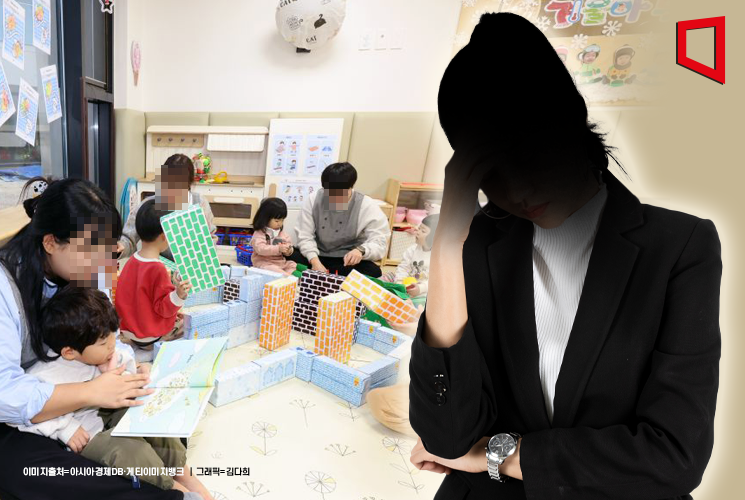
Lee Hyun-chil (42), a single parent working in delivery services, recently had a distressing experience when he visited a daycare center with his 5-year-old child. In the afternoon, unable to find a place to leave his child, he inquired about the extended care program at the daycare, only to be told by the director, "The extended care program is stressful for the children and there aren't enough teachers to look after them, so it's best not to use it if possible." Lee said, "The immediate response to my inquiry about the extended care was, 'Is there really no one to take care of the children?'" He added, "The director seemed to want me not to use the extended care throughout the consultation, so I decided to look for other options."
Dedicated Teacher Supply Rate at 38.7%... "Operation Disrupted Due to Lack of Teachers"
Although the government has stepped up support for extended daycare to ensure stable childcare, the supply rate of dedicated childcare teachers remains in the 30% range, causing operational difficulties at frontline daycare centers. Some complain that regular childcare teachers are also taking on extended care duties, leading to overwork and a decline in the quality of morning classes.
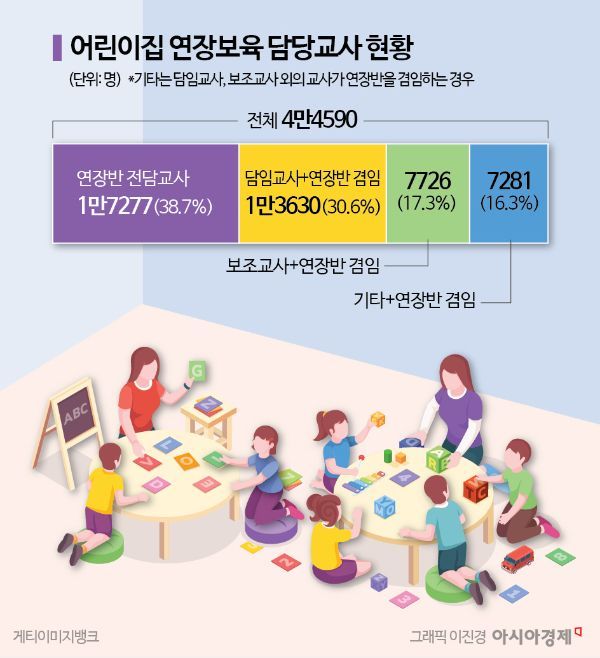
According to a report published on the 8th by the Korea Institute of Child Care and Education, the total number of dedicated extended care teachers nationwide in 2022 was about 17,200, with a supply rate of only 38.7%. The number of homeroom teachers doubling as extended care teachers was about 13,600, accounting for 30.6%. The rate of assistant teachers doubling as extended care teachers was 17.3%, and other categories accounted for 16.3%.
Extended daycare was introduced by the government in 2020 to assist those who find it difficult to provide afternoon care, such as dual-income couples and single-parent families. The operating hours are from 4:00 PM to 7:30 PM, providing additional care for families who want to use the service after the regular class hours (9:00 AM to 4:00 PM) end. The government supports the wages of extended care teachers at operating daycare centers if the extended care enrollment meets at least 50% of the guideline capacity and the total usage time meets certain standards.
However, due to the ongoing 'teacher shortage' for extended care, frontline daycare centers are facing disruptions in operating extended care even in the new semester. March sees a large influx of new students, but hiring extended care teachers is delayed. Kim (45), a daycare center director in Yeongdeungpo-gu, Seoul, said, "It's been two months since we posted a job opening for a dedicated extended care teacher, but we still haven't had a single applicant." She added, "Many parents want to use the extended care, so we can't stop operating it, and for the time being, homeroom teachers will have to take turns covering the extended care."
Avoidance Due to Low Pay and Late Working Hours
Daycare teachers cite late working hours, low pay, and poor working conditions as reasons for avoiding extended care duties. Although the official operating hours for extended care end at 7:30 PM, many days they leave work after 8:00 PM due to helping children leave and completing various paperwork and classroom tidying afterward.
In fact, a survey by the Korea Institute of Child Care and Education found that the main reason for extended care teachers leaving their jobs was "difficulty working until late hours" (29.3%). This was followed by "low salary levels" (19.5%) and "having to handle tasks beyond extended care" (7.3%).
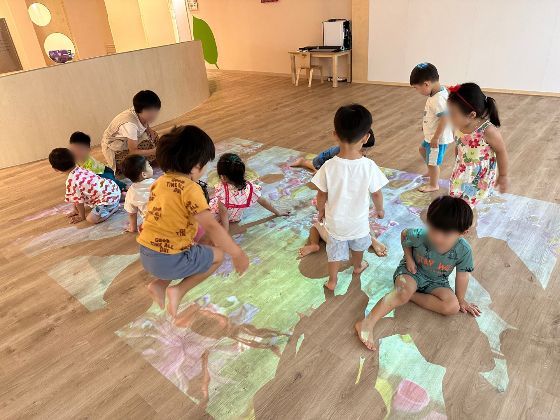
Daycare teachers say that working extended care shifts lacks appeal. Choi (28), who worked as an extended care teacher at a daycare center in Jung-gu, Seoul, for 10 months, said, "I recently got married and am still newlywed, but working evenings made it difficult to enjoy leisure time." She added, "The monthly salary was about 1.4 million won, which wasn't enough to justify enduring the inconvenience, so considering various factors, I decided to quit."
Homeroom teachers who also have to cover extended care express dissatisfaction as well. Because they must handle the regular class starting at 9:00 AM and then the extended care, they have less time to prepare for regular class activities, which leads to a decline in the quality of education.
Lee Yoo-jin (30), who works at a daycare center in Yeongdeungpo-gu, Seoul, said, "After taking photos of the children in the morning, writing the daily report, and making calls to parents, I am exhausted just from the regular class." She added, "But having to be on duty for extended care means there is less time to prepare lessons for the regular class children, so naturally, the quality of activities suffers." She continued, "Trying to care for the children when I'm already physically drained means I can't fully devote my heart to them, which is also a problem."
© The Asia Business Daily(www.asiae.co.kr). All rights reserved.
![Clutching a Stolen Dior Bag, Saying "I Hate Being Poor but Real"... The Grotesque Con of a "Human Knockoff" [Slate]](https://cwcontent.asiae.co.kr/asiaresize/183/2026021902243444107_1771435474.jpg)

















