The Korea Forest Service will delegate part of the authority to lift conservation forest designations to local governments.
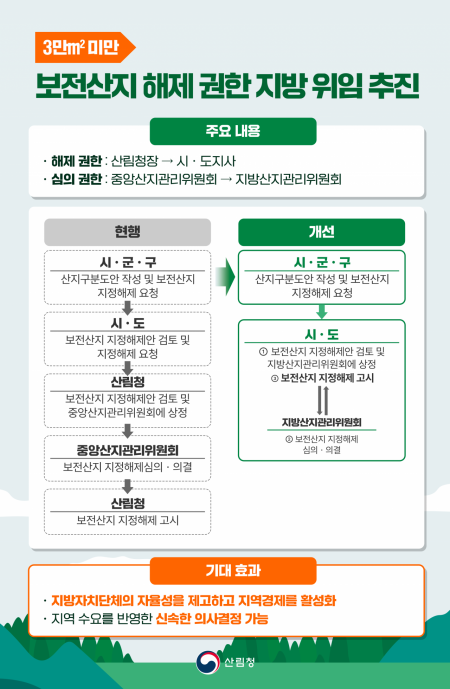
On the 3rd, the Korea Forest Service announced that it will delegate the authority to lift conservation forest designations for conservation forests smaller than 30,000㎡ to the mayors and governors of cities and provinces.
Within conservation forests, only activities stipulated by the Mountainous Area Management Act according to the designated purpose are allowed, making it difficult to freely use the forest land. Conversely, when a conservation forest designation is lifted, it changes to a quasi-conservation forest, and restrictions under the Mountainous Area Management Act no longer apply, thereby expanding the scope of forest land use.
However, to lift a conservation forest designation, the mayor, county governor, or district head must apply to the head of the Korea Forest Service through the mayor or governor of the city or province, and the Korea Forest Service must go through a review by the Central Mountainous Area Management Committee and announce the lifting in an official notice as part of the procedure.
It has taken an average of three months for local governments to lift conservation forest designations through this process, making immediate administrative action difficult.
The purpose of delegating the authority to lift conservation forest designations to mayors and governors is to ease on-site regulations, enable prompt administrative procedures, and enhance the autonomy of local governments.
The Korea Forest Service plans to delegate the review authority of the Central Mountainous Area Management Committee to the local Mountainous Area Management Committees of cities and provinces simultaneously with the delegation of the authority to lift conservation forest designations.
The upper limit of 30,000㎡ for the delegated area was decided through consultations with the Ministry of Land, Infrastructure and Transport and local governments.
The Korea Forest Service plans to amend the Mountainous Area Management Act and its enforcement decree to enable the delegation of authority. Through this, local governments will be able to carry out the procedures to lift conservation forest designations reflecting regional demand and conditions in accordance with the standards set by the Mountainous Area Management Act.
Additionally, the Korea Forest Service plans to delete provisions in the Mountainous Area Management Act that allow the heads of central administrative agencies or local government heads to designate public interest forest land at their discretion, thereby establishing a rational forest management foundation based on statutory purposes.
After the amendment of the law, in order to designate public interest forest land, specific purposes such as the protection of forest ecosystems, forest landscapes, coastal landscapes, or living environments must be met, which the Korea Forest Service expects will add rationality to forest management.
Meanwhile, forest land is broadly classified into conservation forests and quasi-conservation forests. Among these, conservation forests are further subdivided into forestry-use forests and public interest-use forests.
Forestry-use forests refer to forest land necessary for the creation of forest resources and the establishment of forestry management bases to enhance forestry production functions. Public interest-use forests refer to forest land necessary for public interest functions such as forestry production, disaster prevention, water source protection, natural ecosystem conservation, and promotion of public health and recreation.
© The Asia Business Daily(www.asiae.co.kr). All rights reserved.
![Clutching a Stolen Dior Bag, Saying "I Hate Being Poor but Real"... The Grotesque Con of a "Human Knockoff" [Slate]](https://cwcontent.asiae.co.kr/asiaresize/183/2026021902243444107_1771435474.jpg)















