Special Local Education Finance Grants of 3 Billion to 10 Billion KRW Provided
Fostering Regional Excellence in Education Models through Regulatory Relief and Support
Six metropolitan local governments and 43 basic local governments have been selected as the first pilot areas for the Education Development Special Zones, which aim to create a virtuous cycle structure through educational innovation, regional revitalization, and talent development.
Jang Sang-yoon, Senior Secretary for Social Affairs at the Presidential Office, announced the selection results of the first pilot areas for the Education Development Special Zones during a briefing at the Yongsan Presidential Office on the 28th.
The Education Development Special Zones operate by allowing local governments and education offices to autonomously establish educational policies desired by local residents in cooperation with institutions such as universities and industries within the region, while the central government provides various special measures such as financial support and deregulation.
A total of 40 applications were received during the public contest held from November last year to the 9th of this month, and according to evaluations by a committee composed of education policy and regional development experts, six metropolitan local governments and 43 basic local governments were selected as the first pilot areas, explained Senior Secretary Jang.
Regarding the nine basic local governments that were not selected this time, Senior Secretary Jang stated, "These basic local governments will be designated as preliminary areas," adding, "They will be able to be additionally designated in the second contest scheduled from May by supplementing the lacking aspects."
Regarding the operation plan for the first pilot areas, Senior Secretary Jang said, "Together with the Ministry of Education, the Local Era Committee, and policy experts, we will establish detailed implementation plans. The Ministry of Education will provide special local education finance grants ranging from 3 billion to 10 billion KRW and will fully support the creation of excellent local education models by resolving regulations requested by each region."
Although the same regulation nationwide requires teachers to hold teaching certificates to teach students, in the special zones, this regulation will be eased by granting authority to experts in specialized fields selected through school operation committees or education office contests to teach students even without teaching certificates.
Earlier, President Yoon Suk-yeol emphasized at the 11th Livelihood Discussion held in Busan on the 13th that a virtuous cycle system will be created where talents nurtured in the region contribute to the region through region-led Education Development Special Zones.
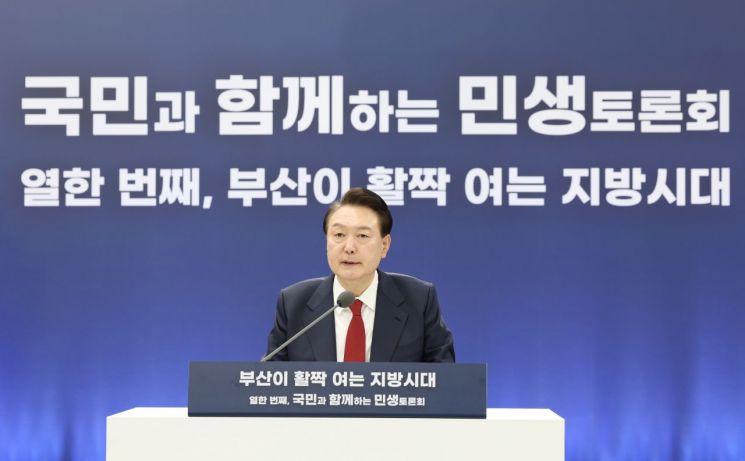 President Yoon Suk-yeol is speaking at the 11th Public Livelihood Discussion held at Busan City Hall on the 13th.
 [Image source=Yonhap News]
As befits the Education Development Special Zones, customized educational programs tailored to each region will also be operated, introduced Senior Secretary Jang.
For example, in Chuncheon City, Gangwon Province, which has Korea's first animation museum, Gangwon Animation High School will be developed as a specialized high school with a partnership in the animation broadcasting field, while Chuncheon High School, an excellent local high school, will be designated and operated as an autonomous public high school.
Additionally, centered on Kangwon National University, designated as a glocal university in the region, cooperation with Hallym University and Korea Polytechnic University will be strengthened to activate employment and start-up education specialized in the Chuncheon regional industry by establishing new departments such as Food Tech and Bio.
Busan City also plans to become a child-friendly city by expanding 24-hour care centers like Neulbom Center and Busan-type 365-hour childcare centers in cooperation with the Busan Metropolitan Office of Education to take full responsibility for all children from 0 years old to 6th grade in elementary school.
As an international maritime and shipping city, Busan will provide experiential English learning programs and edu-tech-based English education content to elementary and middle schools, and establish the Busan K-pop High School (tentative name) to attract foreign students.
In the case of Gyeongsangnam-do, the Jinju-Sacheon-Goseong area will be developed as a specialized special zone in the aerospace field, nurturing Gyeongsang National University as an excellent university in aerospace connected with local research institutes and companies.
In particular, the local talent admission quota for related departments will be expanded to over 50%, and efforts will be made to enable students to advance annually to related departments, the Aerospace Defense Science and Technology Institute, and the Aerospace Defense Research Institute.
Senior Secretary Jang explained, "The Education Development Special Zones are a core policy of the Yoon Suk-yeol administration to realize the local era by revitalizing regions through the power of education and saving regions from the crisis of regional extinction and low birth rates."
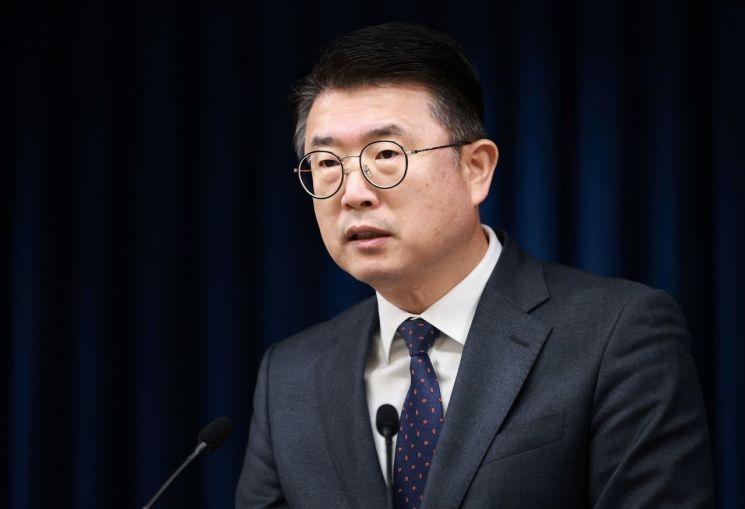 Jang Sang-yoon, Senior Secretary for Social Affairs at the Presidential Office, is giving a briefing on the first designation of pilot areas for the Education Development Special Zone on the 28th at the Presidential Office in Yongsan, Seoul.
 [Image source=Yonhap News]
© The Asia Business Daily(www.asiae.co.kr). All rights reserved.
![Clutching a Stolen Dior Bag, Saying "I Hate Being Poor but Real"... The Grotesque Con of a "Human Knockoff" [Slate]](https://cwcontent.asiae.co.kr/asiaresize/183/2026021902243444107_1771435474.jpg)
















