Second On-Site Inspection Following Visit to Seoul Medical Center the Previous Day
Amid ongoing collective actions by the medical community opposing the government's plan to increase medical school quotas, Seoul Mayor Oh Se-hoon visited Boramae Hospital and urged that there be no disruption to municipal hospital medical services.
On the 22nd at 3 p.m., Mayor Oh visited Boramae Hospital in Dongjak-gu, Seoul, to inspect the emergency medical system of the public medical institution following the mass resignation of residents and to encourage the medical staff protecting the hospital. Boramae Hospital is a Seoul municipal hospital but is operated under consignment by Seoul National University Hospital. It is known that recently, the majority of about 100 residents submitted their resignation letters.
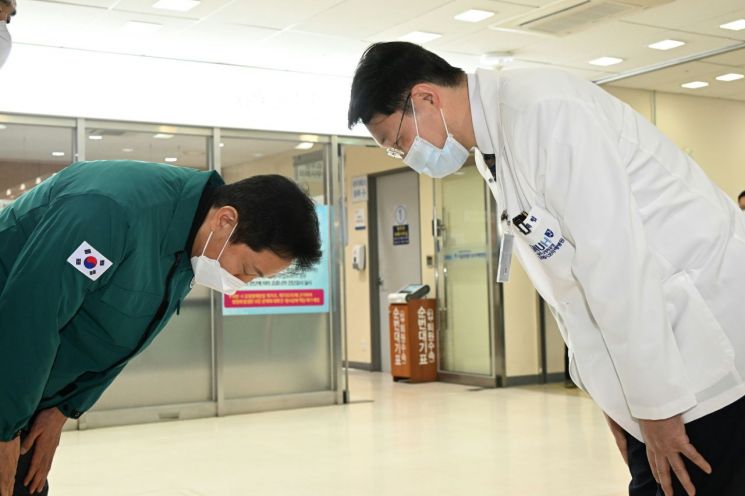 On the afternoon of the 22nd, Seoul Mayor Oh Se-hoon visited Boramae Hospital, toured the regional medical emergency center and inpatient wards, and after completing an inspection of the emergency medical system, expressed his gratitude to Lee Jae-hyeop, the director of Boramae Hospital. Photo by Seoul City
This inspection was the second on-site visit following the previous day’s visit to Seoul Medical Center. With the number of residents who submitted resignation letters in protest against the government’s increase in medical school admissions exceeding 9,000 as of that day, the visit aimed to identify any inconveniences citizens might face in using public medical services. Attending the visit were Kim Hyun-gi, Chairperson of the Seoul Metropolitan Council; Yoo Man-hee and Lee So-ra, Vice-Chairpersons of the Seoul Metropolitan Council’s Health and Welfare Committee; Kim Tae-hee, Director of the Seoul City Citizen Health Bureau; and Kang Ji-hyun, Director of the Seoul Public Medical Promotion Team.
Mayor Oh received a report on emergency medical measures from Lee Jae-hyup, Director of Boramae Hospital, and toured the emergency medical center. He then reviewed emergency medical response procedures and the status of inpatient care, visiting inpatient wards to comfort patients and their guardians worried about disruptions in treatment. He also expressed gratitude to the medical staff who are doing their best to minimize medical service gaps on site.
Mayor Oh said, "In a situation where collective actions by the medical community are intensifying, I sincerely thank the medical staff who are quietly protecting the medical frontlines and working hard to treat patients even at this moment. As a public hospital, Seoul municipal hospitals will do their utmost to minimize medical service gaps by establishing a close transfer system among municipal hospitals and with private hospitals so that patients with severe and emergency conditions can receive treatment without any disruption under any circumstances."
Meanwhile, during the period of collective action by the medical community, the Seoul Metropolitan Government is providing citizens with information on 73 'clinics and hospitals available for night and holiday treatment' so that patients with mild or non-emergency conditions can use nearby medical institutions. Starting from the 23rd, additional information on 'neighborhood clinics and hospitals that are open' will be provided. The city also stated that it will continuously monitor to ensure that emergency patients can receive priority treatment at regional emergency medical centers and other large hospitals.
© The Asia Business Daily(www.asiae.co.kr). All rights reserved.
![Clutching a Stolen Dior Bag, Saying "I Hate Being Poor but Real"... The Grotesque Con of a "Human Knockoff" [Slate]](https://cwcontent.asiae.co.kr/asiaresize/183/2026021902243444107_1771435474.jpg)















