Genetically Modified Grain Results and Overpackaging
2m Rice Unveiled but... Reality Is Poor
Chinese authorities, focusing on a 'food security' drive to feed a population of 1.4 billion, are facing a new challenge: fraudulent exaggeration of the yield results of novel genetically modified (GM) grains.
Hong Kong media outlet South China Morning Post (SCMP) reported on the 22nd (local time) that a significant number of GM grain projects receiving research support and subsidies from the Chinese government have been found to have overstated their yield achievements.
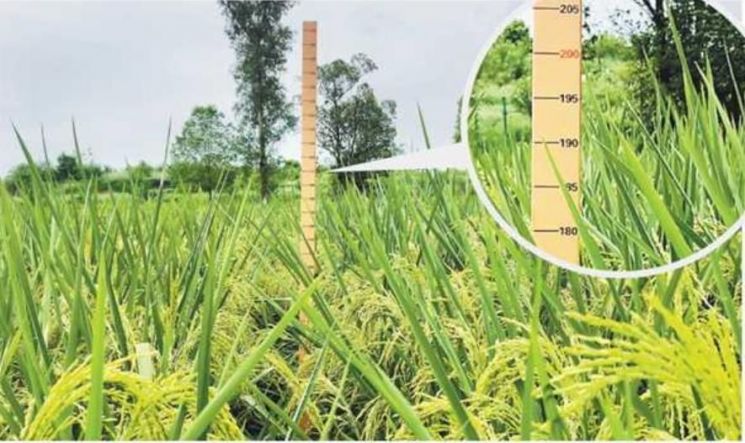 The '2-meter-long' giant rice, known to have been developed in China in the past, has become a hot topic.
 [Image source=Yonhap News]
Currently, the Chinese government prioritizes food security as one of its top policy agendas and is investing accordingly. In particular, it is focused on increasing agricultural productivity through GM grains and developing healthier and larger grains. However, some research institutions have been found to deliberately inflate their results to secure subsidies.
Representative examples include the so-called 'haesoo (海水·sea water) rice,' which can grow in salty and alkaline soils, and the 'giant rice' that grows up to 2 meters tall. Both were hailed as 'game changers' for food security when their development successes were announced, but in reality, the research outcomes were exaggerated.
SCMP reported that "in the case of haesoo rice, the strict standards required in official tests were not followed," and regarding the 2-meter giant rice, "the total weight was inflated by including the rice straw and leaves in the yield to make the rice production appear higher." As a result, the actual amount of rice produced from the 'giant rice' was much less than the reported figures, and the quality of the rice was also said to be poor.
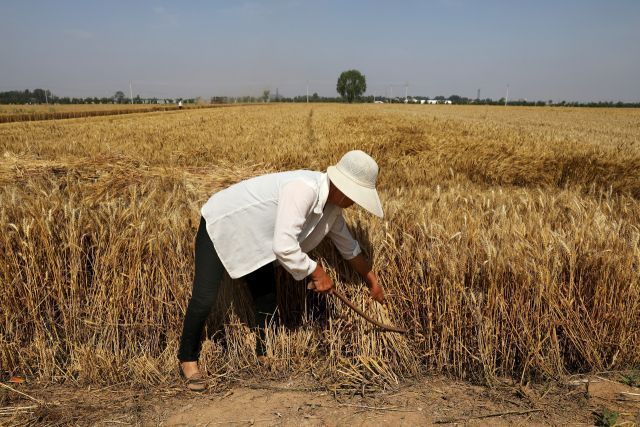 A farm in China. The photo is not related to any specific expression in the article. [Image source=Yonhap News]
Within the Chinese academic community, the so-called 'Great Leap Forward' style policy drive is diagnosed as damaging the credibility of Chinese agricultural research.
A senior analyst at Beijing Oriental Agricultural Consultants told the media, "There is a prevalence of exaggerated reporting and grandiose styles reminiscent of the Great Leap Forward between 1958 and 1962 among bureaucrats," criticizing that "bureaucrats try to achieve unrealistic goals and, in an effort to please their superiors, give a misleading impression of technological progress."
Meanwhile, the reason the Chinese government is focusing on food security is due to its grain production being far lower compared to other advanced agricultural countries. This has led to dependence on grains from geopolitical rivals such as the United States.
For example, while China has achieved notable results in rice and wheat production, it imports a significant amount of soybeans and corn. Last year alone, it imported over 59 million tons (t) of grain from overseas, an increase of 11.1% compared to the previous year.
© The Asia Business Daily(www.asiae.co.kr). All rights reserved.
![Clutching a Stolen Dior Bag, Saying "I Hate Being Poor but Real"... The Grotesque Con of a "Human Knockoff" [Slate]](https://cwcontent.asiae.co.kr/asiaresize/183/2026021902243444107_1771435474.jpg)
















