Low Birthrate Committee, Ministry of Health and Welfare, and Ministry of Economy and Finance Budget Office Unite in Shared Awareness
Ministry of Health and Welfare Focuses on Practical Measures Such as Infertility Support Plans
Government ministries are engrossed in finding drastic measures to overcome the low birthrate. The Low Fertility and Aging Society Committee, the Ministry of Health and Welfare, as well as the Taxation Office and Budget Office of the Ministry of Economy and Finance, are all working together to develop policies to increase the birthrate. This sense of urgency stems from the fact that the total fertility rate has dropped to a world’s lowest level of 0.6 (estimated for the fourth quarter of last year), highlighting the need for strong birth policies. There is also a consensus that while addressing complex issues such as improving labor and childcare environments in the long term, realistic short-term measures must be prepared to put out the immediate fire and raise the number of births even slightly.
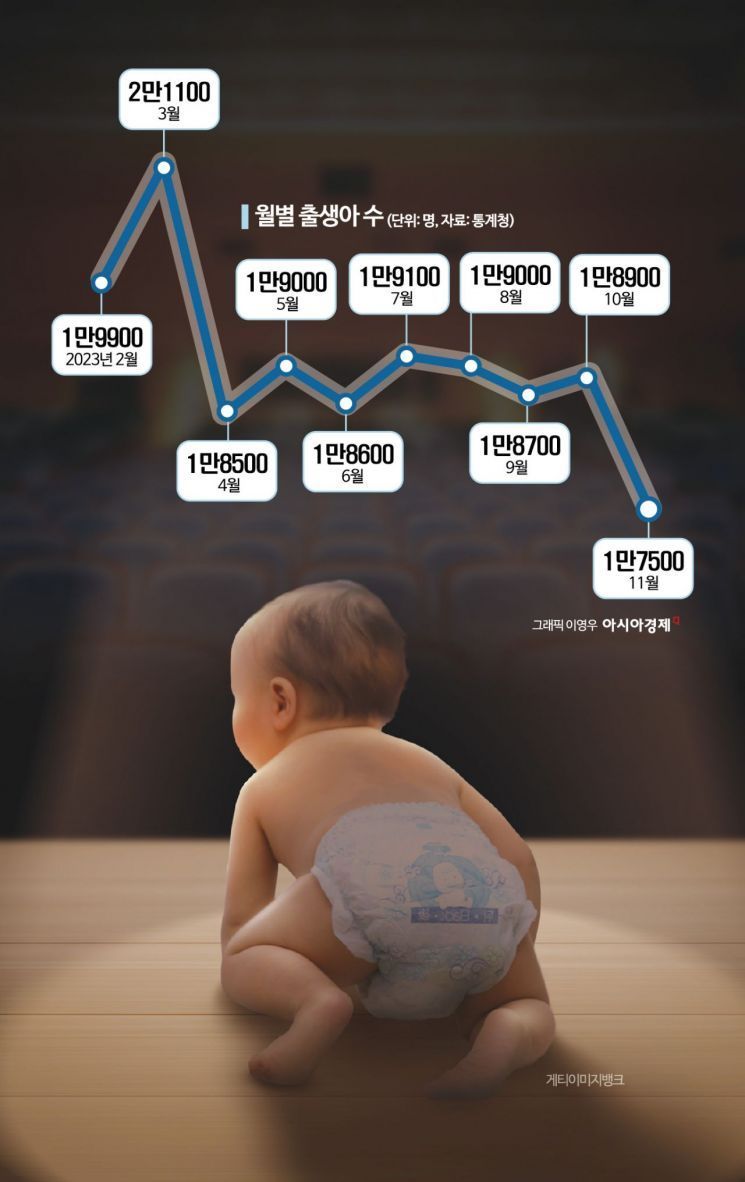
According to the government on the 22nd, the Ministry of Health and Welfare, Ministry of Economy and Finance, and other key related ministries have been busy preparing measures to slightly increase the number of births, which recorded around 17,000 as of November last year. The Ministry of Health and Welfare, the main ministry responsible for low birthrate issues, is gathering awareness that realistic solutions must be intensively developed to increase the number of people choosing to give birth.
Accordingly, the Ministry of Health and Welfare is focusing first on ‘infertility support measures.’ A senior official from the Ministry of Health and Welfare said, “The low birthrate problem should be addressed with a long-term plan that resolves disparities occurring after entering the labor market and reduces the excessive burden of childcare on individuals so that work and family can coexist sufficiently. However, since this is a long-term task, our ministry is currently concentrating on developing realistic alternatives to slightly increase the number of births through focused support for those who have the will to give birth.”
While assuming the mid- to long-term task of creating a society where people who are reluctant to give birth can choose to do so, the strategy is to first focus on creating an environment where those with even a slight willingness to give birth can choose to do so, thereby raising the birthrate. A representative example is the prenatal health management support program starting in April. Not only common-law and soon-to-be-married couples but also couples hoping to conceive can receive fertility (reproductive health) tests through public health centers, with costs supported up to 100,000 KRW for women and 50,000 KRW for men.
"In Korea, giving birth usually requires marriage... We will support those who want to have children as much as possible"
In the same context, policy alternatives to encourage marriage among young people have also been pursued. While encouraging non-marital births is appropriate, considering Korea’s unique reality where giving birth is generally linked to marriage, it is judged that inducing marriage can raise the birthrate in the short term. On the 16th, Lee Ki-il, the first vice minister of the Ministry of Health and Welfare, said at a meeting with a marriage information company, “Unlike major countries such as those in the OECD where non-marital birthrates are high, in Korea, the reality is that people give birth only after marriage,” adding, “We believe that those who have the will to have children should be supported as much as possible.”
The Ministry of Economy and Finance is also busy preparing measures. After President Yoon Suk-yeol instructed the preparation of tax benefits for companies leading birth support, the Taxation Office has been seeking ways to contribute to alleviating the low birthrate through tax incentives for companies and workers. In particular, it is focusing on finding solutions to ease the problem of excessive taxes imposed on companies like Booyoung that provide extraordinary birth support funds. A Ministry of Economy and Finance official explained, “Some criticize that such tax benefits only favor companies and workers with the capacity like Booyoung, but considering the urgent reality of needing to raise the birthrate, shouldn’t we maximize the willingness of people who can choose to give birth?”
Not only the Future Strategy Bureau of the Ministry of Economy and Finance, which is in charge of population issues, but also the Budget Office of the Ministry of Economy and Finance has jumped into discovering policy ideas for low birthrate measures. A Budget Office official said, “Budget office officials always consider policies within the framework of the budget, but since the low birthrate is an urgent issue, we are trying to think about drastic measures without such constraints first,” adding, “We are currently proposing and considering various policy ideas.”
© The Asia Business Daily(www.asiae.co.kr). All rights reserved.
![Clutching a Stolen Dior Bag, Saying "I Hate Being Poor but Real"... The Grotesque Con of a "Human Knockoff" [Slate]](https://cwcontent.asiae.co.kr/asiaresize/183/2026021902243444107_1771435474.jpg)















