47th Industrial Development Forum 'Diagnosis and Development Strategy of the Electric Vehicle Market'
South Korea's Electric Vehicle Sales Last Year Down 4.3% YoY
"Extension of Tax Credit Deadline, Securing Chargers at Highway Rest Areas, etc."
Last year, the cumulative sales volume of electric vehicles (EVs) in Korea decreased by 4.3% compared to the previous year. While competing countries such as the United States, the European Union (EU), China, and Japan saw an increase in sales, Korea was the only country to experience a 'reverse trend.'
The Korea Industrial Federation Forum announced on the 22nd at 10 a.m. that it held the '47th Industrial Development Forum' online. The theme was 'Diagnosis of the Electric Vehicle Market and Development Strategies.'
Kang Tae-il, Senior Researcher at the Industrial Federation Forum, stated in his presentation that the global EV market growth rate recorded between 68% and 123% over several years. Last year, the global cumulative sales volume of EVs reached 10.66 million units, a 31.1% increase from the previous year (8.14 million units).
The problem is that Korea was the only country where sales volume decreased. Korea recorded 167,000 units, down 4.3%. Meanwhile, the United States increased by 49% (1.118 million units), the EU by 38% (2.178 million units), China by 25% (6.677 million units), and Japan by 46% (87,000 units).
Senior Researcher Kang cited the abolition and reduction of purchase subsidies in various countries, lack and malfunction of charging facilities, and battery safety issues as causes for the decline in sales volume. On the 6th, the Ministry of Environment announced a subsidy reform plan that tightened the full subsidy vehicle price from under 57 million KRW to under 55 million KRW and lowered the upper limit from 6.8 million KRW to 6.5 million KRW.
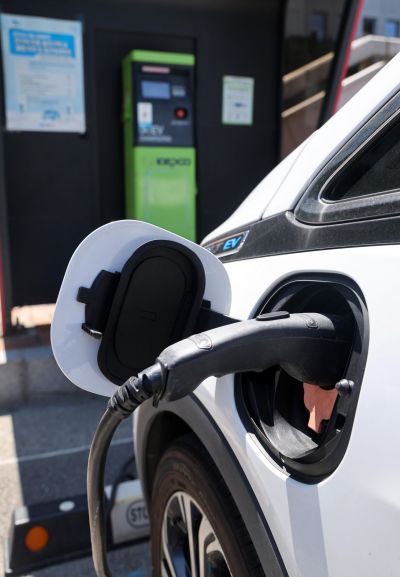
Kang pointed out that the shortage of chargers at highway rest areas, where demand for rapid charging is high, is a problem. Korea's charging infrastructure is the world's best, with about two EVs per charger. However, rapid chargers are installed in public facilities (23%), parking lots (18%), commercial facilities (14%), and apartment complexes (13%), which is problematic. This means chargers are insufficient in high-demand areas and concentrated in low-demand areas. Malfunctions are also frequent. Kang said, "It has been identified that 30% of EV users have experienced public chargers being out of order."
He also suggested the need to extend the tax credit period. Kang said, "The period for national strategic technology tax credits and temporary investment tax credits should be extended," adding, "It is necessary to include the Seoul metropolitan area, which is subject to overpopulation control, in the support targets for national strategic technology facility investments." He further added, "Support for the development of high-performance lithium iron phosphate (LFP) batteries and solid-state batteries should be provided to secure battery price competitiveness and safety."
Jung Manki, Vice Chairman of the Korea International Trade Association and Chairman of the Industrial Federation Forum, argued that even if former President Donald Trump is elected in the upcoming U.S. presidential election in November, the growth trend of the EV market will not be halted. Jung said, "There are concerns about policy changes such as the repeal of the U.S. Inflation Reduction Act (IRA) if President Trump is re-elected," but added, "Significant investments in electrification have already been made in the U.S., and most Republican lawmakers support this, so the trend toward electrification cannot be reversed."
Jung emphasized the need to increase support for research and development (R&D) and facility investments and to effectively implement subsidy policies. He said, "We must strengthen electrification competitiveness by expanding mineral development such as rare earths and batteries, fostering the materials industry, and increasing support for R&D and facility investments, as well as promoting effective subsidy policies for domestic production of electric vehicles." He expressed concern that "if market conditions are not improved through these measures, Chinese electric vehicles will inevitably dominate the domestic market in the long term."
There was also criticism that the number of EV sales is less than one-third of the government's target. Yoon Kyung-sun, Executive Director of the Korea Automobile Mobility Industry Association, pointed out that to achieve the government's 2030 supply target (4.2 million EVs and 300,000 hydrogen vehicles), 600,000 units must be supplied annually, but last year's sales were only about 167,000 units. She said that demand for EVs has sharply declined since the second half of last year, resulting in negative growth.
Yoon argued that subsidy levels should be maintained until 2030, when the EV market is expected to stabilize, to achieve the government’s target. She suggested temporarily reinstating charging fee discounts until demand recovers and maintaining EV tax benefits until 2030. She also emphasized the need to create an environment where charging at home is possible through designated parking systems in apartment complexes.
Above all, she said strong incentives should be provided so that EV users can feel the benefits. Examples of incentives include allowing exclusive highway lanes, installing eco-friendly vehicle-only lanes, giving priority in resident-preferred parking allocations, and establishing vehicle-to-everything (V2X) infrastructure and systems to build battery electricity trading systems.
Kim Sung-tae, Chairman of the Korea Electric Vehicle Users Association, said that the malfunction rate of public chargers in Korea is between 7% and 10%. He said, "As rapid chargers are mainly installed in apartment complexes where rapid charging is not necessary, the utilization rate of rapid chargers is only about 2 hours per day, less than 10% of the 24-hour day." He added, "Rather than simply increasing the number of chargers, efforts should be made to systematically manage already installed chargers and to allocate rapid chargers appropriately through proactive demand site surveys."
© The Asia Business Daily(www.asiae.co.kr). All rights reserved.