Hyundai Motor Company and Kia are joining forces with KAIST to develop next-generation autonomous driving sensors. The plan is to combine technological expertise to create 'LiDAR' sensors, which serve as the eyes of autonomous vehicles, that are smaller and more affordable than current models.
On the 21st, Hyundai Motor Company and Kia announced the establishment of the 'Hyundai Motor Group-KAIST On-Chip LiDAR Joint Research Laboratory' at KAIST's Daejeon campus.
The joint research laboratory aims to develop high-performance, compact on-chip sensor manufacturing technology along with new signal detection methods. High-performance on-chip sensors are essential components for autonomous vehicles and are a highly competitive area of development. Utilizing on-chip sensors enhanced with semiconductor technology allows LiDAR to be made smaller than current versions. Additionally, mass production through semiconductor processes can secure price competitiveness.
Currently, autonomous driving sensors measure the distance to objects by emitting light and measuring the time it takes for the light to return. However, next-generation signal detection technology will utilize Frequency Modulated Continuous Wave (FMCW). This technology emits light whose frequency changes over time and measures the frequency difference of the returning light to detect distance. Compared to existing methods, it has less signal noise and can also calculate the relative speed of objects. It can exclude interference from external light sources such as sunlight, making it relatively advantageous even in rainy conditions.
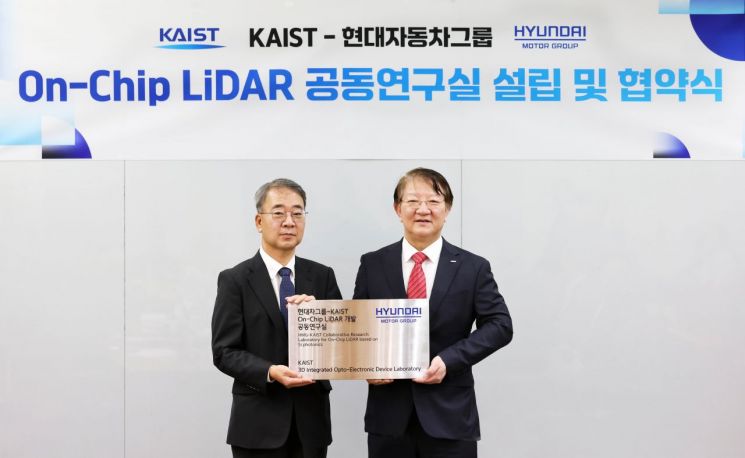 Hyundai Motor Company and Kia announced on the 21st that they will establish the "Hyundai Motor Group-KAIST On-Chip LiDAR Joint Research Laboratory" together with KAIST. Lee Jong-su, Head of Hyundai Motor Advanced Technology Center (left in the photo), and Lee Sang-yeop, Vice President of Research at KAIST, are posing for a commemorative photo at the plaque handover ceremony.
 [Photo by Hyundai Motor Company and Kia]
The joint research laboratory will be composed of about 30 members, including research teams from Hyundai Motor Company and Kia’s Advanced Technology Center, as well as professors and researchers from KAIST’s Department of Electrical Engineering such as Professors Sanghyun Kim, Sangshik Kim, Wanyeong Jeong, and Hamja Kurt. The operation period is set until 2028.
KAIST will take charge of specialized research areas by team, including ▲development of components for compact on-chip LiDAR based on silicon photonics (optical semiconductors), ▲production of high-speed, high-power driving integrated circuits (ICs) for LiDAR operation, and ▲optimization design and verification of LiDAR systems. Hyundai Motor Company and Kia will oversee the operation of the joint research laboratory together with Hyundai Eng.Vi, a specialized industry-academic cooperation organization, providing guidance on technology trends and research directions. They also plan to offer comprehensive support such as recommending technologies and experts to strengthen research capabilities.
A Hyundai Motor Company and Kia official stated, "We expect this collaboration to accelerate the era of fully autonomous driving," adding, "We will do our best to support the joint research laboratory to achieve tangible results."
© The Asia Business Daily(www.asiae.co.kr). All rights reserved.
![Clutching a Stolen Dior Bag, Saying "I Hate Being Poor but Real"... The Grotesque Con of a "Human Knockoff" [Slate]](https://cwcontent.asiae.co.kr/asiaresize/183/2026021902243444107_1771435474.jpg)















