A Vision for Thriving as a Global Forest Power through Forests
Implementing 5 Major Strategies and 12 Detailed Tasks in Forest Policy
Focusing on Strengthening Forest Economy, Environment, and Socio-Cultural Functions
"This year, the Korea Forest Service will place greater emphasis on strengthening the economic, environmental, and socio-cultural functions of forests." This is the blueprint for forest policy envisioned by Nam Seong-hyun, the Commissioner of the Korea Forest Service, for the year.
On the 19th, the Korea Forest Service announced the '2024 Major Forest Policies' at the Government Complex Daejeon, chaired by Commissioner Nam Seong-hyun. The major policies focus on maximizing the economic (increasing income for forestry workers), environmental (zero casualties from forest fires and landslides), and socio-cultural (expansion of forest welfare) functions of forests under the vision of "Leap to a Global Forest Power that Lives Well through Forests."
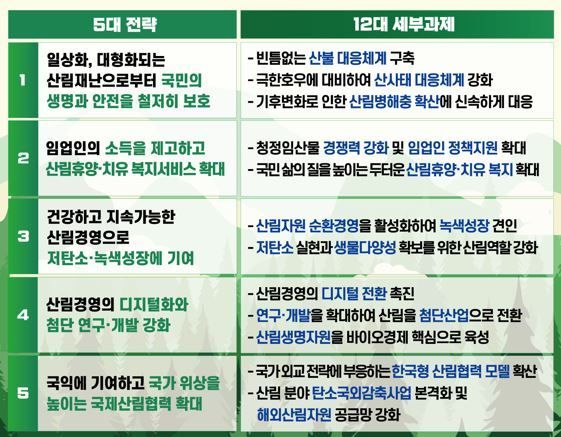
The major policies will be implemented based on five key strategies and twelve detailed tasks. The five strategies are: ▲ Protecting citizens' lives and safety from everyday and large-scale forest disasters ▲ Increasing forestry workers' income and expanding forest recreation and healing welfare services ▲ Contributing to low-carbon and green growth through healthy and sustainable forest management ▲ Digitalization of forest management and strengthening research and development ▲ Expanding international forest cooperation.
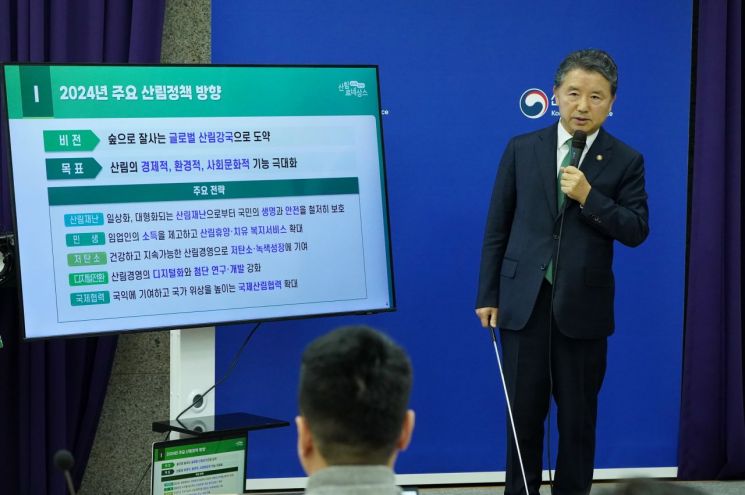 Nam Seong-hyeon, the Commissioner of the Korea Forest Service, is announcing the '2024 Major Policies of the Korea Forest Service' at the Government Daejeon Complex on the 19th. Photo by Korea Forest Service
◆ Strengthening Response to Forest Disasters = First, the Korea Forest Service plans to focus on enhancing capabilities to respond to forest fires and landslides to protect citizens from forest disasters.
In collaboration with local governments and related agencies, it will strengthen routine forest fire prevention activities and expand the AI surveillance camera monitoring system from 10 locations mainly along the East Coast to 30 locations including Gyeongbuk and Gangwon provinces. This is aimed at fundamentally preventing large-scale forest fires, especially in high-risk areas such as Gyeongbuk and Gangwon.
Additionally, seven large leased helicopters will be forward-deployed to forest fire risk areas such as the East Coast, and forest fire access roads will be expanded (up to 409 km within the year) to enhance on-site forest fire suppression capabilities.
Regarding landslides, the Korea Forest Service will integrate forest and surrounding slope management, previously handled by different ministries, into a 'Digital Slope Integrated Landslide Information System,' and build a 'Forest Watershed Numerical Map' that digitizes forest valley distribution and flow data to improve landslide prediction accuracy from 89% to 94%.
In particular, considering that the three major forest disasters?forest fires, landslides, and pests?can be interconnected and escalate into large-scale damage, the Korea Forest Service plans to enact the 'Forest Disaster Prevention Act' within the year to enable integrated management of forest disasters.
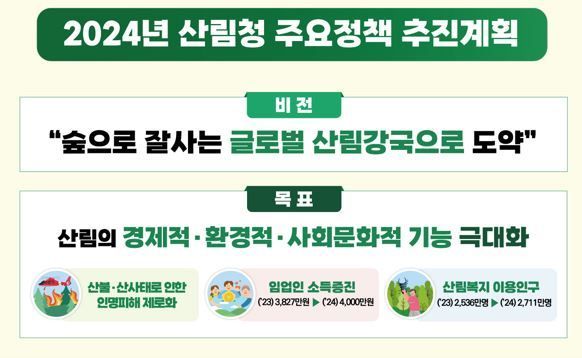
◆ Increasing Forestry Workers' Income and Expanding Forest Welfare = This year, the Korea Forest Service will improve tax systems in the forestry sector by expanding tax exemptions and reducing acquisition taxes to increase forestry workers' income, and relax the payment criteria for the forestry direct payment system to levels similar to related industries.
It will also reorganize restricted forest land conversion areas to support national economic activities and strengthen policy support such as forest start-up activation education, short-term overseas training, and start-up competitions to help young people enter the forestry sector.
Deploying foreign workers to forest sites is also part of this year's policy to resolve difficulties faced by forestry workers. Foreign workers are scheduled to enter the country from September, receive training, and then be deployed to forestry sites. Employers wishing to deploy foreign workers in forestry must apply in advance to the Ministry of Employment and Labor by July.
A representative forest welfare expansion project this year is the opening of a section of the 'East-West Trail' (49 km from Taean to Seosan). The East-West Trail is the first forest trail in Korea that connects the eastern and western parts of the southern middle region of the Korean Peninsula, allowing backpacking travel. It connects five cities and provinces and 21 cities, counties, and districts from Uljin County in Gyeongbuk to Taean County in Chungnam.
In addition, the Korea Forest Service plans to continuously expand forest recreation and healing welfare facilities that allow companion animals.
◆ Forest-Mediated Contribution to 'Low-Carbon and Green Growth' = This year, the Korea Forest Service will link corporate ESG demands to cooperative projects in the forestry sector and promote private sector participation in forest management by enabling free trading of carbon absorption secured through the forest carbon offset system on carbon trading platforms.
It also plans to spread public awareness that wood use directly relates to 'carbon neutrality,' promote the creation of wood-friendly cities, expand eco-friendly wooden construction, and establish a legal foundation for activating wooden construction in cooperation with the Ministry of Land, Infrastructure and Transport.
Increasing national arboretums by climate and vegetation zones to secure biodiversity and strengthen systematic conservation and management of national plant resources is also included in this year's major forest policies.
Furthermore, from this year until 2026, the Korea Forest Service will establish a 'Digital Forest Platform' to support smart decision-making based on digital and AI technologies, and in November, plans to shift the paradigm to advanced forest management and control using 3D virtual reality through a 'Digital Twin' technology demonstration.
Expanding international forest cooperation aims to actively secure overseas carbon emission rights through the establishment of the 'Overseas Forest Carbon Emission Reduction Act' and the 'Overseas Forest Mother Fund,' promoting overseas forest investment and projects to prevent forest degradation and conversion in developing countries.
Commissioner Nam Seong-hyun stated, "This year, the Korea Forest Service will accelerate forest policies to ensure that the public, 2.2 million forest owners, and 210,000 forestry workers can equally enjoy the benefits of forests."
© The Asia Business Daily(www.asiae.co.kr). All rights reserved.
![Clutching a Stolen Dior Bag, Saying "I Hate Being Poor but Real"... The Grotesque Con of a "Human Knockoff" [Slate]](https://cwcontent.asiae.co.kr/asiaresize/183/2026021902243444107_1771435474.jpg)

















