Tax Savings of 1 Billion KRW from Purchasing GPU-Equipped Servers
Supporting Domestic Academic AI Research Alongside Supercomputers
The Institute for Basic Science (IBS, Director Noh Do-young) has purchased and installed Nvidia's 'H100' graphics processor units (GPUs), which have surged in price due to the AI investment boom, at up to 40% below market price. Nvidia GPUs have skyrocketed in price due to the rapid increase in demand for AI semiconductors, and the national research institute has saved more than 1 billion KRW of taxpayers' money.
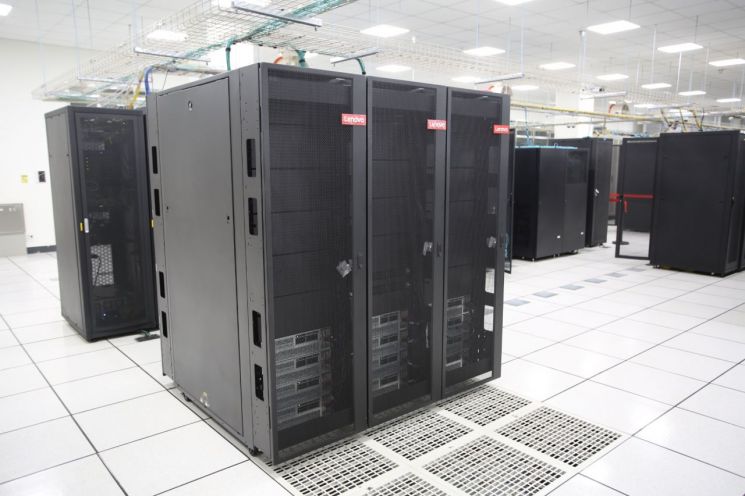
According to the scientific community on the 15th, IBS introduced 48 H100 GPUs at the end of last year through the U.S. headquarters of the Chinese computer company Lenovo and built a data analysis system on the supercomputer 'Olaf.' This was to respond to the demand for generative AI research. The budget spent was about 2.1 billion KRW, approximately 43 million KRW per H100. Although Nvidia does not disclose the exact price, typically one must pay around 60 to 70 million KRW per unit, and it is even difficult to purchase them.
The reason IBS could purchase GPUs at a lower price was due to active bidding by companies. Heo Moo-young, head of the Supercomputing Center at IBS, explained, "Companies wanting to collaborate with our institute participated in the bidding for servers equipped with GPUs, allowing us to secure H100s with a small budget."
The H100 is considered an essential chip for training generative AI such as ChatGPT. Since the emergence of ChatGPT, competition to secure the H100 has intensified, causing prices to soar.
With the introduction of the H100, the supercomputer owned by IBS plays an important role in national research and development. Head Heo explained, "Compared to the Korea Astronomy and Space Science Institute analyzing space-related data on its own, using IBS's supercomputer reduced the computation time to one-eighth." The Ministry of Science and ICT designated IBS as a high-performance computing specialized center in the space field in July 2022.
IBS's situation contrasts with the difficulties faced by the Korea Institute of Science and Technology Information (KISTI) in acquiring the 6th supercomputer, which passed the government's preliminary feasibility study but is struggling due to the surge in GPU prices.
The reason IBS could purchase GPUs at a lower price was due to active bidding by companies. Heo Moo-young, head of the Supercomputing Center at IBS, explained, "Companies worldwide that recognize our institute's research achievements participated in the bidding for servers equipped with GPUs, allowing us to secure H100s with a small budget."
Thanks to the introduction of the H100, the supercomputer owned by IBS is playing a vital role in national research and development. Head Heo explained, "Compared to the Korea Astronomy and Space Science Institute analyzing space-related data on its own, using IBS's supercomputer reduced the computation time to one-eighth." The two research institutes signed a memorandum of understanding (MOU) for cooperation in astronomy and space science on the 14th. The Ministry of Science and ICT designated IBS as a high-performance computing specialized center in the space field in July 2022.
© The Asia Business Daily(www.asiae.co.kr). All rights reserved.
![Clutching a Stolen Dior Bag, Saying "I Hate Being Poor but Real"... The Grotesque Con of a "Human Knockoff" [Slate]](https://cwcontent.asiae.co.kr/asiaresize/183/2026021902243444107_1771435474.jpg)















