'Corporate Finance Support Measures' Bank CEOs Meeting Held
High-Interest Loans Over 5% for SMEs, Reduced by Up to 2%P
26 Trillion Won Funding Support for Advanced Industries like Semiconductors and Secondary Batteries
System and Infrastructure Improvements Also Pursued... Increased Loan Screening Efficiency
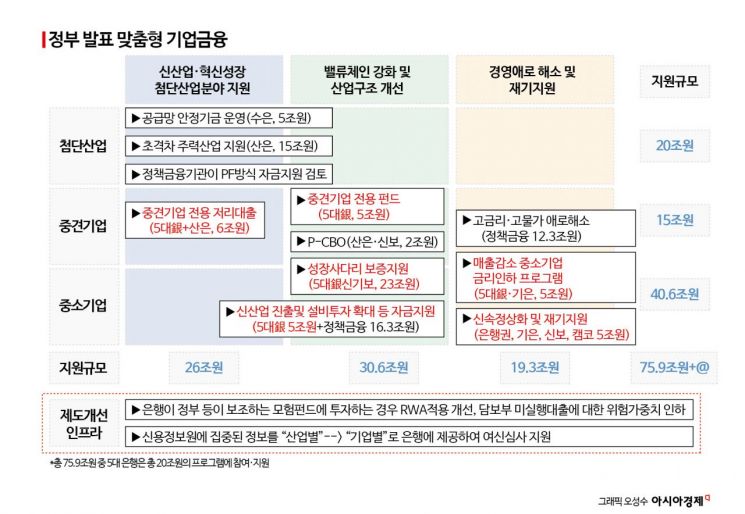
The government, together with the financial sector, will provide multifaceted financial support targeting advanced industries, mid-sized enterprises, and small and medium-sized enterprises (SMEs). The public and private sectors will invest 76 trillion won to focus support on companies operating in ultra-competitive and core industries, strengthen the global competitiveness of the industrial structure, and swiftly assist crisis-hit companies struggling with high interest rates to normalize and recover after failure. Improvements to systems and infrastructure will also be pursued to encourage banks to actively support corporate financing.
On the 15th, the Financial Services Commission (FSC) held a meeting with related agencies including the Ministry of Trade, Industry and Energy, the Ministry of SMEs and Startups, the Ministry of Economy and Finance, and the banking sector based on the 75.9 trillion won "Customized Corporate Financing Support Plan to Overcome High-Interest Difficulties and Transition to New Industries" announced at the previous day’s public-party-government council. The meeting was attended by Minister An Deok-geun of the Ministry of Trade, Industry and Energy, Minister Oh Young-joo of the Ministry of SMEs and Startups, Chairman Cho Yong-byeong of the Korea Federation of Banks, as well as heads of various banks and policy financial institutions.
FSC Chairman Kim Joo-hyun said in his opening remarks, "As China, the largest export country, rapidly advances technologically, the previously complementary relationship is now turning into a competitive one," adding, "Bold investments are being made in future growth industries such as artificial intelligence (AI), robotics, and new materials, accelerating technological innovation, so efforts to secure an ultra-competitive edge in these fields are also necessary."
Relieving High-Interest Burden on SMEs and Mid-Sized Enterprises... 26 Trillion Won for Semiconductor and Secondary Battery Facility Investments
The government’s support plan includes supplying 19.4 trillion won to ease the high-interest burden on SMEs and mid-sized enterprises and to establish a foundation for swift normalization and recovery. In particular, a special interest rate reduction program exclusively for SMEs will be jointly prepared with banks on a scale of 5 trillion won, lowering loan interest rates by up to 2 percentage points for one year on high-interest loans exceeding 5%.
Additionally, 2 trillion won worth of low-interest fixed-rate products will be supplied, allowing conversion between variable and fixed interest rates depending on the interest rate environment, and 11.3 trillion won in policy financing will be provided to alleviate the high-interest burden. For SMEs temporarily experiencing liquidity shortages, a 3 trillion won program for rapid normalization financial support will be operated, exempting additional interest rates.
For the transition to new industries, more than 26 trillion won will be provided for large-scale facility investments in advanced industries such as semiconductors and secondary batteries. KDB Industrial Bank will supply low-interest funds totaling 15 trillion won with interest rates reduced by up to 1.2 percentage points in five major sectors including semiconductors, secondary batteries, and bio. For large-scale capital demands in advanced strategic industries, funding support through project financing (PF) involving demand companies and pension funds as shareholders, along with policy financial institutions and private financial companies, will also be considered.
Furthermore, a 5 trillion won supply chain stabilization fund will be established to support companies needing to diversify import sources and secure overseas resources. Mid-sized enterprises wishing to newly enter or expand investments in new growth sectors will be offered loans with preferential interest rates reduced by 1 percentage point up to 150 billion won per company.
For mid-sized enterprises that have played a pivotal role in the industrial ecosystem but have been neglected in policy support, a 5 trillion won joint fund exclusively for mid-sized enterprises will be created by the five major banks. The five major banks and the Industrial Bank of Korea will prepare a 6 trillion won low-interest loan program exclusively for mid-sized enterprises entering new businesses to support their advancement into new growth industries. Additionally, 1.8 trillion won worth of new corporate bond issuance will be supported to enable mid-sized enterprises to utilize various funding methods such as the capital market, and a 2.3 trillion won growth ladder program will be established through cooperation between banks and guarantee institutions.
"We Must Respond to Global Bloc Formation Centered on National Interests"... Accelerating Regulatory Innovation and System Improvements
Chairman Kim emphasized that global supply chains are being reorganized due to the formation of national-centered economic blocs by major countries such as the U.S., China, and the European Union (EU), as well as changes in geopolitical dynamics, stressing the need for active regulatory innovation and effective responses through system improvements. Accordingly, the FSC will activate the use of the "risk weight reduction application requirements" through the acceptance of non-action letters so that banks can reduce the Basel Committee on Banking Supervision (BIS) capital ratio burden when investing in policy funds. This measure aims to encourage active private sector participation. Although the current system allows risk weights to be lowered from 400% to 100%, banks have found it difficult to apply on their own, resulting in low utilization.
Plans are underway to lower the risk weight on unexecuted amounts of guaranteed split-execution loans and to allow autonomous determination of borrowers’ credit ratings. To ease banks’ burdens, a 0% risk weight will be applied to unexecuted amounts for which guarantee approval notices have been issued, securing banks’ capacity to support corporate financing. Subsequently, decisions on upgrading borrowers’ credit ratings and refunding provisions will also be left to banks’ discretion.
The efficiency of banks’ credit screening will also be enhanced. The FSC will revise the system so that the Korea Credit Information Services, which currently centralizes corporate financial information, technological capabilities, and sales data by industry, will provide more detailed data by product and company to banks. Banks will be able to utilize not only materials submitted by companies during credit screening but also data centralized at the credit information agency, further improving loan screening efficiency.
Meanwhile, the environment where joint support is difficult due to the lack of sharing of the "business restructuring support company list" among banks will also be improved. Currently, the creditor bank selects and recommends business restructuring companies to provide benefits, but information is not shared among banks, hindering joint support. The FSC plans to encourage joint support among banks by sharing lists of approved business restructuring companies and financial support performance recommended by banks through regular meetings.
Chairman Kim stated, "Swift and effective responses to new challenges are necessary for the future of our companies and economy," explaining, "This corporate financing support program is significant as it is the first time that government ministries, policy financial institutions, and commercial banks collaborate closely to provide tailored support for corporate needs."
Minister An Deok-geun of the Ministry of Trade, Industry and Energy said, "The customized corporate financing support plan is expected to greatly contribute to achieving the goals of 700 billion dollars in exports and 150 trillion won in private investment by enabling smooth financial support for strengthening competitiveness in advanced industries, new industry entry, and export expansion of SMEs and mid-sized enterprises." Minister Oh Young-joo of the Ministry of SMEs and Startups added, "The Ministry of SMEs and Startups will also strive to overcome the crisis faced by SMEs by actively supplying 32 trillion won in policy financing this year through organizations such as the Korea SMEs and Startups Agency and the Korea Technology Finance Corporation."
© The Asia Business Daily(www.asiae.co.kr). All rights reserved.
![Clutching a Stolen Dior Bag, Saying "I Hate Being Poor but Real"... The Grotesque Con of a "Human Knockoff" [Slate]](https://cwcontent.asiae.co.kr/asiaresize/183/2026021902243444107_1771435474.jpg)
















