Grocery Prices and Oil Costs Soar... Possibility of Persistent High Inflation
Concerns Grow Over Holiday Policies and Temporary Fuel Tax Cut Ending
Fruit prices have continued to rise at a rate of over 6% for four consecutive months, and gasoline prices have also climbed to the 1,600 KRW per liter range, raising concerns that the high inflation trend may intensify after the Lunar New Year. Although the government maintains the position that "there is no decision to extend the fuel tax cut," it is difficult to reduce the price burden on ordinary citizens without extending the fuel tax cut. Experts predict that inflationary pressure will remain strong throughout the first half of the year and that prices may only stabilize somewhat in the second half.
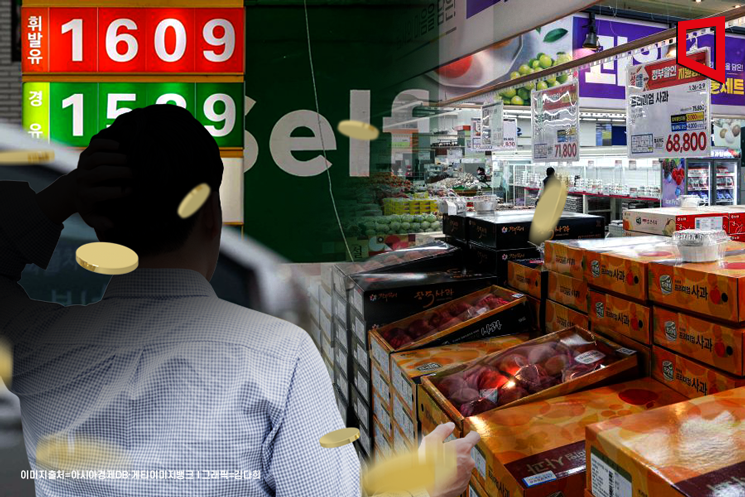
According to the Korea National Oil Corporation’s oil price service Opinet, as of the morning of the 13th, the nationwide gasoline price recorded 1,607.18 KRW per liter. Gasoline prices rose to the 1,600 KRW range on the 8th, just before the holiday, when it reached 1,601 KRW per liter, and have continued to increase since. This is the first time in about two months since the second week of December last year that gasoline prices have reached the 1,600 KRW level. In Seoul, where gasoline prices are relatively high, the price was 1,695 KRW per liter, approaching 1,700 KRW. Diesel prices also surpassed 1,500 KRW for the first time in six weeks on the 6th, recording 1,501.49 KRW, and rose to 1,510.15 KRW as of the morning of the 13th.
The rise in fuel prices is due to the surge in international oil prices amid growing concerns over the expansion of the Middle East conflict, which has already resulted in the first U.S. military casualties. On the 27th of last month, a drone attack by Iranian militias caused the deaths of three U.S. soldiers, triggering a sharp increase in international oil prices. Dubai crude, which serves as the benchmark for domestic gasoline prices, hovered in the high $70s per barrel throughout last month but surpassed the $80 mark for the first time on the 25th, reaching $80.31. After the U.S. military casualties, on the 29th, it jumped further to $83.31. Considering that international oil prices affect domestic fuel prices with a lag of two to three weeks, oil prices are expected to continue rising for the time being.
If the temporary fuel tax cut, scheduled to end at the end of this month, is not extended, the increase in gasoline prices will be even more significant. Currently, the temporary fuel tax cut reduces gasoline prices by 205 KRW per liter and diesel by 212 KRW per liter. If this measure ends, gasoline prices, currently in the 1,600 KRW range, will jump to the 1,800 KRW range, and diesel prices will soar to the 1,700 KRW range. As the temporary tax cut has been extended seven times before, expectations for another extension are growing, but the government has stated that "no decision has been made regarding the operation of the fuel tax’s flexible rate."
Fruit prices are also a factor fueling high inflation. According to the National Statistical Office’s National Statistics Portal, food prices rose 6.0% compared to a year ago last month, maintaining a rise rate of over 6% for four consecutive months. Fruit prices surged 26.9% last month, marking the largest increase since January 2011 (31.2%), and the contribution of fruit prices to the overall inflation rate (2.8%) was also the highest since January 2011 at 0.4 percentage points. The main cause of the fruit price increase is a shortage of supply due to abnormal weather conditions, and there are no signs that this will be resolved easily in the short term.
Despite the government’s efforts to suppress price increases by supplying major seasonal products such as apples and pears ahead of the Lunar New Year, high inflation was recorded, suggesting that fruit prices, which have been suppressed so far, may rise further after the holiday. This is why the high inflation trend is likely to continue in the first half of the year. Professor Kang Sung-jin of Korea University’s Department of Economics said, "Vegetable prices tend to rise in winter, and while oil prices are already high, the likelihood of a dramatic increase is low, but the high inflation trend is likely to continue throughout the first half. In the second half, when there is pressure to lower interest rates, prices may decrease somewhat, resulting in a ‘high in the first half, low in the second half’ trend."
© The Asia Business Daily(www.asiae.co.kr). All rights reserved.
![Clutching a Stolen Dior Bag, Saying "I Hate Being Poor but Real"... The Grotesque Con of a "Human Knockoff" [Slate]](https://cwcontent.asiae.co.kr/asiaresize/183/2026021902243444107_1771435474.jpg)















