Destination presumed to be a third country other than Korea... Investigation into distribution routes and sources
Suspected new drug distribution method known as "Gisaengchung"
Recent investigations revealed that the large quantity of cocaine found on a vessel docked at Busan Port was the result of a delivery accident by an international drug trafficking organization.
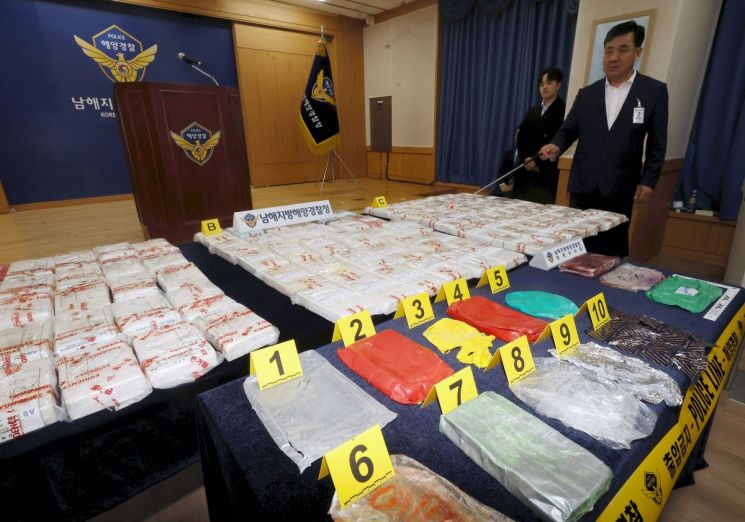
On the 8th, the Narcotics Investigation Unit of the South Sea Coast Guard announced that they have requested international cooperation in the investigation regarding the case where approximately 100 kg of cocaine worth about 350 billion KRW was discovered on the floor of a 75,000-ton cargo ship that arrived at Busan New Port on the 15th of last month.
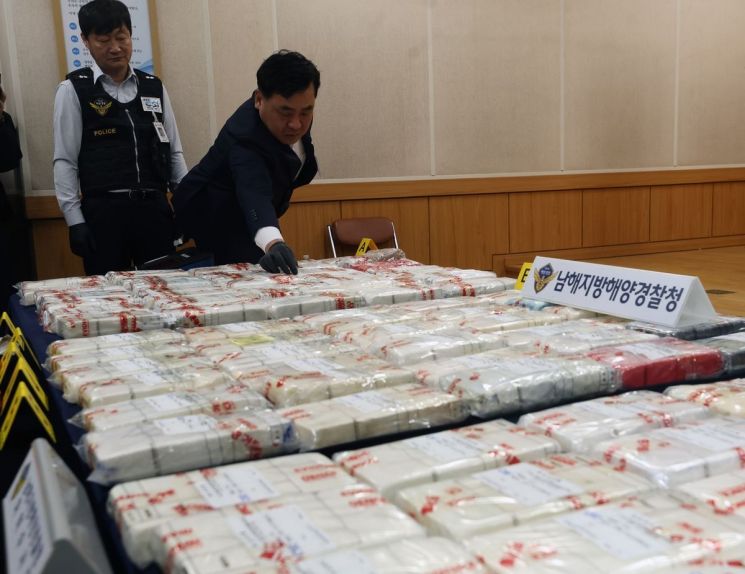
Cocaine is known as one of the three major narcotics along with Philopon and heroin. The seized cocaine was contained in three concealed bags. At the time, the cocaine was found in 100 compressed packages, each weighing 1 kg. The 100 kg of cocaine is enough for all 3.3 million residents of Busan to use simultaneously.
Vessel A is a regular shipping line operating in the sequence of Brazil → Singapore → Hong Kong → South Korea → China. Vessel A departed from a port in Brazil in early December last year, stopped at Singapore and Hong Kong, and arrived at Busan New Port last month.
The Coast Guard explained that this method of concealment using the sea chest space is a new technique recently employed in drug distribution. The sea chest refers to the intake located on the bottom surface of the ship for cooling the main engine. It is difficult to detect even with equipment, hence it is called the ‘parasite’ method.
After establishing an investigation headquarters led by the head of the investigation division, the Coast Guard obtained a search and seizure warrant from the Busan District Court to conduct a thorough search and verification inside the vessel, and secured crew members’ mobile phones for digital forensic analysis.
The packaging containing the drugs was engraved with dolphin patterns, which are known to represent Central and South American drug trafficking organizations. The Coast Guard reported that smuggling cocaine produced in Central and South America from Brazil to Europe has been increasing recently, and they believe the cocaine seized this time was intended to be sent to a third country, not South Korea.
Additionally, fingerprints and DNA presumed to belong to suspects related to this investigation were collected. The investigation revealed that these fingerprints and other evidence did not match any Korean nationals. Therefore, the Coast Guard is considering the crime to have been committed by foreigners. Drug tests conducted on the 23 crew members aboard the vessel all returned negative, and eight tracking devices were found on the ship. Based on the analysis of these results, the Coast Guard is targeting the international narcotics distribution network as the main adversary.
The Coast Guard stated, “Although a large quantity of drugs was found in South Korea, no connection to Koreans was identified, so we have requested Interpol’s international cooperation investigation regarding individuals related to transit countries such as Brazil.”
© The Asia Business Daily(www.asiae.co.kr). All rights reserved.
![Clutching a Stolen Dior Bag, Saying "I Hate Being Poor but Real"... The Grotesque Con of a "Human Knockoff" [Slate]](https://cwcontent.asiae.co.kr/asiaresize/183/2026021902243444107_1771435474.jpg)
















