Changes in Trade Landscape Reflecting US-China Conflict
US Largest Import Partner Shifts from China to Mexico After 20 Years
Mexico, Vietnam, Korea Gain Secondary Benefits
"China Seeks Ways to Bypass US Sanctions"...Statistical Illusion Pointed Out
China has been dethroned as the top import country to the United States for the first time in 20 years. Instead, Mexico has taken China's place. Analysts say this reflects the reality of changing trade flows due to the new US-China cold war and the global supply chain restructuring. South Korea has also gained significant spillover benefits. However, some point out that statistical illusions are hidden in US trade data as China opts for detours by relocating production bases to Mexico, Vietnam, South Korea, and others.
US Largest Import Country, From China to Mexico for the First Time in 20 Years
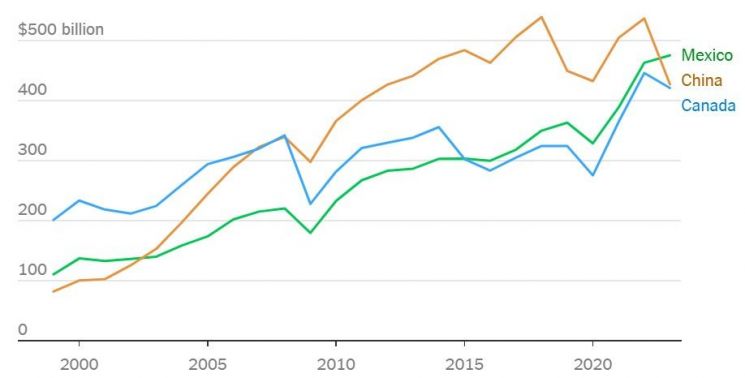
According to the US Department of Commerce on the 7th (local time), last year’s import value from Mexico was about $475.6 billion, similar to the previous year. Imports from China amounted to $427.2 billion, down 20% from the previous year. As a result, Mexico surpassed China for the first time in 20 years to become the United States' largest import country. China, which had held the top spot for 20 years, dropped to second place.
The US trade deficit with China significantly decreased. The US recorded a trade deficit of $279.4 billion with China, a 26.9% reduction compared to the previous year. The trade deficit with China as a percentage of US Gross Domestic Product (GDP) was 1%, the lowest level since 2002. Last year, the overall US trade deficit was $737.4 billion, down 18.7% from the previous year. Exports increased by $35 billion (1.2%), and imports decreased by $142.7 billion (3.6%), reducing the trade deficit.
China losing its position as the US's largest import country is attributed to US-China decoupling and the US-led supply chain restructuring. The Biden administration has pursued supply chain restructuring excluding China and is implementing a 'friend-shoring' strategy by partnering with allies and friends to build supply chains. Ahead of the US presidential election in November, leading Republican candidate former President Trump has pledged to raise tariffs on China to over 60% if re-elected. Amid this trend, US imports from China remain at levels similar to 10 years ago. According to Ralph Ossa, chief economist at the World Trade Organization (WTO), trade between the US and China is growing about 30% slower compared to trade between the US and other countries due to the contraction in US-China trade.
Mark Zandi, chief economist at Moody’s Analytics, noted, "The US and China are decoupling, which is putting significant pressure on trade flows." Maeba Kurzon, senior global economist at Bloomberg Economics, said, "2023 trade data confirms that the US import landscape is shifting from China to other trading partners. Since 2018, tariffs on China have driven this change, but now there are early signs that US trade diversification may expand to other categories."
US-China Trade Decoupling Benefits Mexico, Vietnam, South Korea, and Others
As US-China decoupling continues and the US accelerates friend-shoring, Mexico, South Korea, Taiwan, and Europe are gaining spillover benefits. Although the US trade deficit with China shrank last year, the trade deficit with Mexico reached a record high of $152.4 billion. The trade deficit with South Korea was $51.4 billion, also an all-time high. Additionally, deficits with Germany, Italy, the Netherlands, Taiwan, and India also hit record levels.
The US daily newspaper The New York Times (NYT) focused on South Korea as a beneficiary of the changing US-China trade flows. It highlighted that the Korea-US Free Trade Agreement (FTA) lowers tariffs on Korean products, and that South Korean electric vehicle battery and parts companies are accelerating their entry into the US market through the Biden administration’s Inflation Reduction Act (IRA), actively participating in supply chain restructuring. SK On has already invested $2.6 billion in Georgia to produce EV batteries and is building factories in Tennessee and Kentucky through joint ventures with US automaker Ford.
South Korea’s spillover benefits from US-China tensions are also evident in statistics. According to the Ministry of Trade, Industry and Energy, South Korea’s exports to the US in December last year reached $11.292 billion, and the trade surplus with the US was $5.03 billion, both record highs. The US has displaced China as South Korea’s largest export market for the first time in 20 years.
"China Circumvents US Trade Sanctions"…Claims of Statistical Illusions
Some analysts argue that the observed US-China decoupling in US foreign trade includes statistical illusions. They claim Chinese companies are relocating production bases to Mexico, Vietnam, and other countries to reduce production costs and avoid high tariffs. Essentially, products labeled 'Made in China' are being exported to the US with only the country of origin changed. The US trade deficit with Mexico and Vietnam has significantly increased compared to before the US-China trade war began in 2018. The US recorded a $15.1 billion trade deficit with Mexico from December 2022 to November 2023, double the amount in 2017. The trade deficit with Vietnam during the same period was $104 billion, about three times higher than in 2017. The US economic journal The Wall Street Journal (WSJ) reported, "A significant portion of the increased imports from Vietnam and Mexico are supplied from China," but added, "It is difficult to quantify due to data gaps."
There is also a view that China is exploiting the US tariff law that exempts import tariffs on goods priced under $800. Amit Khandelwal, an economist at Yale University who analyzed US government data, found that the number of goods under $800 eligible for tariff exemption reached 1 billion last year, tripling since 2017. He interpreted this as China finding detours to evade US trade sanctions.
Experts believe that as the US raises the level of trade sanctions against China, China’s efforts to circumvent them will become more sophisticated. Although China’s share in US trade is expected to gradually decline, it may take considerably longer than anticipated. Brad Setser of the Council on Foreign Relations said, "China will double its efforts to avoid or neutralize higher tariffs. They disassemble products, remove screws, find alternative suppliers, ship to third parties to ensure products are not 100% Chinese-made, and have third parties repackage for export. These efforts are truly remarkable."
The WSJ reported, "Tariffs have not severely worsened US-China trade relations," and "Chinese companies are also playing the game to resolve US tariff issues."
© The Asia Business Daily(www.asiae.co.kr). All rights reserved.
![Clutching a Stolen Dior Bag, Saying "I Hate Being Poor but Real"... The Grotesque Con of a "Human Knockoff" [Slate]](https://cwcontent.asiae.co.kr/asiaresize/183/2026021902243444107_1771435474.jpg)
















