Luixing Coffee, HeyTea, Ganfeng Lithium, etc.
Chinese Authorities Strengthen Related Laws... "IP Protection"
Chinese companies that achieved rapid growth in the past through a 'copycat (plagiarism/similar product) strategy' are recently facing difficulties as they themselves have become targets of copying.
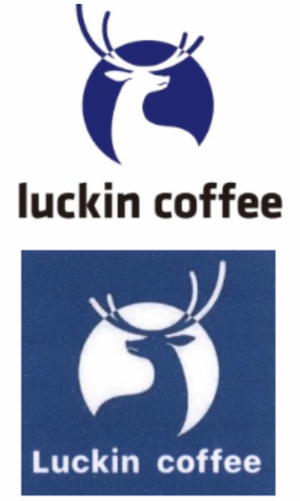 The brand logos of China's famous coffee franchise 'Ruixing (瑞幸·luckin) Coffee' (above) and Thailand's 50R Group's 'Luckin' Coffee. [Image source=Wall Street Journal (WSJ) capture]
On the 5th (local time), The Wall Street Journal (WSJ) reported that China's famous coffee franchise 'Luckin Coffee (瑞幸·luckin)' is engaged in a legal dispute with a similar brand in Thailand. Previously, Luckin Coffee from China filed a trademark infringement lawsuit against Thailand's '50R Group' because 50R Group was operating a coffee brand in Thailand using the English spelling of Luckin Coffee's name, 'luckin coffee,' along with a similar font and a left-right reversed deer-shaped logo.
This case began in early 2021 when a netizen posted on social media (SNS) that they had drunk Luckin Coffee in Thailand. However, at the end of last year, the Thai court ruled in favor of 50R Group. Instead, 50R demanded compensation of 10 billion baht (approximately 370 billion KRW) from Luckin Coffee. This is because Thailand follows a 'first-to-file, then-register' system that grants usage rights to whoever registers the trademark first. The 50R Group has been operating this coffee brand since 2018 and registered nearly 200 trademarks.
Cases of Chinese brands being imitated in Thailand are increasing. Local Thai marketing firms and law firms revealed that among the 'Top 100 Most Valuable Chinese Brands of 2023,' 73 brands attempted to register trademarks in Thailand, and about half of these were estimated not to be owned by the legitimate trademark holders.
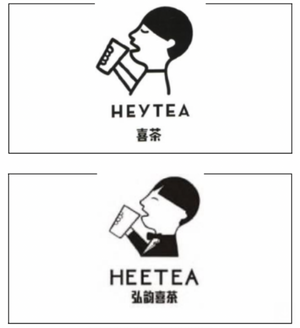 Brand logos of China's famous tea franchise 'HEYTEA' (above) and Singapore's 'HEETEA'. [Image source: Wall Street Journal (WSJ) capture]
Not only in Thailand but also in several other countries, Chinese brands are being imitated. China's famous tea franchise 'HEYTEA' is also struggling due to Singapore's 'HEETEA.' HEETEA's brand logo depicts a 'person drinking tea,' which is very similar to HEYTEA's. Additionally, a local Nigerian venture company, the first lithium processing firm in Nigeria launched in October last year, has a name similar to a Chinese company. This venture company's name, 'Ganfeng Lithium Industry,' appears to be derived from the Chinese company 'Ganfeng Lithium,' which supplies products to Tesla. Later, 'Nigeria Ganfeng' protested against media reports portraying them as a subsidiary of the Chinese company, claiming instead that the Chinese company was impersonating them.
Recently, international lawyers have reported a sharp increase in inquiries from Chinese companies seeking to protect their intellectual property (IP). In 2022, the number of trademark registrations in China was about 6.2 million, which is three times higher compared to five years ago. Chinese authorities are also strengthening law enforcement related to IP protection. Foreign media pointed out, "Many Chinese companies have become admired brands during their overseas expansion," adding, "They have begun to face 'copying,' one of the pitfalls of global success."
© The Asia Business Daily(www.asiae.co.kr). All rights reserved.
![Clutching a Stolen Dior Bag, Saying "I Hate Being Poor but Real"... The Grotesque Con of a "Human Knockoff" [Slate]](https://cwcontent.asiae.co.kr/asiaresize/183/2026021902243444107_1771435474.jpg)
















