Soso Bank, KCD Bank Followed by U Bank Consortium Competition
Increased Competition Due to Last Year's Financial Authority Approval Changes
Internet Bank Growth Also Plays a Role
However, Solid Capital Procurement and Financial Soundness Required
The number of consortiums preparing to launch the 4th internet-only bank has increased to three. Following Soso Bank and KCD Bank, which are preparing internet banks aimed at small business owners, a consortium called U-Bank, centered around the fintech platform 'Samjeomsam,' has been formed. All are expected to submit their preliminary internet bank license applications to financial authorities by next month. However, there is analysis that if a solid capital base and financially expert quality investors do not back them, they may fail to obtain the license.
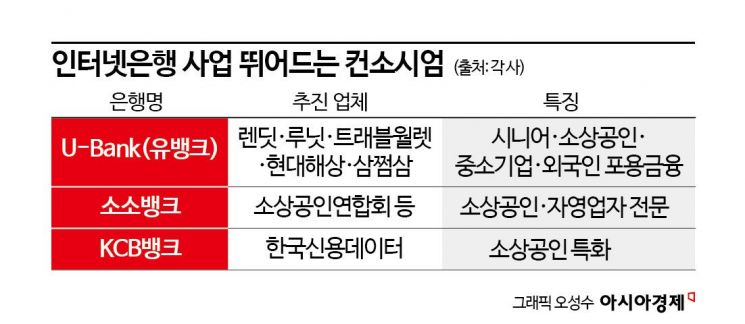
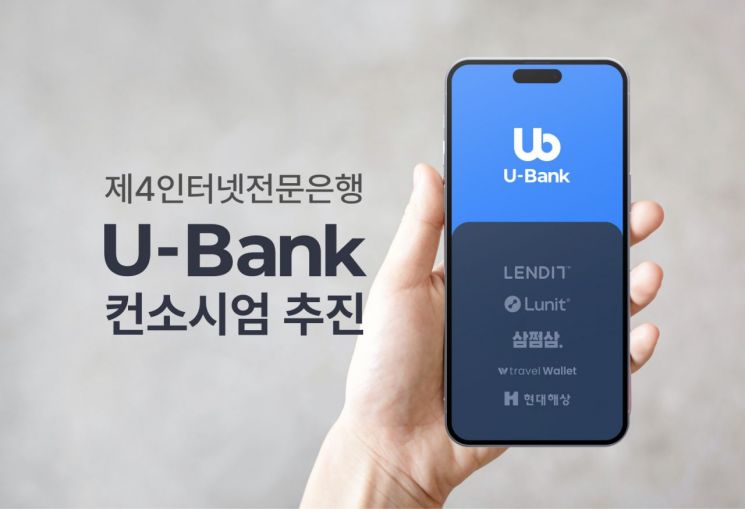
The U-Bank consortium announced on the 5th that it is preparing to apply for the preliminary internet bank license. This consortium includes online investment-linked finance company Lendit, fintech platform Jarvis & Villains (Samjeomsam), foreign exchange specialized fintech company Travelwallet, medical AI (artificial intelligence) company Lunit, and Hyundai Marine & Fire Insurance. U-Bank has formed the consortium with the goal of creating an internet bank that embraces financially marginalized groups who have had difficulty accessing traditional financial institutions such as conventional banks. Specifically, it aims to be a financial institution that embraces the elderly, small business owners and SMEs, and foreigners.
Currently, there are three consortiums declaring their intention to become the 4th internet-only bank, including U-Bank. The Small Business Federation, consisting of 12 regional chairpersons and 35 nationwide small business organizations, has formed the 'Soso Bank Establishment Preparation Committee' and is preparing a specialized bank for small business owners. It is known that they plan to apply for the preliminary license next month. In September last year, KCD (Korea Credit Data) formed a task force (TF) to prepare for the launch of KCD Bank, a specialized internet bank for small business owners.
The reason various companies including fintech firms are challenging the establishment of internet banks is due to changes in the bank licensing system by financial authorities. In July last year, the Financial Services Commission and the Financial Supervisory Service announced that the banking industry, which had an oligopoly structure, would be transformed into a competitive market where competitors can enter at any time. Previously, after the financial authorities announced licensing policies, new license applications and reviews were conducted. Going forward, new licenses will be granted on a rolling basis to operators with sufficient soundness and business plans.
Also, companies providing specialized banking services are subject to more relaxed criteria than general bank licensing requirements. This is why consortiums are competing to promote themselves as 'specialized banks.'
The rapid growth of internet banks since their launch is also cited as a reason why various companies are participating in internet bank consortiums. Kakao Bank recorded its highest-ever cumulative net profit of 279.3 billion KRW in the third quarter of last year, seven years after its launch. Toss Bank also earned a net profit of 8.6 billion KRW during the same period. K Bank recorded a net profit of 38.2 billion KRW and is preparing for an IPO (initial public offering).
Industry insiders expect that securing capital will be crucial to becoming an internet bank. The capital requirement for new internet bank licenses is at least 25 billion KRW, which is lower than that for commercial banks (100 billion KRW), but unlike commercial banks, internet banks are subject to government controls on the loan ratio to medium- and low-credit borrowers. At least 30% of total credit loans must be made to customers in the bottom 50% credit score bracket. Since loans are made to those with higher default risk, asset soundness is important.
In fact, Soso Smart Bank, which included regional small business federations as members in 2019, failed to obtain the preliminary license. At that time, financial authorities judged it unqualified, stating, "The capital procurement plan and business plan were insufficient, and it appears unprepared to manage an internet bank stably."
This is also why the U-Bank consortium secured Hyundai Marine & Fire Insurance as a partner. The existing three internet banks also submitted license applications after securing financial investors. Kakao Bank partnered with Korea Investment Holdings and KB Kookmin Bank, and K Bank partnered with Woori Bank. Toss Bank, which competed with Soso Smart Bank in 2019, submitted its license application after completing shareholder composition including Hana Bank, SC First Bank, Welcome Savings Bank, Hanwha Investment & Securities, and two capital companies.
An official from the banking sector said, "Many small business owners are among medium- and low-credit borrowers, but it is difficult to aggregate their income and their sales fluctuate greatly, making banking services for them complicated. Only those with proper capabilities and skills as a bank can survive in the competition."
© The Asia Business Daily(www.asiae.co.kr). All rights reserved.
![Clutching a Stolen Dior Bag, Saying "I Hate Being Poor but Real"... The Grotesque Con of a "Human Knockoff" [Slate]](https://cwcontent.asiae.co.kr/asiaresize/183/2026021902243444107_1771435474.jpg)
















