'Document No. 1' Mentions Rural Issues... "Focus on Increasing Farmers' Income"
The Chinese Party and government have identified the ‘San Nong (三農, agriculture, rural areas, and farmers)’ issue as the top national priority this year. This marks the 21st consecutive year of the same focus. Since China declared the end of poverty in 2021, the focus of San Nong work has shifted from poverty alleviation to rural revitalization.
On the 4th, Chinese state media Xinhua News Agency and others reported that the Communist Party of China announced the Central No. 1 Document the day before, containing a roadmap to more strongly and effectively promote rural revitalization efforts. The No. 1 Document refers to the core national agenda that China prioritizes each year.
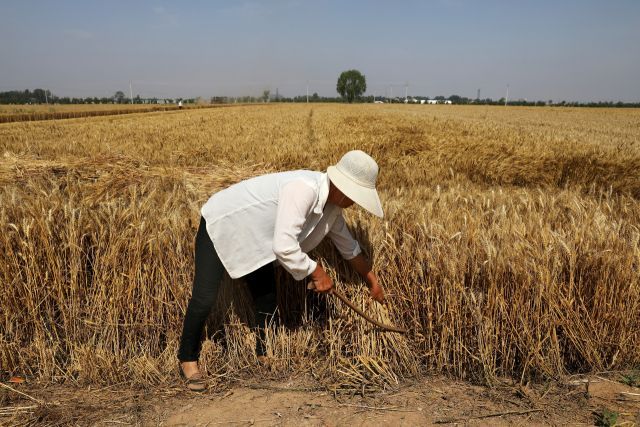 A farmer is harvesting wheat crops in Weixian, Handan City, Hebei Province, China.
 [Photo by Yonhap News]
In particular, the document emphasized, “The development philosophy, work methods, and promotion mechanisms of the ‘Ten Million Project’ must be well studied and operated, making comprehensive rural revitalization the backbone of San Nong work in the new era (since Xi Jinping’s leadership). It stressed the need to adhere to new development concepts and formulate policies tailored to local conditions (因地制宜), implement categorized policies (分類施策), pursue gradual progress (循序漸進), and maintain long-term efforts (久久爲功), focusing capabilities on practical issues that the public can feel.”
Commonly abbreviated as the ‘Ten Million Project,’ this initiative was a rural revitalization effort promoted in 2003 when Xi Jinping, then Party Secretary of Zhejiang Province, was in office.
At that time, the goal was to comprehensively renovate 10,000 out of 40,000 villages in Zhejiang Province over five years, creating 1,000 core villages as Xiaokang (middle-class) model villages. The revival of this project this year is interpreted as a move to further glorify President Xi’s leadership in rural revitalization.
Yang Chunhua, Deputy Director of the Rural Economy Research Center at China’s Ministry of Agriculture and Rural Affairs, told China Agriculture Daily, “Especially, the Ten Million Project is meaningful in San Nong work as it promotes rural revitalization with farmers as the main agents, guarantees farmers’ substantial interests and rights, and helps farmers lead better lives.”
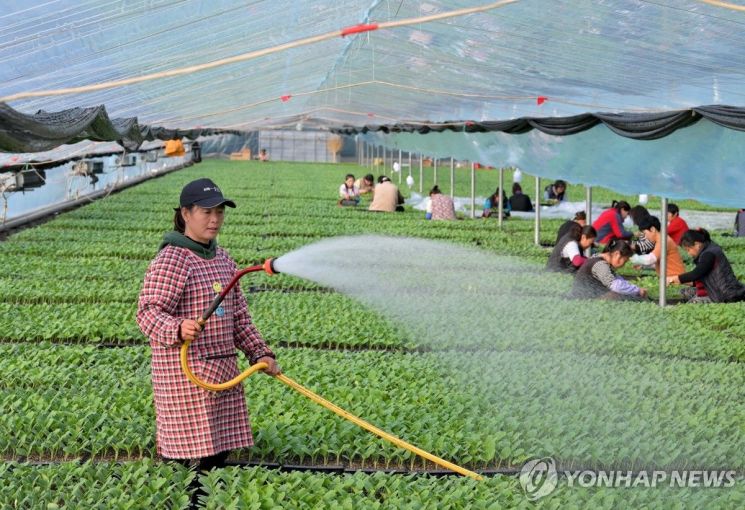
Furthermore, the document outlined work in six areas: securing food security, preventing large-scale re-poverty, developing rural industries, improving rural construction standards, enhancing rural governance, and others.
The Chinese Party and government emphasized the need to provide production subsidies for major grains and expand the scope of agricultural cost and income insurance. They also pledged to continue goals such as protecting arable land and diversifying agricultural product supply and demand.
Additionally, they committed to advancing agricultural science and technology, promoting rural reforms, and increasing farmers’ incomes. Last year, the per capita disposable income of rural residents in China was 21,691 yuan (approximately 4.02 million KRW), with the urban-rural disposable income ratio (rural residents’ income = 1) at 2.39 to 1, narrowing from 2.45 to 1 the previous year.
Li Guoxiang, a researcher at the Rural Development Institute of the Chinese Academy of Social Sciences, emphasized, “This year’s No. 1 Document shows that the Chinese leadership will accelerate rural revitalization and meet farmers’ needs. It demonstrates that the leadership values agricultural modernization, rural revitalization, and farmers’ livelihoods.”
© The Asia Business Daily(www.asiae.co.kr). All rights reserved.
![Clutching a Stolen Dior Bag, Saying "I Hate Being Poor but Real"... The Grotesque Con of a "Human Knockoff" [Slate]](https://cwcontent.asiae.co.kr/asiaresize/183/2026021902243444107_1771435474.jpg)
















