Only 33.7% of Gen Z Teachers Say They Will "Stay Until Retirement"
Considering Job Change Due to Low Wages and Teacher Rights Violations
Concerns Over Teacher Supply, Innovation Delays, and Accountability Weakening
Son Mo (27), a middle school teacher, began considering a job change just three years after passing the difficult teacher certification exam. Son said, "If you end up with even one 'malicious complaint' parent in your class, you have to spend a year like hell." After seeing cases among colleagues and thinking 'this could happen to me,' Son started to believe that changing jobs would be better than continuing the teaching career he had dreamed of.
Half of the young, early-career teachers surveyed said they were thinking about leaving the classroom. According to the "Seoul Teacher Longitudinal Study 2020 Year 3" conducted by the Seoul Metropolitan Office of Education Research and Information Center (Seogyo-yeon), among 2,079 elementary, middle, and high school teachers, MZ generation teachers born after the 1980s answered "yes" to questions about "plans to change jobs" at twice the rate of X generation teachers born in the 1960s and 1970s. Specifically, 29.1% of X generation and 54.8% of M generation teachers said they have plans to change jobs or would consider changing jobs if given the opportunity.
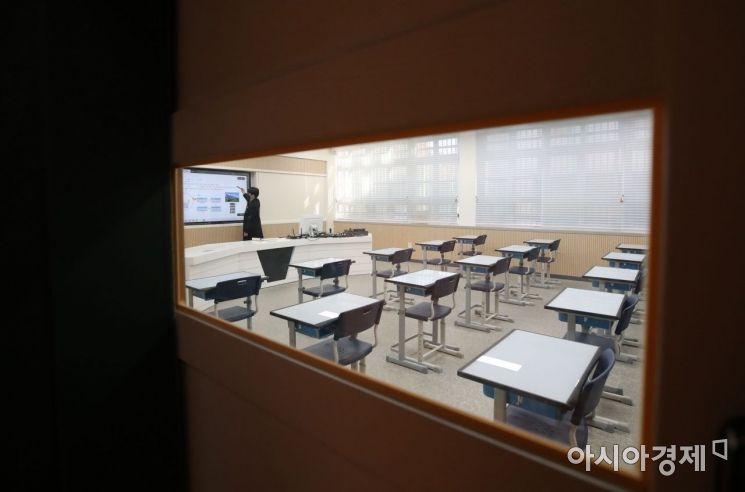 A teacher is conducting a remote class in a classroom of a high school in Seoul.
 Photo by Hyunmin Kim kimhyun81@
In particular, among Z generation teachers born after 1990 and still in their 20s, 8.9% currently have plans to change jobs, and 57.7% said they would like to change jobs if given the opportunity in the future. Only 33.7% of Z generation teachers responded that they expect to remain in teaching until retirement. Regarding reasons for considering a job change, "interference with educational activities" and "low wages" showed high response rates across all generations.
The research institute analyzed, "Young generations tend to have lower job satisfaction and perceptions of fairness in workload distribution and compensation, and higher intentions to leave their jobs," adding, "The phenomenon of their leaving schools may gradually increase in the future." In fact, the number of young teachers leaving the classroom is increasing. According to the office of Kwon Eun-hee, a member of the People Power Party, 589 national and public elementary, middle, and high school teachers with less than five years of service retired in the past year, about twice the 303 teachers who retired the previous year.
As young teachers' departures accelerate, various concerns are being raised in the field. Son said, "With the rapid application of technological capabilities such as EdTech and artificial intelligence in education, if young teachers who learn quickly leave, I think educational innovation may slow down."
There are also concerns that the increase in temporary teachers due to the rapid departure of regular teachers will weaken educational accountability. From the school's perspective, there is worry that stable supply of teachers, i.e., human infrastructure, could be undermined.
Ultimately, experts advise that improving work support and treatment should be prioritized to solve the problem. Professor Cho Sang-sik of Dongguk University's Department of Education said, "Although Korean teachers do not rank relatively low in treatment according to OECD indicators, in terms of actual quality, they are high-quality personnel," adding, "Social treatment should be improved, and human support such as reducing administrative tasks and implementing assistant teacher systems should be expanded."
© The Asia Business Daily(www.asiae.co.kr). All rights reserved.
![Clutching a Stolen Dior Bag, Saying "I Hate Being Poor but Real"... The Grotesque Con of a "Human Knockoff" [Slate]](https://cwcontent.asiae.co.kr/asiaresize/183/2026021902243444107_1771435474.jpg)















