Choi Sang-mok, Deputy Prime Minister for Economic Affairs and Minister of Strategy and Finance, diagnosed on the 2nd that "although the economic recovery trend is steadily continuing, it has not yet reached a recovery that can be felt." He also expressed concerns that although inflation in January fell to the 2% range, international oil prices have risen again to the $80 per barrel level, and inflation this month and next month could rise again to the 3% range.
On the same day, at the Emergency Economic Ministers' Meeting and Price-Related Ministers' Meeting held at the Government Seoul Office, Deputy Prime Minister Choi said, "While private consumption continues a gradual slowdown, there is a large temperature difference between sectors, such as the rapid appearance of sluggish construction investment, so it has not yet reached a 'recovery that can be felt.'"
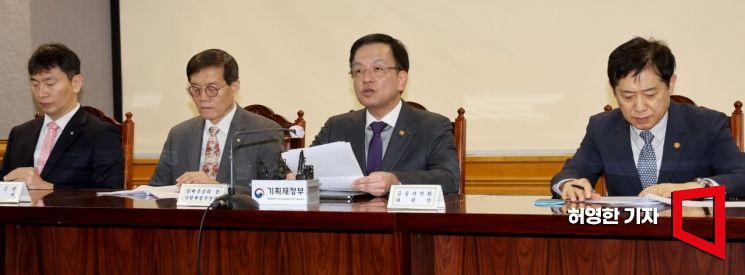 On the morning of the 1st, at the Emergency Macroeconomic and Financial Meeting held at the Bankers' Hall, Choi Sang-mok (third from the left), Deputy Prime Minister for Economic Affairs and Minister of Economy and Finance, is delivering opening remarks. From the left, Lee Bok-hyun, Governor of the Financial Supervisory Service; Lee Chang-yong, Governor of the Bank of Korea; Minister Choi; and Kim Ju-hyun, Chairman of the Financial Services Commission. Photo by Heo Young-han younghan@
Regarding inflation, he said, "Consumer prices in January recorded 2.8%, and core inflation, which is the trend inflation, also fell to 2.5%," adding, "however, due to recent instability in the Middle East and other factors, international oil prices have risen again to the $80 range, so inflation in February and March could rise again to around 3%," maintaining vigilance.
Deputy Prime Minister Choi emphasized, "The government will make every effort to ensure that inflation in the 2% range settles quickly and firmly," and "we will closely manage policies such as expanding the supply of essential goods and discount support to maintain the average price of 16 Lunar New Year essential goods lower than last year."
In particular, despite government measures, to stabilize prices of apples and pears, which are still higher than the previous year, an additional 10 billion won will be invested in the discount support budget for agricultural and livestock products. Deputy Prime Minister Choi said, "We will expand the contract cultivation volume of apples and pears by 8,000 tons to proactively prepare for future supply and demand instability," and "we will also focus inter-ministerial capabilities on stably managing service prices, which have many price adjustments at the beginning of the year."
The government will also begin full-scale reform of levies. Deputy Prime Minister Choi said, "We are preparing reform standards through a full survey of 91 levies currently underway and discussions with the public-private joint task force (TF), and after consultations with related ministries, we will announce specific levy reform measures by March at the latest," adding, "Along with these government efforts, we once again request the National Assembly to pass urgent livelihood bills in February."
He also emphasized solving livelihood tasks. Deputy Prime Minister Choi said, "We will start interest refunds for individual business owners totaling 1.5 trillion won within this month," and "We will proceed without delay with the opening of the Suseo-Dongtan section of the metropolitan express railroad (GTX)-A line in the metropolitan area by March and the groundbreaking of the B line, and prepare focused support plans for advanced strategic industrial complexes such as the semiconductor mega cluster."
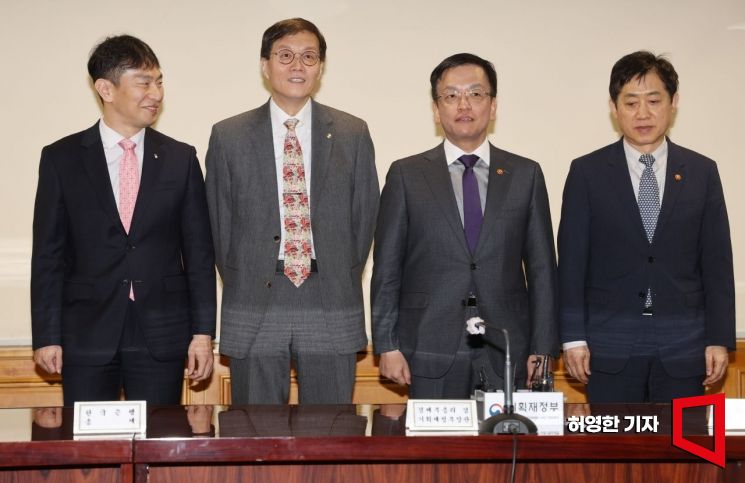 On the morning of the 1st, an emergency macroeconomic and financial meeting was held at the Bankers' Hall. From the left, Lee Bok-hyun, Governor of the Financial Supervisory Service, Lee Chang-yong, Governor of the Bank of Korea, Choi Sang-mok, Deputy Prime Minister and Minister of Economy and Finance, and Kim Ju-hyun, Chairman of the Financial Services Commission, posed briefly before the meeting. Photo by Heo Young-han younghan@
On the same day, the Ministry of Strategy and Finance, Ministry of Trade, Industry and Energy, and Ministry of Agriculture, Food and Rural Affairs reported the following agenda items to the Emergency Economic Ministers' Meeting: ▲ Improvement plans for public institutions' citizen-oriented services ▲ Field-centered regulatory innovation plans for the hydrogen industry ▲ Strategies to strengthen the global competitiveness of the Korean food industry.
Deputy Prime Minister Choi said, "We will increase the number of nighttime tours of palaces with high public demand, such as Gyeongbokgung and Changdeokgung, and expand the number of driver's license test centers operating on Saturdays from 11 to 15," adding, "we will expand the number of types of employment and industrial accident insurance documents provided via mobile from 10 to 24 to allow faster and simpler verification."
He continued, "To lead the hydrogen industry with great growth potential, we will improve five key regulations, including easing material and component standards for water electrolysis facilities and rationalizing distance regulations for hydrogen charging stations, and continue to strengthen consultations with the European Union (EU) to recognize carbon costs such as domestic emission allowance prices," adding, "we will establish a new 'Young Chef' program to train young chefs in collaboration with companies and create a 'K-Gourmet Belt' linked to K-tourism."
© The Asia Business Daily(www.asiae.co.kr). All rights reserved.
![Clutching a Stolen Dior Bag, Saying "I Hate Being Poor but Real"... The Grotesque Con of a "Human Knockoff" [Slate]](https://cwcontent.asiae.co.kr/asiaresize/183/2026021902243444107_1771435474.jpg)
















