Venice Biennale Korean Pavilion Construction Commemorative Work
220 Million Won Prepared for Maritime Transport Costs
Time and Costs Increase Due to Detours from War Impact
Air Transport Costs Triple, Special Discount Arranged with Korean Air
With the 30th anniversary of the Korea Pavilion at the Venice Biennale coming up next year, a major commemorative event is planned for this year. However, the Korea Arts & Culture Commission, which is organizing the event, has encountered a significant obstacle. The maritime transport route for the works of about 30 participating artists in the commemorative exhibition has been blocked.
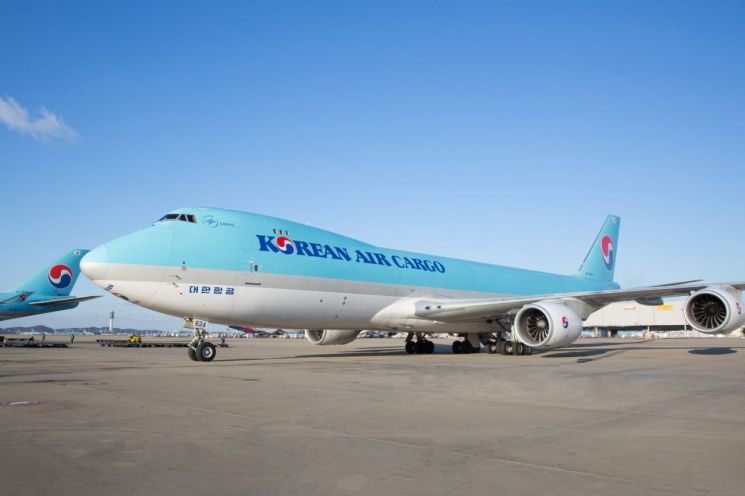 Korean Air B747-8F cargo aircraft used for air freight transport of artworks and other items.
 [Photo by Korean Air]
Typically, artworks exhibited at the Venice Biennale from Korea have been transported by ship via the Suez Canal. However, following the Gaza war triggered on October 7 last year, the pro-Iranian Shia Houthi rebels in Yemen attacked ships navigating near the Bab el-Mandeb Strait at the southern entrance to the Red Sea, which leads to the Suez Canal. As a result, shipping companies began avoiding this route and started using alternative detours.
The problem is that both the duration and cost have increased due to this. Initially, the Arts Commission planned to spend a total of 220 million KRW on transportation costs for the exhibition. However, air transport became inevitable to ensure the safe delivery of the artworks. The issue was that the cost would nearly triple. Fortunately, Korean Air agreed to apply a special discounted rate. Chairman Jeong Byeong-guk requested support, and Korean Air accepted it as part of their cultural and artistic support efforts.
The transportation of precious artworks traveling overseas for exhibitions of domestic artists or special exhibitions of famous foreign artists in Korea incurs costs comparable to business trips of CEOs of large corporations. Renowned artworks receive VIP-level treatment.
In 2021, for the exhibition commemorating the 140th anniversary of Pablo Picasso’s birth, the transportation of 110 of his works brought to Korea involved protection beyond that of VIPs and the application of special aviation technology. The transportation, conducted in four phases, included devices to minimize shocks, technology to maintain optimal temperature and humidity, and security systems to prepare for emergencies such as theft.
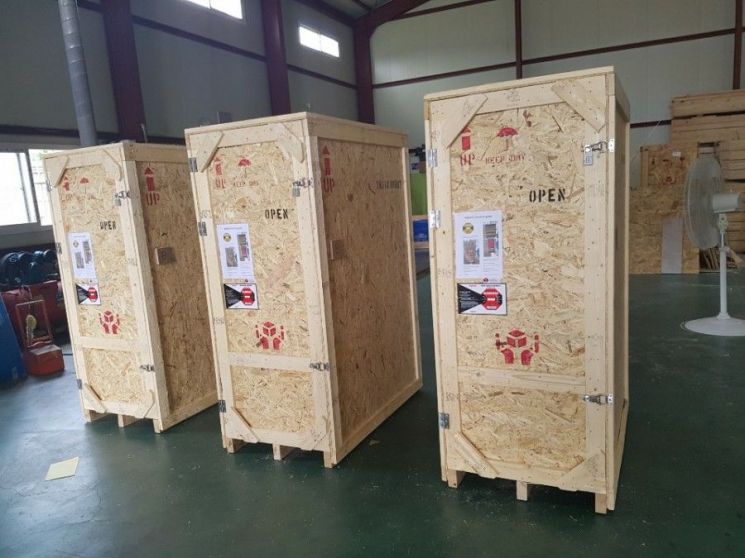 Artwork cargo packed in wooden crates for transportation. To prevent damage to the pieces, they are transported in boxes larger than the artwork itself, and recently, cases have occurred where nearly half of the artwork's price is paid as transportation fees.
 [Photo by Korea GLS]
Korean Air positioned the aircraft at the closest parking stand to minimize ground movement and reduce even minor shocks to the artworks. During transport to the airport, vibration-free vehicles equipped with temperature and humidity control were used to prevent deformation or impact. Armed security vehicles escorted these vibration-free vehicles. At the airport, the artworks underwent cargo security screening and were safely loaded into pallets or containers designed for air transport.
Once the artworks cleared customs and were loaded onto the aircraft, the details were directly communicated to the pilot. During the flight, cabin temperature and humidity were optimally controlled, and a curator accompanied the artworks to observe the transportation process firsthand, given the high value of the pieces. Additionally, cargo information between departure and arrival points was shared in real time using advanced IT technologies such as Google Workspace, leveraging the company’s accumulated expertise in cargo operations.
The transportation of Picasso’s works was a special case applying cutting-edge technology due to their economic value worth trillions of KRW. Recently, as global logistics costs have risen, the cost of air transport for artworks has increased, causing difficulties for general galleries and collectors. Some collectors have tried to reduce shipping costs by removing frames and rolling only the canvases with cushioning materials in tubes, but paper packaging often led to unavoidable damage, resulting in frequent problematic situations.
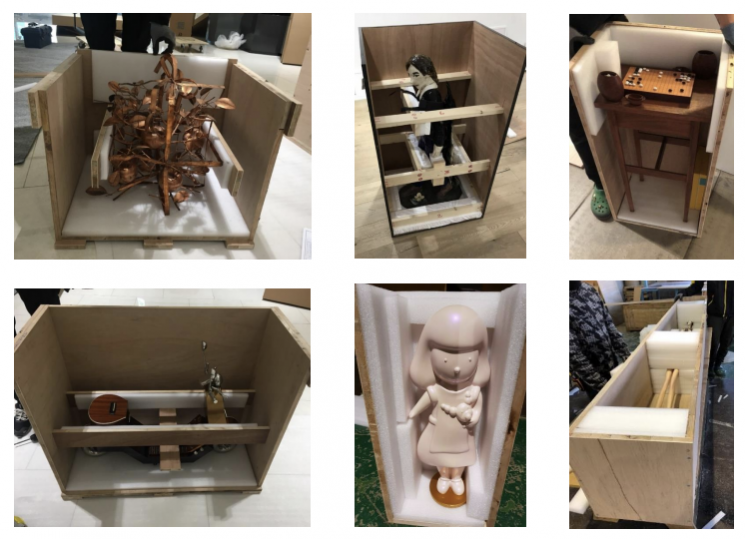
One collector said that when transporting a work purchased overseas, they packed it in a wooden crate to prevent damage, but a 2kg artwork ended up weighing 25kg due to the packaging. Given this situation, the collector explained that there are frequent cases where the artwork’s price is 10 million KRW, but the shipping cost alone is 4 million KRW.
Domestic transportation also follows similarly stringent procedures despite shorter distances. In the case of auctions where artworks are frequently traded, the artwork management team shadows the entire process from the moment the consignor hands over the piece, through the auction stage, to the final delivery to the buyer.
A representative from a domestic auction’s artwork management team explained that the first step usually involves wrapping the painting with tissue or acid-free paper, then packaging it again with ventilated corrugated cardboard before placing it in a wooden box to cushion shocks. Before the auction, light restoration work and frame replacement are also carried out. From the auction’s successful bid to delivery to the buyer, the same packaging method is used. Due to continuous variables such as exhibitions, especially for high-value works, a more thorough security process is applied.
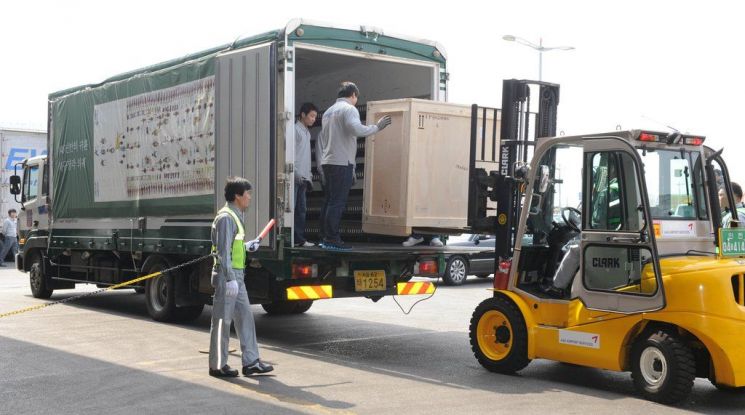 The first batch of 75 volumes of the Oegyujanggak books, which were looted by the French army that invaded Ganghwado Island in 1866 during the Byeonginyangyo incident and had been held at the National Library of Paris, returning to Korea and being loaded onto a vibration-free vehicle at the cargo terminal of Incheon International Airport.
 [Photo by Yonhap News]
Vibration-free vehicles are used for land transportation. Strictly speaking, these low-vibration transport vehicles are equipped with special suspension systems between the wheel axles and the cargo bed to minimize shocks from the road surface. While regular vehicles use coil springs or laminated steel plate suspensions, vibration-free vehicles use air suspension, which consists of rubber balloons resembling tires. This reduces the shocks felt inside the vehicle to about 30-55% of those in regular vehicles. Unlike regular vehicles that only absorb vertical shocks, vibration-free vehicles can also absorb some lateral shocks during cornering, and have been used for art transportation since the 1990s. Depending on the distance, transporting a 5-ton wing-body vibration-free vehicle within Seoul typically costs around 2 million KRW per trip.
Meanwhile, keeping pace with the growth of the art market and market trends, Incheon Airport, which has entered the art logistics business, plans to complete a storage facility optimized for artwork movement and storage by 2026. An Incheon Airport official explained, "The facility allows transportation to the aircraft with minimal distance, and Korea’s advanced storage construction capabilities have been highly evaluated. Even before opening, more than 50% of the storage space is already occupied by artworks."
© The Asia Business Daily(www.asiae.co.kr). All rights reserved.
![Clutching a Stolen Dior Bag, Saying "I Hate Being Poor but Real"... The Grotesque Con of a "Human Knockoff" [Slate]](https://cwcontent.asiae.co.kr/asiaresize/183/2026021902243444107_1771435474.jpg)

















