With 35 Political Parties... Manual Vote Counting Due to Inability to Use Voting Machines
Ballot Papers May Get Longer If Satellite Parties Proliferate Again
With 72 days remaining, there is a prospect that the ballot paper length for the upcoming April 10 general election could once again break the record for the longest length. This is due to the deadlock in the ruling and opposition parties' discussions on electoral reform.
The longest ballot paper in history was used in the 2020 21st general election for proportional representation voting, measuring a staggering 48.1 cm. This far exceeded the length of the ballot paper used in the previous 20th general election (33.5 cm, 21 parties). It was the first general election held after the introduction of the semi-proportional representation system, but the proliferation of satellite parties such as the Future Korea Party of the major parties and the Together Citizens' Party lengthened the ballot paper. The number of parties registered to elect proportional representatives reached 35. As a result, the existing ballot sorting machines, which could only handle up to 24 parties (34.9 cm), could not be used, leading to manual counting of ballots one by one.
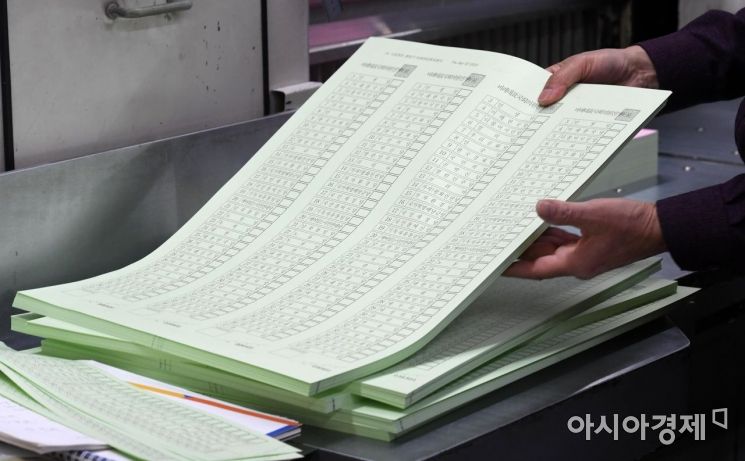 On the 6th, nine days before the 21st National Assembly election, ballot papers are being printed at a printing shop in Jung-gu, Seoul. Photo by Hyunmin Kim kimhyun81@
The Democratic Party is currently deliberating on the electoral system. Initially, they promised to maintain the semi-proportional representation system, but opinions have diverged with calls to revert to the parallel system. On the 29th, Democratic Party floor leader Hong Ik-pyo said on CBS Radio, "Both systems have their pros and cons," adding, "The leadership will soon decide between reverting to the parallel system and maintaining the semi-proportional system and gather opinions within the party." The party leadership is expected to reach a conclusion as early as this week.
The semi-proportional representation system was introduced to help smaller parties enter the National Assembly and secure political pluralism, but it has been criticized for deepening the two-party structure as the major parties created satellite parties. The Future Korea Party, a satellite party of the United Future Party (predecessor of the People Power Party), and the Together Citizens' Party, a satellite party of the Democratic Party, won 19 and 17 seats respectively. If the decision is made to maintain the semi-proportional representation system, it is highly likely that both major parties will create satellite parties again this time. In that case, the ballot paper could be even longer than the one used in the 21st general election.
The People Power Party has already started preparations to establish a satellite party, stating they will "respond to the Democratic Party's outrage." Although they advocate reverting to the parallel system, they plan to respond with satellite parties as in the previous election in case the current semi-proportional system is maintained. On the 19th, Han Dong-hoon, emergency committee chairman of the People Power Party, hinted at preparing a satellite party, saying, "If the Democratic Party intends to maintain this flawed system with the power of the majority, the People Power Party needs Plan B to form a parliamentary composition that reflects the will of the people."
Besides satellite parties, several new parties have already completed their formation. First, the 'Future Grand Alliance,' mainly composed of former Democratic Party lawmakers, and 'New Future,' led by former Democratic Party leader Lee Nak-yeon, have agreed to merge into the 'Reform Future Party' (tentative name). The 'Reform New Party,' led by former People Power Party leader Lee Jun-seok, and 'Hope of Korea,' led by Yang Hyang-ja, have also declared a merger. Additionally, Song Young-gil, former Democratic Party leader who was arrested and indicted over the party convention cash envelope scandal, declared from prison his intention to establish the 'Political Prosecution Dismantlement Party' (tentative name). There are also ongoing rumors about former Justice Minister Cho Kuk leading a new party formation through the policy think tank 'Reset Korea Action.'
© The Asia Business Daily(www.asiae.co.kr). All rights reserved.
![Clutching a Stolen Dior Bag, Saying "I Hate Being Poor but Real"... The Grotesque Con of a "Human Knockoff" [Slate]](https://cwcontent.asiae.co.kr/asiaresize/183/2026021902243444107_1771435474.jpg)
















