Conflict Over Subway Fare Evasion Issue
Lee Jun-seok "Should Replace with Prepaid Cards"
Kim Ho-il "Populism Could Lead to Waste"
 Former People Power Party leader Lee Jun-seok (current Reform New Party leader) is holding a press conference on leaving the party at a restaurant in Nowon-gu, Seoul on the 27th. Photo by Kang Jin-hyung aymsdream@
On the 26th, Lee Jun-seok, leader of the Reform New Party, and Kim Ho-il, president of the Korea Senior Citizens Association, appeared on a radio show and engaged in a heated debate over the pledge to abolish free subway rides for the elderly. The two sides clashed sharply over the causal relationship between free rides for seniors and subway deficits, as well as the effectiveness of the prepaid transportation card proposed by Lee.
On the 26th, Kim appeared on ‘CBS Kim Hyun-jung’s News Show’ and stated, “There is no correlation between the subway deficit and free rides for the elderly,” questioning, “Doesn’t the train operate regardless of whether passengers board or not?” He used an analogy, saying that if a household sets the temperature to 18 degrees Celsius, the electricity bill remains the same whether it’s just a couple or if five more guests come over. He added, “Similarly, when the subway runs from the starting point to the terminal, the electricity cost is the same whether people ride or not,” and argued, “The cause of the deficit should be found elsewhere.”
He claimed that the deficit caused by fare issues or mismanagement is being blamed on the elderly. On the other hand, Lee countered that various costs such as cleaning fees, operating expenses, and maintenance costs are proportional to the number of passengers. He explained, “Subway maintenance costs are diverse. Costs for cleaning restrooms, providing guidance, removing trash, and operating elevators and escalators are all proportional to the total number of passengers, regardless of whether they ride for free or pay.” He continued, “Subways in Seoul usually run with 10 cars. Divided into 10 compartments, each car weighs 20 tons, and if 200 people board, the passengers’ weight is nearly 12 tons. Therefore, the electricity cost during operation varies depending on the ratio of free riders.”
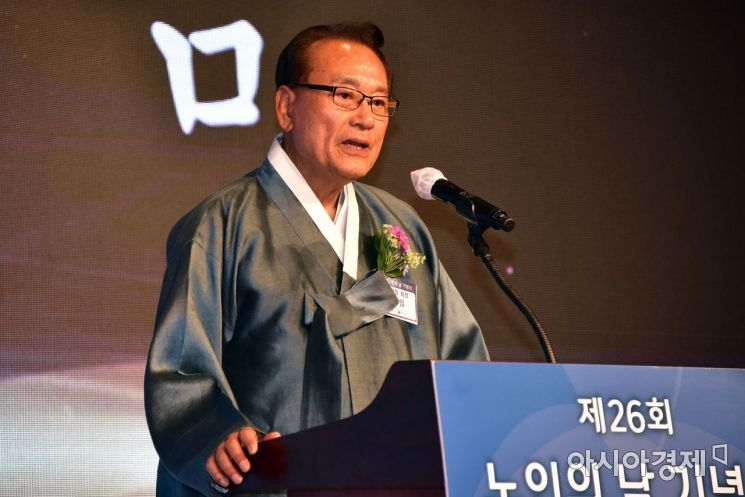 Kim Ho-il, President of the Korea Senior Citizens Association, is delivering a greeting at the 26th Senior Citizens Day ceremony held on the 30th at the Baekbeom Kim Koo Memorial Hall in Yongsan-gu, Seoul. Photo by Yoon Dong-joo doso7@
The two also clashed over the ‘120,000 won prepaid transportation card’ proposed by Lee as an alternative. Lee said, “Many of the transportation-disadvantaged live outside station areas,” and added, “(Since it can be provided to residents outside station areas) it will actually increase support.” In contrast, Kim said, “120,000 won equals 10,000 won per month, and with the average bus and subway fare at 1,400 to 1,500 won, a round trip costs about 3,000 won, so 10,000 won only allows about three outings per month,” adding, “That means staying home and being inactive, which could harm seniors’ health.”
He argued, “Because seniors use the subway, medical expenses are reduced by about 400 billion won annually, which benefits both seniors’ health and the nation,” and stated, “(Moreover) support should be given to those who intend to travel, but if money is given to those who use cars as well, it would be populism and waste.”
Earlier, on the 18th, the Reform New Party led by Lee announced a pledge to abolish the ‘free subway rides for those aged 65 and over’ system and switch to providing an annual 120,000 won prepaid transportation card usable on urban rail, buses, and taxis. Lee stated, “This system, modeled after the free ride policy for the elderly in the former Soviet Union, has now reached its end. The costs incurred from free rides remain as debt and are passed on to future generations.”
© The Asia Business Daily(www.asiae.co.kr). All rights reserved.
![Clutching a Stolen Dior Bag, Saying "I Hate Being Poor but Real"... The Grotesque Con of a "Human Knockoff" [Slate]](https://cwcontent.asiae.co.kr/asiaresize/183/2026021902243444107_1771435474.jpg)
















