508 Violation Cases Until January This Year
36 Prosecutor Indictments, 12 Court Sentences
"Reduction Difficult with Punishment- and Regulation-Focused Laws"
Since the enforcement of the Serious Accident Punishment Act, the number of violations has been increasing. There are calls for the courts and prosecutors to provide clear standards regarding the legal provisions.
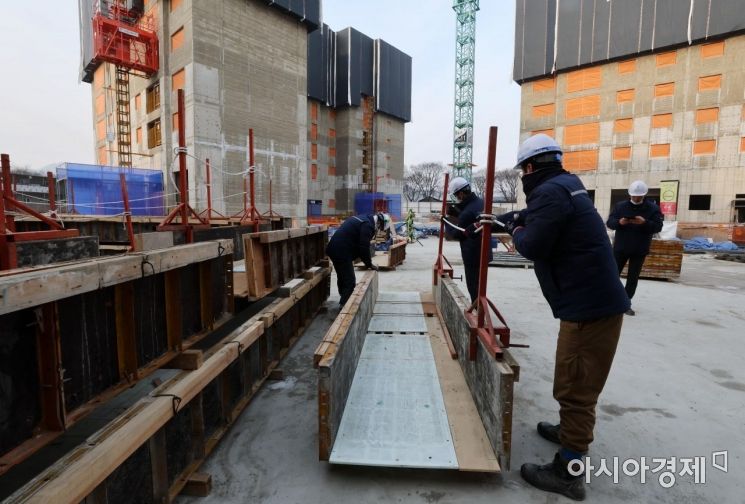 On the first day of the Serious Accidents Punishment Act enforcement, which allows for the punishment of management officials when serious accidents such as worker fatalities occur, managers are conducting a safety inspection at an apartment construction site in Gyeonggi-do on the 27th. Photo by Kim Hyun-min kimhyun81@
At the seminar titled "Two-Year Evaluation and Tasks of the Enforcement of the Serious Accident Punishment Act," co-hosted by the Korea Housing Association and the Korea Housing Construction Association on the 25th, Jin Hyun-il, a lawyer at Sejong Law Firm, pointed out, "The top priority is for prosecutors and courts to present clear interpretative standards for the provisions of the Serious Accident Punishment Act."
Since the enforcement of the Serious Accident Punishment Act, violation cases have actually increased. Companies feel anxious about being prosecuted and tried even after establishing safety and health management systems. From January last year to January 4 of this year, there have been a total of 508 violation cases of the Serious Accident Punishment Act. There were 244 cases in 2022, 261 cases in 2023, and 3 cases in 2024. Among these, 102 cases underwent prosecution investigation, 36 cases were indicted by prosecutors, and 12 cases received verdicts.
Analysis of court rulings shows that 9 rulings sentenced management officials to imprisonment from 6 months to 1 year, and 3 rulings sentenced imprisonment from 1 year and 2 months to less than 1 year and 6 months. The fines imposed on corporations were 20 million KRW in 2 cases, 30 million KRW in 2 cases, 50 million KRW in 4 cases, 70 million KRW in 1 case, 80 million KRW in 2 cases, and 100 million KRW in 1 case.
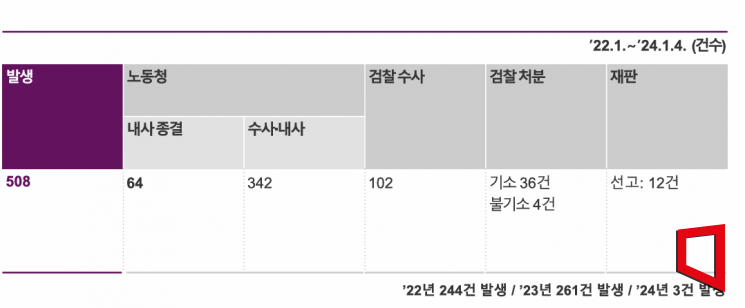
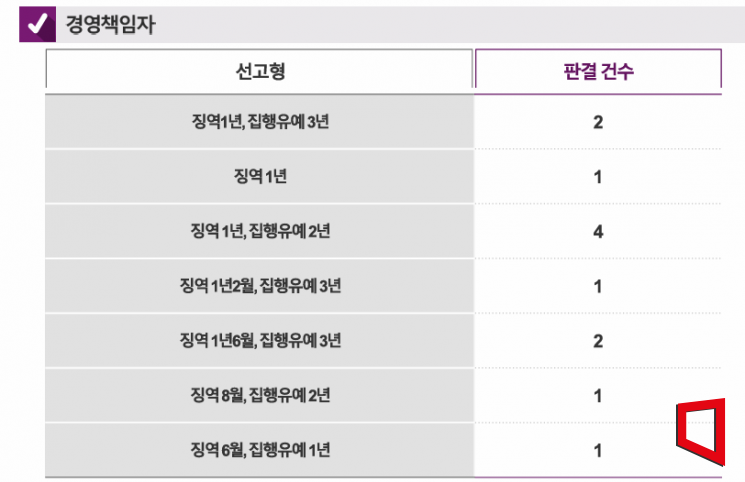 Status of Sentencing for Management Responsible under the Serious Accidents Punishment Act (Source: Law Firm Sejong)
Lawyer Jin explained, "As the sentencing standards for industrial accident cases have been raised, courts have generally handed down suspended prison sentences. The most important mitigating factor in the standards of courts and prosecutors is whether an agreement has been reached with the victim's side, so it is crucial to reach a settlement with the bereaved family before disposition. The degree of responsibility for the accident, prior similar offenses, and measures to prevent recurrence are also important sentencing factors."
Since rapid legislative amendments are difficult, Lawyer Jin emphasized the need for specific standards in prosecutorial dispositions and court rulings. These include whether the management official subject to punishment should be limited to the 'CEO,' the level of obligation to ensure safety and health, and the causal relationship and foreseeability between violation of the safety and health obligation and the serious accident.
The construction industry is also strengthening safety and health in response to these institutional changes but points out that punishment and regulation alone have limitations. Park Kwang-bae, director of the Construction Policy Research Institute, argued, "At the two-year mark since the law's enforcement, no direct impact or effect on reducing serious accidents has been observed."
He explained, "It has already been confirmed through foreign cases that it is difficult to drastically reduce serious accidents through punishment- and regulation-oriented laws, so it is necessary to explore approaches that can change the direction."
Director Park added, "There are many claims that the Serious Accident Punishment Act excessively deviates from the requirements that a law for preventing industrial accidents should have and that there may be constitutional issues. Even in the 'Ministry of Employment and Labor, Serious Accident Reduction Roadmap,' punishment and regulation are still being presented."
The Korea Housing Association stated, "In a situation where the construction market is deteriorating and PF funding is tightening, creating overlapping adverse conditions and heightening the sense of stagnation, expanding the enforcement of the Serious Accident Punishment Act with excessively high levels of punishment will impose a triple burden on the construction industry. We will strive to enhance the effectiveness of safety accident prevention and guide the construction industry toward the right policy direction through efforts to improve the system, including clarifying ambiguous interpretative standards."
© The Asia Business Daily(www.asiae.co.kr). All rights reserved.
![Clutching a Stolen Dior Bag, Saying "I Hate Being Poor but Real"... The Grotesque Con of a "Human Knockoff" [Slate]](https://cwcontent.asiae.co.kr/asiaresize/183/2026021902243444107_1771435474.jpg)

















