No Submission to Plenary Due to Ruling and Opposition Disagreement
Implementation of Law on 27th Unavoidable
Extraordinary Session Until 8th Next Month...Possibility of Further Ruling and Opposition Discussions
The bill to postpone the application of the Serious Accident Punishment Act (Serious Accident Act) to workplaces with fewer than 50 employees ultimately did not come up for a vote in the National Assembly plenary session on the 25th. Considering the disagreements between the ruling and opposition parties and the political schedule, the implementation of the Serious Accident Act for workplaces with fewer than 50 employees has now become inevitable. Although the possibility of retroactive legislation remains, the likelihood of the ruling and opposition parties reaching a dramatic agreement ahead of the general election is slim.
The National Assembly held a plenary session that day and processed 79 bills, but the bill to postpone the application of the Serious Accident Act to workplaces with fewer than 50 employees was not among them. The ruling and opposition parties blamed each other for the failure to pass the bill and engaged in a heated exchange.
Earlier, Hong Ik-pyo, the floor leader of the Democratic Party, said at the Democratic Party policy coordination meeting in the morning, "It seems unlikely that the Serious Accident Act will pass today," adding, "So far, neither the People Power Party nor the government side has responded to any of the conditions I mentioned." Hong said, "There has been no proper apology from the government side for the lack of preparation over the past two years, and when we asked for specific measures and budget allocations for the two-year postponement period, nothing was brought forward," adding, "If confusion arises at the site due to the implementation of the Serious Accident Punishment Act, the government and ruling party, who refused even our party's request to prepare and create at least a safety net, must take full responsibility."
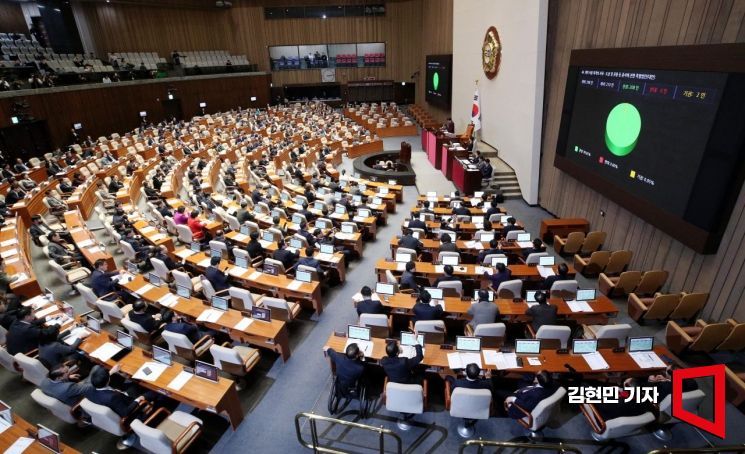 On the 9th, the National Assembly plenary session passed the "Special Act on the Termination of Breeding, Slaughter, and Distribution of Dogs for Food Purposes." Photo by Hyunmin Kim kimhyun81@
Yoon Jae-ok, floor leader of the People Power Party, criticized the Democratic Party at the Emergency Response Committee meeting, saying they were being obstinate despite their demands being met. Yoon said, "The ruling party and government announced concrete plans for tasks needed at the workplace, including direct financial investment of 1.2 trillion won, training of related professionals, and support for safety equipment and facilities, which both labor and management have requested, and the small and medium-sized business sector promised not to request additional postponement," adding, "However, the Democratic Party immediately added the establishment of the Industrial Safety and Health Agency as an additional condition after the ruling party and government's measures were announced." Yoon warned, "The Democratic Party's insistence on establishing the Industrial Safety Agency until the end can only be seen as a sign that they never intended to accept the postponement plan. If the law is expanded, the risk of large-scale business closures and mass unemployment cannot be ruled out, and in that case, our political circles will be blamed by the public as the main culprits of the livelihood collapse."
Although the ruling and opposition parties heatedly debated responsibility, the possibility of negotiation remains. In fact, during the plenary session, the Speaker of the National Assembly and the floor leaders of both parties were seen having additional discussions, showing a busy scene. The National Assembly also extended the session of the January extraordinary session until the 8th of next month. It is possible to hold additional plenary sessions and pass retroactive legislation based on an agreement between the ruling and opposition parties.
The issue lies in the will of both parties. Both sides are sensitive to how this issue will affect voter sentiment in this year's general election. Despite opposition from labor groups and within the party, Floor Leader Hong and the Democratic Party leadership have kept the possibility of negotiating the Serious Accident Act open, fearing backlash from small and medium-sized enterprises and small business owners. However, from the opposition party's perspective, they need to gain justification somehow on the issue of the Industrial Safety Agency, which the government and ruling party have shown reluctance to accept. The ruling party is likely to emphasize the opposition party's responsibility. This is because the fact that neighborhood restaurants and bakeries are also subject to the Serious Accident Act has become known, causing great concern not only among small and medium-sized enterprises but also among small self-employed business owners. However, as the ruling party, there is also a significant burden in not being able to ignore the confusion in the industrial sector by focusing solely on a blame game.
© The Asia Business Daily(www.asiae.co.kr). All rights reserved.
![Clutching a Stolen Dior Bag, Saying "I Hate Being Poor but Real"... The Grotesque Con of a "Human Knockoff" [Slate]](https://cwcontent.asiae.co.kr/asiaresize/183/2026021902243444107_1771435474.jpg)















