Sake Import Value Surpasses $20 Million for the First Time
Beer Imports Up 283%... Regains No.1 Position in 5 Years
Japanese Alcohol Targets Korean Market with Differentiation and Scarcity Strategies
The Japanese wave is blowing strongly in the domestic liquor market. Last year, Japanese whiskey and sake set new records for imports, and Japanese beer, which had once disappeared due to the boycott movement 'No Japan,' recently reclaimed the top spot among imported beers, returning to the top. As Japanese liquors, which faced extinction in the domestic market, open a new renaissance, it is expected that Japanese liquor companies' attacks on the domestic market will intensify this year.

According to export-import trade statistics from the Korea Customs Service on the 23rd, last year, the import value of Japanese sake (cheongju) in Korea was $21.38 million (about 29 billion KRW), a 12.6% increase from the previous year ($18.99 million), marking the highest amount since related statistics began in 2000.
The import value of Japanese sake has maintained an annual level of around $10 million for more than 10 years since 2010, but last year exceeded $20 million for the first time ever. The import volume also increased by 10.7% from the previous year (3,882 tons) to 4,298 tons, the highest since before the No Japan movement in 2018 (5,444 tons). The popularization of Japanese-style izakayas has increased demand for mid- to low-priced sake, especially in dining establishments, leading to the rise in sake imports.
Individual overseas direct purchases (direct imports) of sake also increased significantly. According to the overseas direct purchase platform Malltail, while Japanese direct purchase sales increased by 17% compared to 2022, sake sales surged by 712%. Along with famous products such as 'Dassai' and 'Kubota,' local traditional liquors with regional characteristics gained popularity, and it appears that enthusiasts mainly purchased high-priced sake through direct imports. The continued weakness of the Japanese yen since last year also influenced the increase in direct purchase demand.

A more dramatic change appeared in beer. Last year, the import value of Japanese beer was $55.52 million (about 74 billion KRW), a 283.3% increase from the previous year ($14.48 million). With the import value nearly quadrupling in one year, Japanese beer reclaimed the top spot among imported beers for the first time in five years since 2018, before the boycott movement. Japanese beer was one of the items most affected by the boycott, and in 2020, when the boycott peaked, it virtually disappeared from convenience stores and supermarkets. However, it began to rebound in earnest from 2022, recovering to about 70% of the pre-boycott level last year.
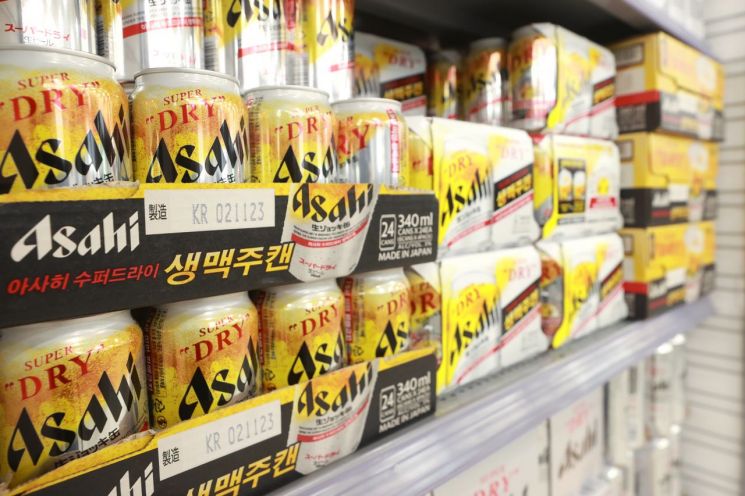
The rise was led by Asahi. The 'Asahi Super Dry Draft Beer Can,' known as the 'King Cap Beer' because the entire can lid opens and foam rises like draft beer, caused a sold-out frenzy after Lotte Asahi Liquor officially launched it in Korea in May last year, leading the revival of Japanese beer. As Japanese beer rebounded, Lotte Asahi Liquor, which recorded an operating loss of 19.8 billion KRW in 2019, turned a profit with an operating income of 3.5 billion KRW in 2022, and significant performance improvement is expected again this year. Lotte Asahi Liquor plans to continue the momentum by launching 'Asahi Shokusai,' a successor product to the Asahi draft beer can, in March.
Along with sake, whiskey imports also set record highs, proving that Japanese liquors are the trend. Last year, the import value of Japanese whiskey was $7.99 million (about 1.1 billion KRW), a 92.5% increase from the previous year ($4.15 million), representing an eightfold growth in five years since it first exceeded $1 million in 2018. The import volume also increased by 68.3% to 897 tons compared to 533 tons in 2022.
The growth was driven by mid- to low-priced, low-alcohol highball products that expanded overall volume, including Suntory's 'Gakubin,' which ranked first in whiskey sales in major distribution channels. High-alcohol single malt products such as 'Yamazaki' also gained popularity by emphasizing their rarity, stimulating thirst for Japanese whiskey. Currently, high-alcohol Japanese whiskey is in short supply even locally, and due to the nature of whiskey requiring long aging periods, the recent high demand was difficult to predict in the past, leading to the current supply-demand imbalance.
The strength of Japanese liquors is expected to continue this year. The boycott against Japanese products has effectively ended, and as the domestic liquor market gradually enters maturity, domestic consumers' demand for various types of alcohol is steadily increasing. As a result, there are voices in the industry that the new product offensives of major Japanese liquor companies may intensify this year. However, some express skepticism about sustained growth despite the highball's popularity lasting longer than initially expected, and suggest that companies may maintain a conservative strategy by adjusting import timing to avoid cannibalization effects.
An industry insider said, "Major companies such as Asahi, Suntory, Kirin, and Sapporo have many competitive RTD (Ready to Drink) liquor products like 'Sawa' and 'Chuhai,' which are well suited for distribution mainly in convenience stores and supermarkets, in addition to their well-known beers," adding, "Since highballs have succeeded and generated results in the domestic market, attempts to expand into other liquor categories are likely to continue."
© The Asia Business Daily(www.asiae.co.kr). All rights reserved.
![Clutching a Stolen Dior Bag, Saying "I Hate Being Poor but Real"... The Grotesque Con of a "Human Knockoff" [Slate]](https://cwcontent.asiae.co.kr/asiaresize/183/2026021902243444107_1771435474.jpg)


















