Japanese Stock Market Ranks High in Gains Among Major Countries
Ilhak Gaemi's Net Stock Purchases Surge Significantly
Yen-Denominated US Treasury Investment ETFs Gain Popularity
As the domestic stock market has shown sluggish performance this year, investors' interest in the Japanese stock market, which continues to show strength, is growing. The net purchase volume of Japanese stocks by 'Ilhak Gaemi' investors investing in the Japanese stock market has increased significantly this year, and Japanese-related exchange-traded funds (ETFs) are also being bought in the domestic stock market.

According to the Korea Securities Depository on the 22nd, domestic investors have net purchased Japanese stocks worth 59.2 billion KRW as of the 17th of this year. This figure represents an increase of more than 500% compared to the total net purchase volume of 9.8 billion KRW in January last year. The amount of Japanese stock holdings also increased significantly, reaching 3.78548 billion USD (approximately 5.0687 trillion KRW) as of the 16th, compared to 2.84399 billion USD (approximately 3.8081 trillion KRW) in January last year.
By individual stocks, the 'iShares 20+ Year US Treasury Bond JPY Hedged ETF' investing in US bonds denominated in yen was the most purchased, with a net purchase of 31.7 million USD. It was followed by the 'iShares Core 7-10 Year US Treasury Bond JPY Hedged ETF' with 2.74 million USD. Excluding ETFs, semiconductor-related stocks were heavily bought. Semiconductor-related stocks such as Tokyo Electron, Lasertec, and Advantest ranked high in net purchases.
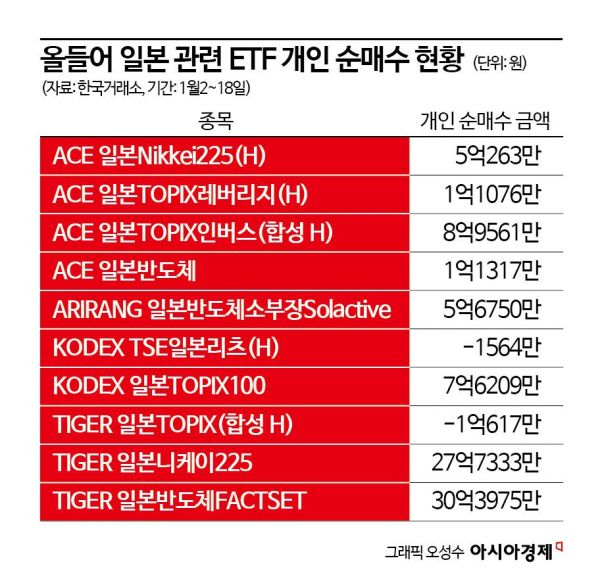
Japanese-related ETFs are also being purchased domestically. According to the Korea Exchange, individuals have net purchased 3.03975 billion KRW of TIGER Japan Semiconductor FACTSET and 2.77333 billion KRW of TIGER Japan Nikkei 225 as of the 18th of this year. Additionally, 110.76 million KRW worth of ACE Japan TOPIX Leverage (H) was purchased. During this period, ACE Japan TOPIX Leverage (H) recorded a return of 12.82%, making it the only leveraged ETF included in the top 10 in terms of returns. Due to the recent market downturn, inverse ETFs occupy most of the top returns. Besides, ARIRANG Japan Semiconductor Materials Solactive was net purchased for 567.5 million KRW, ACE Japan Semiconductor for 113.17 million KRW, and ACE Japan Semiconductor for 113.17 million KRW respectively. As the Japanese stock market has risen significantly, anticipating a decline, ACE Japan TOPIX Inverse (Synthetic H) was also purchased for 895.61 million KRW.
The Japanese stock market has continued its strength this year, ranking among the top in terms of growth rate among major countries' stock markets. The Nikkei 225 index has risen about 6% this year. The background of the Japanese stock market's strength includes policy factors and exchange rates. Bo-won Choi, a researcher at Korea Investment & Securities, explained, "The main reasons for the strength of the Japanese stock market are threefold: the new Nippon Individual Savings Account (NISA) system, the synchronization trend with US IT companies, and the slowdown in the depreciation of the yen against the dollar due to the earthquake." He added, "The new NISA policy, applied since early January, strengthened the tax exemption system, leading to an inflow of funds for long-term investment, and dividend stocks, which had been neglected, rebounded."
Good earnings by Japanese companies also contributed to the stock market's upward trend. Jeong-yeon Lee, a researcher at Meritz Securities, analyzed, "Japan continues to show a distinctive upward momentum in earnings compared to global countries. While a slowdown in earnings momentum has appeared globally, including in the US and Korea since the end of last year, Japan's earnings forecasts for 2024 and 2025 have been revised upward, resulting in a continued rise in the 12-month forward earnings per share (EPS) since the second half of last year."
However, as the Japanese stock market has continued its upward trend, there are forecasts that the short-term rise may slow down. Researcher Choi said, "Although the Nikkei index still has room to rise this year, the short-term upward trend is expected to slow down, and caution is needed as a temporary pullback may occur ahead of the Shunto (joint wage negotiation struggle by Japanese labor unions) period in March and April."
© The Asia Business Daily(www.asiae.co.kr). All rights reserved.
![Clutching a Stolen Dior Bag, Saying "I Hate Being Poor but Real"... The Grotesque Con of a "Human Knockoff" [Slate]](https://cwcontent.asiae.co.kr/asiaresize/183/2026021902243444107_1771435474.jpg)
















