The Gyeongbuk Provincial Council (Chairman Bae Han-cheol) announced the achievements of its legislative activities in 2023 and the direction of legislative operations for 2024 on the 18th.
One year ago, Chairman Bae Han-cheol stated the 2023 legislative operation direction as “Focusing legislative capabilities on creating a new local era through a great transformation of Gyeongbuk by preparing future food sources.”
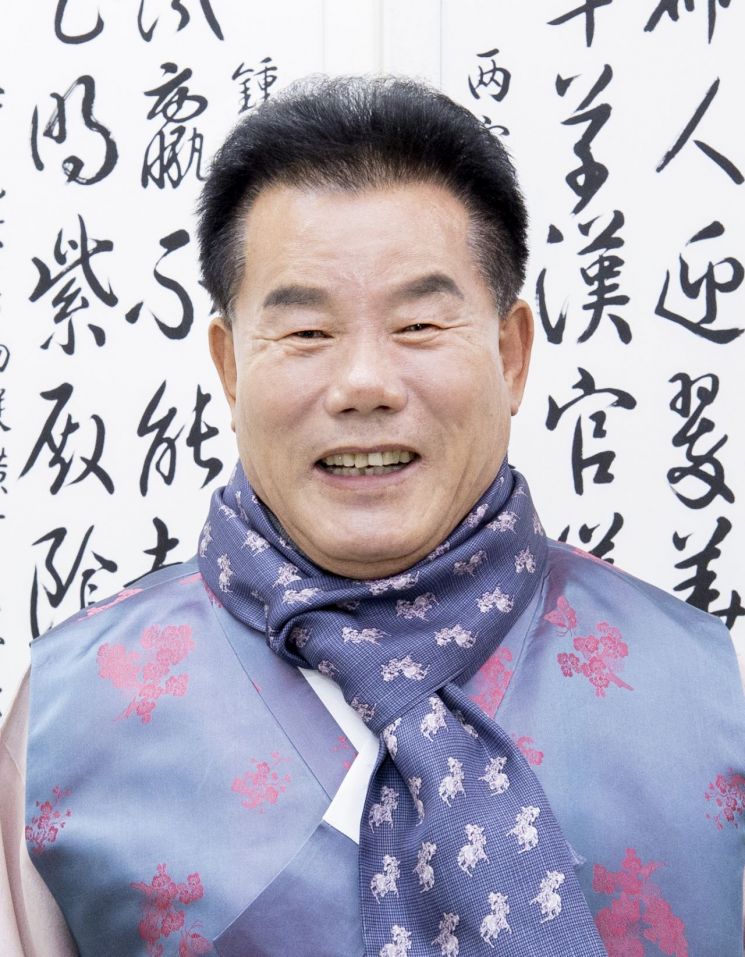
Over the past year, the Gyeongbuk Provincial Council reduced unproductive conflicts with the executive branch and worked with Gyeongbuk Province and the Gyeongbuk Office of Education to establish a foundation for job creation in future industries such as secondary batteries, semiconductors, SMR, nuclear hydrogen, and bio industries. It also focused on responding to local extinction through comprehensive innovation in the livelihood economy, social welfare, administration, agriculture and fisheries, and education. Notably, the Gyeongbuk Provincial Council was the only metropolitan council to receive a first-grade rating in the 2023 Local Council Integrity Evaluation conducted by the Anti-Corruption and Civil Rights Commission, earning praise for building the trust of residents, the foundation of the local era, and fulfilling its promises to the residents.
Regarding the legislative operation direction for 2024, Chairman Bae Han-cheol said he would devote legislative capabilities to creating “a Gyeongbuk where residents can dispel anxiety about the future and have a secure future” together with the residents.
The biggest regional issue in 2023 was the selection of the National Advanced Strategic Industry Specialized Complex. The specialized complex was evaluated as the greatest opportunity given to local areas since the first public institution relocation in 2007, when 153 public institutions moved their bases.
To gain an advantage in future food source industries, local governments nationwide applied for 21 candidate sites, and the Pohang Secondary Battery and Gumi Semiconductor Specialized Complexes were finally selected.
In this process, since 2022, the Gyeongbuk Provincial Council persistently demanded that all administrative power be concentrated by cooperating with related organizations such as local governments, companies, and research institutes through administrative audits, five-minute free speeches, and budget reviews to attract the specialized complexes.
Also, during the selection process of three national industrial complexes (Gyeongju SMR, Uljin Nuclear Hydrogen, Andong Bio), not only local assembly members but the entire provincial council raised their voices to make them models of balanced development.
Once the specialized complexes and national industrial complexes were selected, the council immediately turned its attention to the next steps. It enacted ordinances supporting the semiconductor and secondary battery industries and significantly expanded the scope of subsidies available to companies investing in these sectors.
The Planning and Economy Committee of the Gyeongbuk Provincial Council (Chairman Lee Chun-woo) laid the foundation for innovative growth and regional economic development through fostering the artificial intelligence industry, establishing a regional problem-solving platform, promoting digital transformation and virtual convergence economy, reducing local taxes in special disaster areas, promoting ESG management in public institutions, and fostering the data industry.
The Administration, Health, and Welfare Committee (Chairman Choi Tae-rim) enhanced administrative efficiency through the consolidation and efficient operation of affiliated institutions, improved the execution rate of funds responding to local extinction, urged the establishment of medical schools within the province, supported public rehabilitation hospitals and medically vulnerable areas, provided support for multi-child families, and created child-friendly cities to prevent medical service gaps in vulnerable areas and eliminate welfare blind spots.
The Culture and Environment Committee (Chairman Kim Dae-il) proposed cultural policies harmonized with the environment, including post-support for UNESCO World Heritage sites, preservation of modern and contemporary cultural heritage, fostering campgrounds, developing East Coast content, chemical substance safety management, disposal of banned pesticides, and promotion of food waste recycling.
The Agriculture, Fisheries, and Livestock Committee (Chairman Nam Young-sook) introduced policies to make rural areas less burdensome and more profitable through increasing agricultural disaster recovery funds, disclosing seafood safety inspection results via mobile apps, mechanization of agriculture, and securing foreign seasonal workers.
The Construction and Fire Safety Committee (Chairman Park Seung-jik) focused on creating a safe and convenient living environment by improving accessibility to Daegu-Gyeongbuk New Airport, implementing river disaster prevention projects and facility installations, managing disaster relief funds, improving residential environments, promoting region-centered balanced development, ensuring safety management of roads and tunnels, and strengthening digital disaster support, thereby laying the foundation for economic revitalization.
The Education Committee (Chairman Yoon Seung-oh) made local education a driving force for regional development by enhancing the efficiency of the Office of Education’s financial management, improving basic academic skills, reducing education and care gaps, protecting victims of school violence, restoring the educational community, specializing rural high schools, providing financial support for alternative schools, supporting education expenses for multi-child students, and installing school complex facilities.
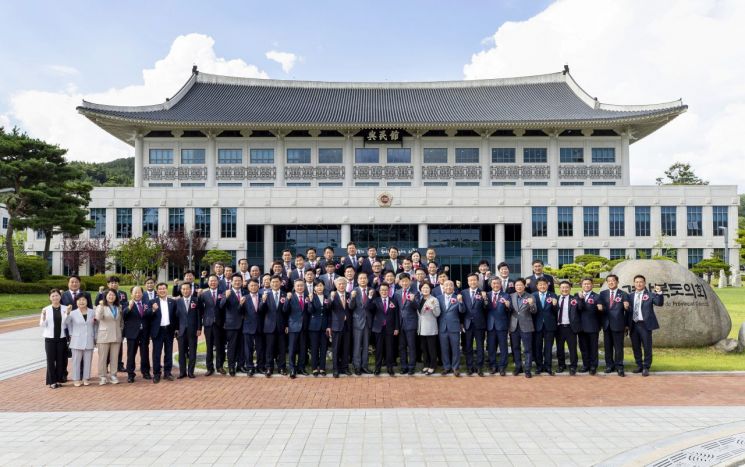 Sixty members of the Gyeongbuk Provincial Council are gathered in one place for a commemorative photo.
Over the past year, 76% of the 203 ordinances, totaling 156, were initiated by council members, demonstrating a commitment to the role of a representative body by leading the enhancement of residents’ rights and the improvement of unreasonable systems.
Additionally, to propose practical alternatives, the council held policy seminars on rural youth, infertility support, integrated care, medical services for children in small and medium-sized cities, labor, and tourism revitalization, creating policy alternatives together with policy beneficiaries and experts.
To realize an open council centered on communication with residents, the council actively communicated through Facebook, Instagram, and YouTube, and produced council newsletters to allow residents easy access to vivid council news.
Bae Han-cheol, Chairman of the Gyeongbuk Provincial Council, has led legislative activities with the belief that “a proper local era starts with a capable and honest local government. Only an honest local government can guarantee policy acceptance and efficiency based on high resident trust.”
In the 2023 comprehensive integrity evaluation of local councils conducted by the Anti-Corruption and Civil Rights Commission, the Gyeongbuk Provincial Council was the only metropolitan council to receive a first-grade rating. Including basic councils, only four received first-grade ratings.
The Gyeongbuk Provincial Council views 2024 as a turning point determining the success of the local era and plans to run together with residents to recover the economy of ordinary citizens and the regional economy. It also intends to align with Gyeongbuk Province to significantly transfer central government authority to local governments and implement policies suited to local conditions, concentrating capabilities on balanced development and creating a local area free from survival worries.
In particular, the council will secure the expertise of its members to become a productive council that proposes reasonable policy alternatives for the successful promotion and resolution of urgent regional projects such as the designation of four major special zones including opportunity development zones, construction of Daegu-Gyeongbuk New Airport, and efficient allocation of reduced resources.
Chairman Bae Han-cheol said, “True leadership is demonstrated when trust is earned from residents through communication,” and added, “To create a Gyeongbuk where the economy recovers and ordinary citizens can smile brightly, we will create various channels both inside and outside the council to develop policies that resonate with residents.”
© The Asia Business Daily(www.asiae.co.kr). All rights reserved.
![Clutching a Stolen Dior Bag, Saying "I Hate Being Poor but Real"... The Grotesque Con of a "Human Knockoff" [Slate]](https://cwcontent.asiae.co.kr/asiaresize/183/2026021902243444107_1771435474.jpg)
















