Hyundai Motor and Kia Separate R&D Organizations into SW and HW
Integrate Dispersed SW Personnel within Group... Establish AVP Headquarters
Vehicle HW Development Assigned to Separate R&D Headquarters
Dual Leadership with Song Chang-hyun and Yang Hee-won Leading Each Headquarters
Chairman Chung Eui-sun Orders Accelerated SDV Development
Hyundai Motor Company and Kia have established their research and development (R&D) organizations into a two-pronged system focusing on software (SW) and hardware (HW), accelerating the development speed of software-defined vehicles (SDV). They plan to shift their vehicle development system to be software-centric, similar to Tesla. This means that software will be updated separately on top of the proprietary vehicle models (HW), allowing consumers to enjoy the effect of always driving a new car without changing the vehicle hardware.
According to Hyundai Motor Company, Kia, and related industries on the 17th, the company reportedly instructed employees to speed up development while explaining the R&D organizational restructuring plan to executives and staff the day before. On this day, Hyundai Motor Company and Kia decided to consolidate SW development personnel within the group into the AVP (Advanced Vehicle Platform) headquarters, and create a separate R&D headquarters for the HW sector, appointing President Song Chang-hyun and Vice President Yang Hee-won as heads of these respective headquarters.
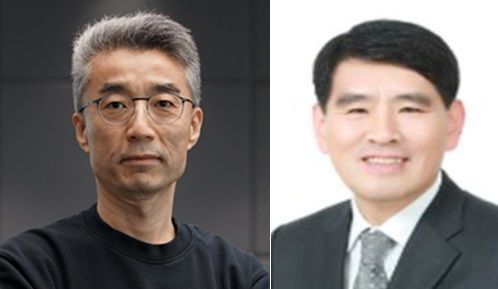 Song Chang-hyun, CEO of 42dot and Head of Hyundai Motor AVP Division (President, left), Yang Hee-won, Head of Hyundai Motor R&D Division (Vice President)
 [Photo by Hyundai Motor Group]
This aligns with Hyundai Motor Group Chairman Chung Eui-sun’s intention to accelerate the transition to SDV across the entire company. Chairman Chung recently expressed his concerns about the SDV transition with direct remarks such as "it's late, and there is a long way to go."
The company expects that the R&D organizational restructuring will speed up development and verification processes. Currently, hardware is developed first, followed by software integration, but in SDV, these tasks proceed simultaneously. This approach is believed to enhance vehicle compatibility and safety. This direction is part of Hyundai Motor Group’s ‘Chip to Factory’ strategy, which covers everything from semiconductors to mass production of finished vehicles.
Previously, Hyundai Motor Group declared the transition to SDV for all vehicle models by 2025. However, the plan revealed by President Song at the world’s largest electronics and IT exhibition CES is to deploy the SDV platform in 2025 and apply it to mass-produced vehicles in 2026. From the consumer’s perspective, this means the SDV transition plan has been delayed by about a year.
In response, Chairman Chung issued a special order to maximize the speed of SDV development. At this CES as well, Chairman Chung is known to have unofficially met with CEOs of several software development companies. Publicly, he showed great interest in the SDV transition by visiting booths of software and semiconductor companies such as Mobileye and Qualcomm.
Ultimately, this restructuring appears to be the result of Chairman Chung’s concerns to accelerate the SDV transition. With all software personnel in the group placed under President Song’s supervision, his leadership is also being put to the test. President Song has long argued that software and hardware development must be separated to speed up SDV development. At the recent CES, he unveiled an AI machine-based vehicle OS and announced plans to strengthen SDV utilization in fleet businesses (corporate, rental, and used car bulk sales).
In a meeting with reporters, President Song expressed confidence in the SDV transition. He said, "Hyundai Motor Company is now at the stage of starting the SDV transition, but we can increase the speed very quickly," adding, "The market is well aware of SDV, and the direction on how to proceed has already been established internally." He further stated, "The most important thing is to hire good tech engineers, and we also plan to actively utilize partner companies."
President Song has consistently emphasized the importance of securing excellent software talent. When meeting reporters at the ‘HMG Developer Conference’ held last November, he stressed that the core task for the SDV transition is "talent." The HMG Developer Conference was a kind of recruitment briefing session prepared to secure outstanding IT developers in Korea. Recently, 42dot, a company, established overseas bases in Silicon Valley, USA, and Warsaw, Poland, also as part of efforts to secure excellent overseas talent.
According to the Korea Automotive Technology Institute, the domestic mobility software workforce is around 10,000. In contrast, the United States, which is leading SDV development, is estimated to have more than 30,000 mobility software personnel. As the SDV era transition begins in earnest, the global competition among automakers to secure software talent is intensifying. Automakers such as Volkswagen, Toyota, and General Motors (GM) are increasing recruitment of software-related talent by establishing software subsidiaries, even amid company-wide workforce reductions.
© The Asia Business Daily(www.asiae.co.kr). All rights reserved.
![Clutching a Stolen Dior Bag, Saying "I Hate Being Poor but Real"... The Grotesque Con of a "Human Knockoff" [Slate]](https://cwcontent.asiae.co.kr/asiaresize/183/2026021902243444107_1771435474.jpg)
















