Rose Prices Up 118% Compared to 3 Years Ago, Carnations and Lilies Also Rising
Large Middlemen Acquire Auction Rights with High-Priced 'Descending Auction' Method
Most Supplies Swept Up and Resold to Retailers at Higher Prices
A office worker A (46), residing in Gwacheon-si, Gyeonggi Province, was recently surprised when visiting a local flower shop ahead of their elementary school child's graduation ceremony.
They picked three roses, three carnations, and some baby's breath to make a modest bouquet, but the total came to 67,000 won. A said, "I usually don't buy flowers except for special occasions, so I didn't know the market price, but I was shocked at how much flower prices have risen." They added, "I arranged the bouquet just enough so it wouldn't look sparse, but it still cost nearly 70,000 won, so buying flowers will be a burden going forward."
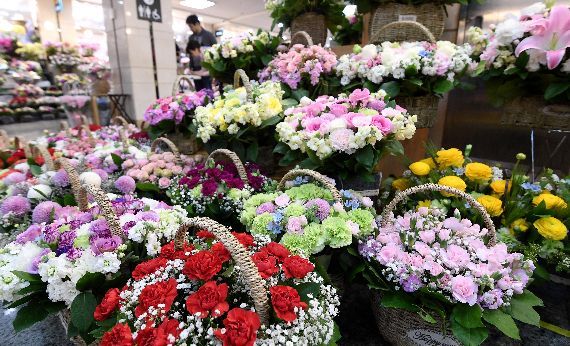 Flower baskets are displayed at a flower shop in Banpo Underground Shopping Center, Seocho-gu, Seoul.
 [Photo by Kim Hyun-min]
January is a peak season for flower shops nationwide due to graduation ceremonies, but both consumers and merchants are distressed by soaring flower prices. Consumers complain that prices have risen excessively and accuse merchants of overcharging. On the other hand, merchants argue that due to the distribution structure of the domestic flower market, abnormal weather, and decreased shipments, wholesale prices have risen significantly, leaving them no choice.
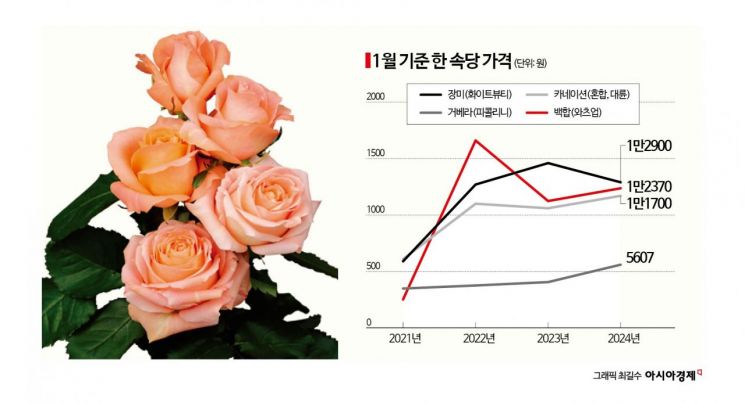
According to the 'Floriculture Distribution Information' from the Korea Agro-Fisheries & Food Trade Corporation (aT) on the 17th, the average winning bid price for a bundle of roses (White Beauty) traded at the Yangjae Flower Auction Market this month was 12,900 won, a 118% increase compared to 5,900 won in 2021, three years ago.
During the same period, another variety mainly used in bouquets, carnations (mixed, large-flowered), rose from 6,100 won to 11,700 won, a 92% increase. Additionally, prices for other commonly used decorative flowers such as lilies (389.1%), irises (105.1%), and gerberas (60.9%) also rose sharply, showing an upward trend across all varieties.
An official from the Ministry of Agriculture, Food and Rural Affairs stated, "December and January, when graduation ceremonies cluster, are periods when flower prices temporarily surge each year due to demand." They added, "The resumption of in-person graduation ceremonies after the COVID-19 endemic has increased demand compared to previous years, but flower prices are expected to stabilize again after a few months."
Small business owners running local flower shops express frustration over the 'overcharging' controversy. They say that merchants who must sell flowers to end consumers are also in a difficult position due to the fluctuating flower prices during peak seasons. Yoon Ju-hee (36), who runs a flower shop in Dongjak-gu, Seoul, said, "Prices have risen so much from the auction stage that even nearby merchants are buying with a 'grin and bear it' attitude." She added, "When consumers who don't understand the situation accuse us of overcharging and leave, it ruins the whole day's mood."
Flower shop merchants claim that the cause of price increases lies not only in supply and demand but also in the long-standing domestic flower distribution structure. Currently, flower prices nationwide are determined through auctions held at six 'legal wholesale markets' operated by the Korea Agro-Fisheries & Food Trade Corporation, including the Yangjae Flower Market in Seoul and Eomgung-dong in Sasang-gu, Busan. These markets conduct a unique 'descending auction,' where prices start high and gradually decrease. This method is faster than ascending auctions but tends to result in much higher bid prices.
Small business owners argue that during this process, capital-rich intermediate wholesalers and large franchise companies acquire most of the auction rights. These well-funded intermediaries and franchise companies submit high bids to purchase most of the supply and then resell it to retailers at higher prices, causing consumer prices to rise steadily.
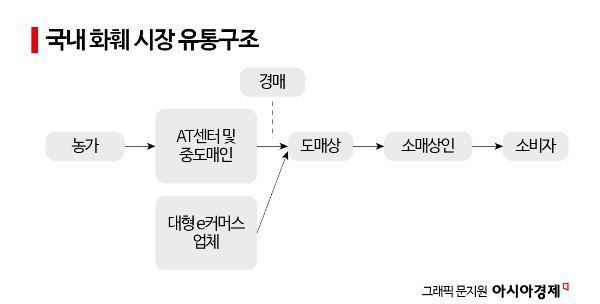
Since COVID-19, large e-commerce companies such as Coupang, Kurly, and Oneul-ui Kkot (Today's Flower) have also entered the auction competition, worsening the situation. Small business owners now have to buy flowers from wholesalers at prices three to four times higher than before or compete for the remaining stock after prices have already surged.
A representative from the Korea Florist Association stated, "The fundamental cause of the current sharp rise in flower prices lies in the domestic flower distribution structure, where anyone with money can purchase auction rights." They argued, "Like Japan and other countries, Korea should strictly manage auction rights in the flower wholesale market."
© The Asia Business Daily(www.asiae.co.kr). All rights reserved.
![Clutching a Stolen Dior Bag, Saying "I Hate Being Poor but Real"... The Grotesque Con of a "Human Knockoff" [Slate]](https://cwcontent.asiae.co.kr/asiaresize/183/2026021902243444107_1771435474.jpg)

















