Impact of Rapid Increase in Power Demand Due to Semiconductor Investment and Electric Vehicle Expansion
Commitment to Carbon Neutrality by 2050
Consideration of Building More Than Four Nuclear Reactors in the 11th Basic Plan for Electricity Supply and Demand
President Yoon Suk-yeol stated on the 15th, "Nuclear power plants are essential for fostering the semiconductor industry," adding, "If we abandon nuclear power, we must give up not only semiconductors but also advanced industries." He believes that nuclear power plants, which supply high-quality electricity stably, must be expanded to ensure the smooth operation of semiconductor factories. This also reflects the government's intention to expand power supply capacity, including the consideration of new nuclear power plants.
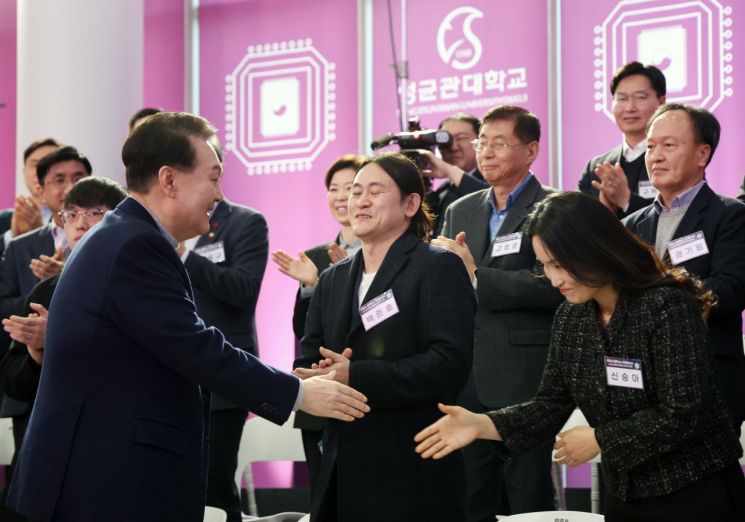
On the same morning, President Yoon visited Sungkyunkwan University in Suwon, Gyeonggi Province, a leading domestic semiconductor workforce training institution, promising to "invest a total of 622 trillion won to create 3 million jobs," and included 'nuclear power expansion' as an additional support measure.
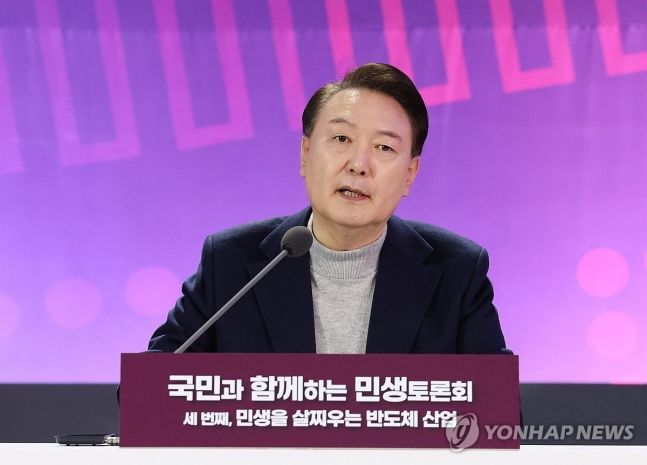 President Yoon Suk-yeol is speaking at the "Third Public Discussion on Livelihoods - Enriching Livelihoods through the Semiconductor Industry" held on the 15th at the Semiconductor Hall of the Natural Sciences Campus, Sungkyunkwan University, Jangan-gu, Suwon-si, Gyeonggi-do.
 [Photo by Yonhap News]
The core of the government's support plan announced that day is to establish the world's largest and most advanced semiconductor cluster in the southern Gyeonggi areas of Pangyo, Suwon, Yongin, Icheon, Anseong, Pyeongtaek, and Hwaseong. To this end, Samsung Electronics and SK Hynix plan to invest a total of 622 trillion won by 2047 to build 16 new fabs (semiconductor manufacturing facilities). President Yoon said, "The semiconductor industry enriches people's lives and creates quality jobs more than any other industry," and anticipated the creation of 3 million jobs.
In particular, President Yoon mentioned the Samsung Electronics site in Giheung, stating, "Installing one semiconductor foundry line requires one 1.3GW nuclear power plant," and pointed out, "It took more than 10 years just to establish the power transmission system." This highlights the need for high-quality, stable power supply to build data centers and promote the widespread adoption of electric vehicles, emphasizing that "nuclear power is now essential."
He further stated, "If we abandon nuclear power, we must give up not only semiconductors but also advanced industries." President Yoon added, "Although this is beyond semiconductors, the nuclear power industry must continue to develop to enrich our people's livelihoods."
The background behind President Yoon's condition of 'nuclear power expansion' for focused semiconductor industry development includes a plan to strengthen the nuclear power industry to solve power supply issues across industries. The Yoon administration's early consideration of nuclear power stems from the rapidly increasing power demand due to semiconductor investments and electric vehicle expansion. The Yongin specialized complex, being developed by Samsung Electronics and SK Hynix as the world's largest system semiconductor cluster, is expected to require over 10GW of power, which accounts for about 25% of the entire metropolitan area's demand.
Moreover, the government must fulfill its 2050 carbon neutrality pledge. China has decided to build 10 additional nuclear power plants to achieve carbon neutrality by 2060. The French government is also increasing its existing six nuclear plants to eight and is considering further new constructions.
President Yoon has expressed his commitment to expanding nuclear power multiple times. One month after the government took office, he visited Doosan Enerbility, a leading nuclear power industry company in Changwon, Gyeongnam, criticizing the Moon Jae-in administration's nuclear phase-out policy by saying, "If we had not done foolish things for five years and had solidly built the nuclear power ecosystem, we probably would have no competitors now." Regarding the current nuclear power industry, he described it as "on the verge of extinction" and urged related ministries to provide proactive government support such as early orders. President Yoon also mentioned resuming construction of Shin Hanul Units 3 and 4, stating, "We will proceed efficiently to shorten the time as much as possible."
The government's support measures for nuclear power expansion will also be in full swing this year. It is known that the government is seriously considering including the construction of at least four nuclear power plants in the working draft of the '11th Basic Plan for Electricity Supply and Demand' (Electricity Plan), which applies until 2038. The key issue in the Electricity Plan is whether to include new nuclear power plant construction, which disappeared during the previous administration's nuclear phase-out policy. If the 11th Electricity Plan includes new nuclear power plant construction plans, it will be the first time in nine years since the 7th Electricity Plan in July 2015, which included the Shin Hanul Units 3 and 4 construction plans.
Earlier, President Yoon also urged government-level support, saying, "The nuclear power industry is currently a battlefield devastated by the bomb called nuclear phase-out," and "With extraordinary determination, please boldly place orders and initiate projects. Otherwise, the nuclear power industry cannot survive. In wartime, bureaucratic thinking that prioritizes safety must be abandoned."
© The Asia Business Daily(www.asiae.co.kr). All rights reserved.
![Clutching a Stolen Dior Bag, Saying "I Hate Being Poor but Real"... The Grotesque Con of a "Human Knockoff" [Slate]](https://cwcontent.asiae.co.kr/asiaresize/183/2026021902243444107_1771435474.jpg)
















