Four Asiatic Black Bears Raised in Gyeonggi-do
Eating Tangerines, Playing in Water, and Showing Active Movements
"Bangapsudaye! ('Nice to meet you' in Jeju dialect)"
On the 13th, four Asiatic black bears that recently settled in Jeju were revealed to the general public for the first time.
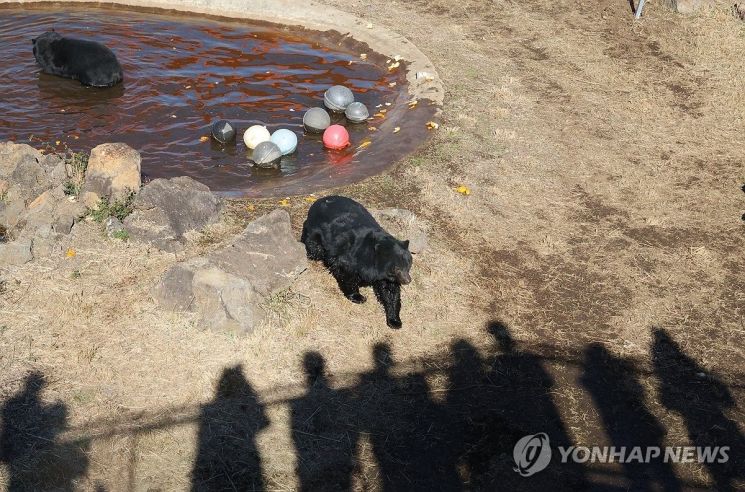
The Asiatic black bears, Dalgomi and Ilgomi (both females), and Bandali and Woongi (both males), all born in 2013, were relocated from a private facility in Yongin, Gyeonggi Province, to Jeju on December 15 last year. After completing their adaptation training, the bears met visitors for the first time on this day.
According to Yonhap News Agency, the bears showed lively behavior such as peeling tangerines with their front paws and playing in the water. Families waiting at the viewing platform burst into cheers when the bears appeared. Some young visitors cried, possibly scared by seeing the bears for the first time, but soon welcomed them with sparkling eyes.
The park officials explained, "Each Asiatic black bear consumes about 3 kg of food daily, including feed and fruits, and they are living healthily."
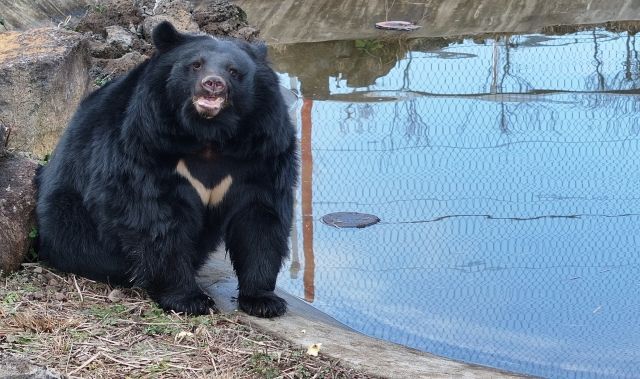 On the morning of the 5th, a moon bear was seen by the water at Jeju Natural Ecology Park in Susan-ri, Seongsan-eup, Seogwipo-si, Jeju.
 [Photo by Yonhap News]
Kang Chang-wan, director of Jeju Ecological Park, said, "We feed them various fruits such as apples and pears, but all four especially like tangerines, which is admirable," adding, "We expect these bears to play a positive role in natural ecological education in the Jeju region within an appropriate scope."
The Asiatic black bears can be seen at Jeju Ecological Park daily from 10 a.m. to 4 p.m., and there is no separate admission fee.
Originally, these bears were raised at a private facility in Gyeonggi Province, but in January 2022, the private facility agreed with the government to end bear breeding by 2025, leading to their transfer to the Jeju protection facility. This is the first case of bears being moved from a private facility to a protection facility. The Asiatic black bear was designated as a natural monument in Korea in 1982 and was classified as a Grade 1 endangered wild animal in 2012, receiving protection accordingly.
© The Asia Business Daily(www.asiae.co.kr). All rights reserved.
![Clutching a Stolen Dior Bag, Saying "I Hate Being Poor but Real"... The Grotesque Con of a "Human Knockoff" [Slate]](https://cwcontent.asiae.co.kr/asiaresize/183/2026021902243444107_1771435474.jpg)
















