VC Industry "Stock Price Undervalued Compared to Other Sectors"
Market Capitalization at About 0.1% of Assets Under Management
There are concerns that the stock prices of listed venture capital (VC) firms are undervalued compared to other industries. The VC industry is considering ways to shed the label of "risk capital" and expand investor accessibility.

According to the investment banking (IB) industry on the 15th, HB Investment, which is challenging entry into the KOSDAQ market, will finalize its public offering price on this day. The general subscription period is scheduled for the 16th to 17th, with a target listing date of the 25th. With a hoped-for public offering price of 2,400 to 2,800 KRW, the expected market capitalization is projected to be around 64.5 billion to 75.2 billion KRW. If HB Investment goes public, the number of VCs listed on the stock market will increase from the existing 19 to 20.
Typically, most VCs do not go public and remain unlisted companies. In contrast, some VCs attempt to list in order to secure fund contributions and resolve liquidity issues. Since it is not an industry that generally attracts significant interest from retail investors, the strategy is to increase points of contact with investors through an IPO. HB Investment also announced plans to actively attract new institutional limited partners (LPs) such as financial institutions through this listing, encourage re-investment from existing LPs, and strengthen both existing and new LP networks to expand assets under management (AUM).
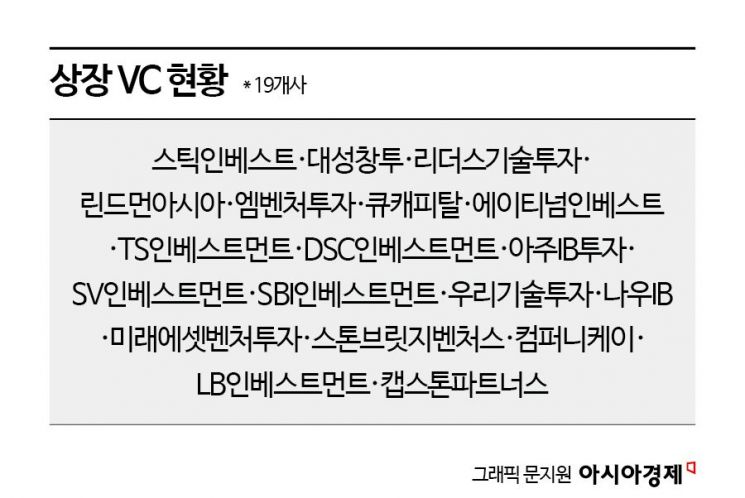
However, the stock prices of previously listed VCs have been sluggish. As of the closing price on the 12th, among all listed VCs, only 10 companies?including Wooree Tech Investment, Stick Investment, Stonebridge Ventures, Company K, Lindemann Asia, Leaders Technology Investment, Atinum Investment, Mirae Asset Venture Investment, Aju IB Investment, and SV Investment?had stock prices higher than a year ago. Overall, listed VCs have not been able to surpass their all-time highs for over a year. The two VCs that went public last year also saw their stock prices fall below their listing day prices. LB Investment and Capstone Partners recorded closing prices of 8,450 KRW and 9,180 KRW respectively on their first day of listing, but as of the 12th, their stock prices dropped to 4,685 KRW and 7,600 KRW. Notably, LB Investment’s stock price is even lower than its public offering price of 5,100 KRW.
The industry views the stock prices of listed VCs as excessively undervalued. Despite steady corporate investments and AUM growth, their market capitalization is smaller compared to sectors like materials, parts, and equipment (SoBuJang) or biotechnology. Yoon Geon-su, chairman of the Korea Venture Capital Association, said, "There are still many views that see VCs as 'risk capital.' Once a certain level is reached, evaluations should focus more on the virtuous cycle of investment and profit rather than the risk itself." He added, "Proper stock price valuation is necessary to leverage and raise funds in the market. This is also related to granting stock options to employees of VC firms."
In fact, the market capitalization of each company is only about one-tenth of their AUM. Aju IB Investment and Atinum Investment each surpassed 2 trillion KRW in AUM last year, while Stonebridge Ventures, Mirae Asset Venture Investment, LB Investment, DSC Investment, and SBI Investment also have AUM exceeding 1 trillion KRW. This is why there are calls for the value of large-scale AUM to be more reflected in company valuations.
Due to the nature of the industry, VCs experience high volatility in performance depending on stock market and economic conditions, as well as the timing of investment exits. Operating revenue (sales) mainly comes from funds, with 'management fees' earned from fund operations and 'performance fees' earned on returns exceeding the internal rate of return (IRR) at fund liquidation being representative. There is also equity-method income recognized based on the shareholding ratio in invested companies.
Jeong Hong-sik and Jo Eun-ae, researchers at eBest Investment & Securities, explained, "VCs experience a structural gap between net income and cash flow, making it difficult to evaluate operating performance by net income. VC net income reflects equity-method income based on the shareholding ratio and net income of invested companies, but actual cash flow depends on the fund rules and operational performance of the funds managed by the VC." They added, "In other words, the cash flow for shareholders of listed stocks is determined by the stock price of the shares held, which can diverge from the company’s actual performance."
The VC industry is working to improve public perception of the sector and find ways for investors to more easily access shares of listed VCs. Chairman Yoon stated, "Capital needs to flow in first for market capitalization to grow, but currently large institutions are not actively buying VC stocks. Since there needs to be space for institutions to enter, we are also considering proposing a 'venture capital company ETF' to asset management firms that design exchange-traded funds (ETFs)."
© The Asia Business Daily(www.asiae.co.kr). All rights reserved.
![Clutching a Stolen Dior Bag, Saying "I Hate Being Poor but Real"... The Grotesque Con of a "Human Knockoff" [Slate]](https://cwcontent.asiae.co.kr/asiaresize/183/2026021902243444107_1771435474.jpg)

















