Only Three Indictments and Five Rejected Arrest Warrants in Three Years
Controversy Overshadows Achievements
Eleven Out of Thirteen First-Term Prosecutors Have Resigned
Uncertainty Looms Over the Second Term of the CIO
The Corruption Investigation Office for High-Ranking Officials (CIO), a symbol of prosecutorial reform under the Moon Jae-in administration, has become the subject of criticism after failing to achieve any meaningful results in the three years since its establishment. The first term of the CIO will come to an end on January 20, when the tenure of its inaugural chief, Kim Jinwook, concludes.
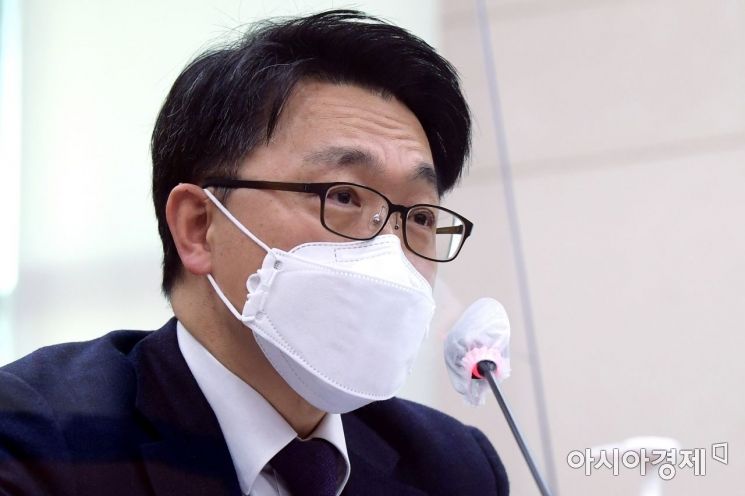 Kim Jinwook, Chief of the Corruption Investigation Office for High-Ranking Officials. Photo by Yoon Dongjoo doso7@
According to an Asia Economy investigation on January 12, the CIO has directly prosecuted only three cases in the past three years. Of these, one resulted in acquittal even at the appellate court, and another ended in acquittal at the first trial. The verdict for the "Son Junseong Prosecutor Accusation Manipulation Allegation" case is scheduled to be delivered on January 31. Furthermore, all five arrest warrants requested by the CIO have been dismissed by the courts.
Both within and outside legal circles, there is a prevailing sentiment that the CIO was flawed from its inception. The leadership was composed of a chief and deputy chief who were both former judges with no investigative experience, leading many to believe that a tragic outcome was inevitable.
Deputy Chief Prosecutor A commented, "I never had high expectations because the organization was structurally abnormal from the start," and added, "How could people with no investigative experience provide proper leadership or guidance to prosecutors?"
The CIO has instead drawn attention for controversies arising during its investigations. Early in its existence, while investigating the "Kim Hakui Former Vice Minister of Justice Illegal Exit Ban Case," the CIO escorted then Seoul Central District Prosecutor Lee Sungyun in the chief's official vehicle, sparking what became known as the "Emperor Summons" controversy.
Additionally, during the investigation into the accusation manipulation allegations, the CIO collected telecommunications data from a large number of individuals, including prosecutors and journalists. The office also faced criticism for allegedly conducting a biased investigation by focusing its investigative resources on Yoon Sukyeol, the People Power Party's presidential candidate at the time.
As the CIO struggled to conduct proper investigations, an exodus of prosecutors and investigators occurred throughout Kim Jinwook's tenure. The office repeatedly posted recruitment notices for chief prosecutors and prosecutors due to chronic staffing shortages. Currently, excluding the chief and deputy chief, only two of the original thirteen first-term prosecutors remain at the CIO.
Attorney B, a former deputy chief prosecutor, stated, "Whenever the CIO was criticized, Chief Kim would excuse the lack of investigations by citing insufficient personnel. However, the CIO's staffing level is comparable to that of a branch office with a deputy chief prosecutor. The real issue is not the number of personnel, but the lack of competence among the leadership and prosecutors."
With negative public opinion mounting against the CIO, the second term of the office now faces the risk of not being launched on time. Chief Kim's term is set to expire in a week, and Deputy Chief Yeo Wookook, who would act as chief, will see his term end on January 28. If both positions become vacant, Kim Seongyu, Head of Investigation Division 1, will serve as acting chief.
The CIO Chief Nomination Committee, formed in November last year, has failed to select the final two candidates for over two months. The committee can only recommend two final candidates to the president if at least five of its seven members agree. It appears that discussions will resume only after the mandatory committee member, the Chief Justice of the National Court Administration, changes from Supreme Court Justice Kim Sanghwan to Supreme Court Justice Cheon Daeyeop on January 15. The date for the next discussion has not been set. The nomination committee consists of seven members: two recommended by each of the ruling and opposition parties, the Minister of Justice (or acting minister), the Chief Justice of the National Court Administration, and the President of the Korean Bar Association. Even if the nomination process is completed, a confirmation hearing and other procedures remain, meaning the leadership vacancy is expected to continue for an extended period.
© The Asia Business Daily(www.asiae.co.kr). All rights reserved.
![Clutching a Stolen Dior Bag, Saying "I Hate Being Poor but Real"... The Grotesque Con of a "Human Knockoff" [Slate]](https://cwcontent.asiae.co.kr/asiaresize/183/2026021902243444107_1771435474.jpg)















