"March is too early to cut interest rates." As the US consumer price inflation, which had shown a disinflation trend, rebounded to the mid-3% range, Loretta Mester, President of the Federal Reserve Bank of Cleveland, dismissed market expectations that the first rate cut could be made in March.
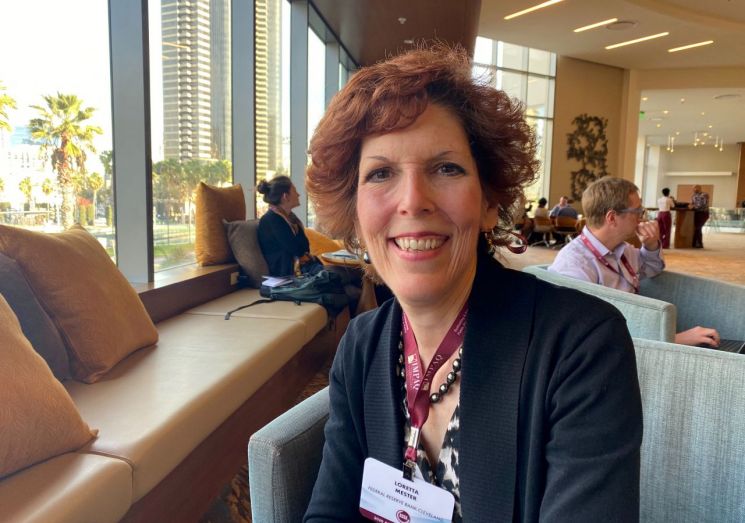
In an interview with Bloomberg TV on the 11th (local time), President Mester said, "In my view, March is probably too early to expect a rate cut as we need to see more evidence (of inflation easing)." Mester, who holds voting rights at this year’s Federal Open Market Committee (FOMC), has been a consistent hawk advocating for further rate hikes over the past two years.
Mester’s remarks came immediately after the release of the December Consumer Price Index (CPI), which exceeded market expectations. She explained, "The December CPI report showed that there is more work to be done," adding, "This means a restrictive monetary policy will continue." She further noted that more disinflation progress needs to be confirmed in housing costs, and wage growth also needs to slow down.
According to the US Department of Labor, the December CPI rose 3.4% year-on-year and 0.3% month-on-month, surpassing Wall Street forecasts. The year-on-year increase was the highest in three months. Mester evaluated, "We certainly do not want inflation progress to stall, and this report does not suggest that is happening," but added, "It means there is more work to be done."
On the same day, Thomas Barkin, President of the Federal Reserve Bank of Richmond, assessed that the December CPI was "about as expected." While goods inflation eased, service inflation remained sticky. He said, "There is still a disconnect between goods and services," and added that broader improvements are needed to be confident that inflation is moving toward the 2% target. Regarding the possibility of a rate cut in March, he refrained from making a premature judgment.
With the CPI inflation rate rebounding to the mid-3% range, the Federal Reserve’s dilemma ahead of this year’s rate cut decisions is expected to deepen. Anna Wong, an economist at Bloomberg Economics, evaluated, "The surprisingly strong December CPI figures show that returning to the 2% price stability target will be challenging and that the last mile could be difficult." John Meyer, Chief Investment Officer at GlobalX, predicted, "The Fed may potentially strengthen or maintain its restrictive monetary policy stance in response to these inflationary pressures."
The unemployment data released on the same day also reaffirmed a still robust labor market. According to the Department of Labor, new unemployment claims for the week of December 31 to January 6 decreased by 1,000 from the previous week to 202,000, falling below Wall Street’s forecast of 210,000.
However, in the interest rate futures market, the March rate cut scenario remains dominant. According to the Chicago Mercantile Exchange (CME) FedWatch, the futures market currently reflects more than a 70% probability that the Fed will cut rates by at least 0.25 percentage points in March. Earlier, following the December FOMC, the Fed indicated through a new dot plot that the median forecast for the year-end policy rate is 4.6%, suggesting that three rate cuts could occur within the year. The current rate stands at 5.25?5.5%.
© The Asia Business Daily(www.asiae.co.kr). All rights reserved.
![Clutching a Stolen Dior Bag, Saying "I Hate Being Poor but Real"... The Grotesque Con of a "Human Knockoff" [Slate]](https://cwcontent.asiae.co.kr/asiaresize/183/2026021902243444107_1771435474.jpg)















