Withstands 10m Tsunami
The Nuclear Safety and Security Commission announced on the 1st that regarding the strong earthquake that occurred in the Noto Peninsula area of Ishikawa Prefecture, Japan, "there are no unusual seismic-related issues at nuclear power plants located on the East Coast so far."
An official from the NSSC stated, "No vibrations caused by this earthquake were detected in the East Coast nuclear power plant areas."
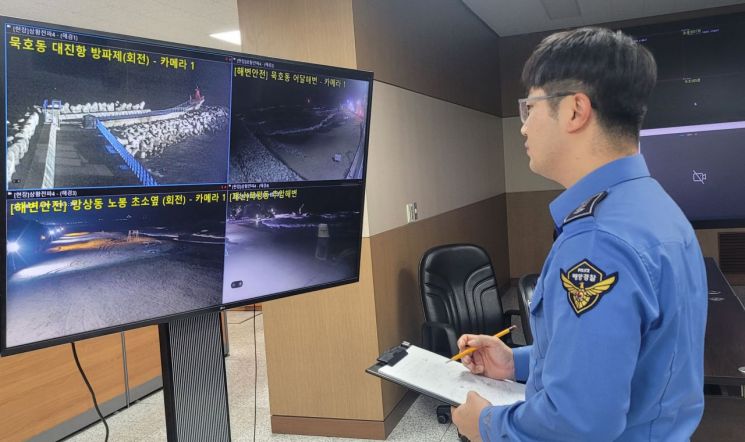 On the afternoon of the 1st, a strong earthquake occurred in the northern sea area of Toyama Prefecture, Japan, causing a tsunami on the East Coast and increasing the risk of sea level rise. An officer from the East Sea Maritime Police Agency is monitoring the coastal closed-circuit (CC) TV in the control room. 2024.1.1 [Image source=Yonhap News]
It is reported that all domestic nuclear power plants, including those on the East Coast, are designed and constructed to withstand a 10-meter tsunami.
The Ministry of Foreign Affairs stated on the same day that they are checking in Ishikawa Prefecture, Japan, whether there are any Korean casualties related to the earthquake. A ministry official said, "We are confirming whether our citizens have been affected, and so far, no reports have been received."
According to the Japan Meteorological Agency, at around 4:10 PM on the same day, an earthquake with an estimated maximum magnitude of 7.6 occurred in the Noto Peninsula area of Ishikawa Prefecture, Japan. Consequently, a tsunami warning was issued for many coastal areas in the northwestern part of Japan centered on Ishikawa Prefecture.
The initial arrival times of the tsunami by East Coast region are as follows: Namhangjin, Gangneung, Gangwon Province at 6:01 PM; Mukho, Donghae at 6:06 PM; Sokcho at 6:10 PM; Imwon, Samcheok at 6:15 PM; and Hupo, Uljin, Gyeongbuk Province at 6:52 PM. As of 8 PM, the maximum tsunami heights were 67 cm at Mukho, 41 cm at Sokcho, 30 cm at Imwon, 20 cm at Namhangjin, and 18 cm at Hupo.
© The Asia Business Daily(www.asiae.co.kr). All rights reserved.
![Clutching a Stolen Dior Bag, Saying "I Hate Being Poor but Real"... The Grotesque Con of a "Human Knockoff" [Slate]](https://cwcontent.asiae.co.kr/asiaresize/183/2026021902243444107_1771435474.jpg)
















