The Ministry of Science and ICT held a 'Meeting for Leading Global Norm Discussions in the Age of Artificial Intelligence (AI)' on the 28th to gather opinions from various sectors.
This meeting was held to share with the private sector the trends in the competition for leadership in AI norms among major countries, such as U.S. President Biden’s executive order signed last October and the European Union (EU)’s agreement on AI legislation earlier this month. Additionally, it aimed to collect opinions on the direction for establishing domestic AI norms.
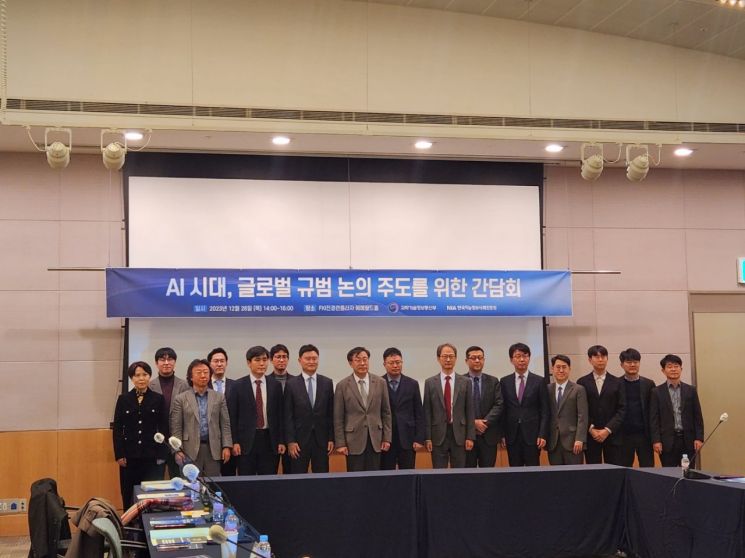 The Ministry of Science and ICT held a meeting on the 28th titled 'Leading Global Norm Discussions in the Age of Artificial Intelligence (AI)' to gather opinions from various sectors.
 [Photo by Choi Yuri]
Before the full-fledged open discussion, presentations on AI regulatory trends in major countries were conducted.
Seongpil Park, Dean of the Graduate School of Future Strategy at the Korea Advanced Institute of Science and Technology (KAIST), presented on U.S. President Biden’s ▲eight principles related to AI safety, security, and trust, and major companies’ voluntary implementation pledges ▲and the key contents and implications of the executive order for safe and trustworthy AI.
The Biden administration announced the executive order last July based on voluntary pledges made by big tech companies. It aims to lead the development and use of AI that is safe, secure, and trustworthy, characterized by a balanced view of AI’s benefits and risks. Dean Park explained, “The U.S. views AI as a national security issue and provides clear grounds for the need for regulation,” adding, “At the same time, it supports developers and companies’ access to AI technology resources.”
Next, Jiwon Kang, a lawyer at Kim & Chang law firm, introduced the key contents and implications of the EU AI Act, which is scheduled to be enacted early next year.
The EU AI Act expands the scope of prohibited AI compared to the previous European Commission proposal and introduces regulations for general-purpose AI. It also adopts a comprehensive regulatory approach with the character of a fundamental law. It prohibits AI types with high risks of fundamental rights violations or personal data misuse and strengthens obligations for AI operators.
Following the presentations, participants shared the preparedness and challenges of Korean companies regarding the U.S. and EU regulations. Discussions were also held comparing domestic policies for securing AI reliability and safety.
Korea will host the AI Safety Summit in May next year. Since it can proactively propose agendas on AI safety, there is an opinion that it is necessary to continue gathering views on the direction of AI norms going forward.
Woongyu Park, 2nd Vice Minister of the Ministry of Science and ICT, explained, “With the development of generative AI, the competition for leadership in AI norms at the international level is intensifying, including the G7’s ‘Hiroshima AI Process’ and the United Nations (UN) ‘High-Level AI Advisory Body Operation,’ as well as the U.S. and EU.” Vice Minister Park emphasized, “In a situation where different regulations such as the U.S.-style self-regulation and the EU’s strong regulation are being pursued, it is important for Korea to take a balanced approach that makes the most of the innovation opportunities given to us while ensuring that it does not threaten the safety of individuals and society.” He added, “We will do our best to systematically support the AI industry, promptly enact AI legislation that can respond to side effects, and lead norms at next year’s AI Safety Summit.”
© The Asia Business Daily(www.asiae.co.kr). All rights reserved.
![Clutching a Stolen Dior Bag, Saying "I Hate Being Poor but Real"... The Grotesque Con of a "Human Knockoff" [Slate]](https://cwcontent.asiae.co.kr/asiaresize/183/2026021902243444107_1771435474.jpg)
















