A suggestion has been made that the negative impact of global trade fragmentation on our exports can be mitigated through export diversification.
On the 27th, the Bank of Korea stated this in a BOK Issue Note report titled "Background and Impact of Recent Changes in the Global Trade Environment." Regarding exports, it pointed out that South Korea has a high dependence on certain items or countries such as semiconductors and China, and in terms of imports, there is also a high dependence on China for key raw materials in major industries like secondary batteries. Without diversification, there is concern that volatility in exports and imports could increase due to future changes in external conditions.
Due to conflicts such as the US-China tensions, countries are considering geopolitical factors alongside economic factors when making corporate trade and investment decisions, leading to regional fragmentation in investment and trade.
For example, in the case of corporate foreign direct investment, investments in allied countries (friendshoring) or nearby regions (nearshoring) centered on the US and Europe have increased, while investments in China have decreased.
Since the US-China trade dispute in 2018, global policy uncertainty has also significantly increased, and the report analyzes that this heightened uncertainty could notably suppress corporate export and investment activities.
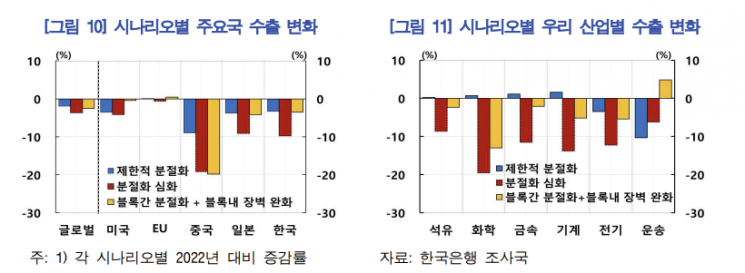
According to the report, if major countries impose import tariffs to increase self-sufficiency in advanced industries (electrical and electronic equipment and transportation equipment), South Korea’s exports are expected to decrease by about 3% in the long term, mainly in those industries, while global exports are projected to decline by approximately 2%.
If trade barriers between two blocs are strengthened and protectionist measures are implemented even within the blocs, the negative impact is more severe. South Korea’s exports could decrease by up to 10%, and global exports by around 4%. By industry, exports of chemicals, machinery, and electrical equipment are estimated to experience the largest declines.
However, even amid intensified fragmentation between blocs, if barriers within blocs are eased, South Korea’s exports are expected to decrease by the mid-3% range and global exports by the mid-2% range, significantly reducing the negative impact caused by fragmentation.
Son Min-gyu, Deputy Director of the International Trade Team at the Bank of Korea’s Research Department, said, "Changes in the global trade environment such as the expansion of industrial policies and trade regulations by major countries, trade fragmentation centered on the US and China, and China’s economic structural transformation present both risks and opportunities for our economy." He added, "In the rapidly changing global trade environment, it is necessary to steadily pursue diversification of our exports by item and region and strengthen industrial competitiveness to ensure stable growth of our economy."
© The Asia Business Daily(www.asiae.co.kr). All rights reserved.
![Clutching a Stolen Dior Bag, Saying "I Hate Being Poor but Real"... The Grotesque Con of a "Human Knockoff" [Slate]](https://cwcontent.asiae.co.kr/asiaresize/183/2026021902243444107_1771435474.jpg)















