December Pigeon Color Strengthened Fed Policy
Expect Lower Funding Costs if US Rate Cuts Occur
Bright Earnings Outlook but Earnings Shock Distrust Remains
As the possibility of aggressive interest rate cuts in the U.S. next year is anticipated, some securities firms have hurriedly revised their annual KOSPI index bands (expected ranges). This is due to expectations that next year's earnings indicators will improve significantly compared to this year, as well as the recent dovish tone of the U.S. Federal Open Market Committee (FOMC). However, some caution that the current KOSPI index, which has risen to the 2600 level, may have already priced in the expectations for rate cuts, warning against excessive optimism.
Major Securities Firms Raise Targets on Rate Cut Optimism
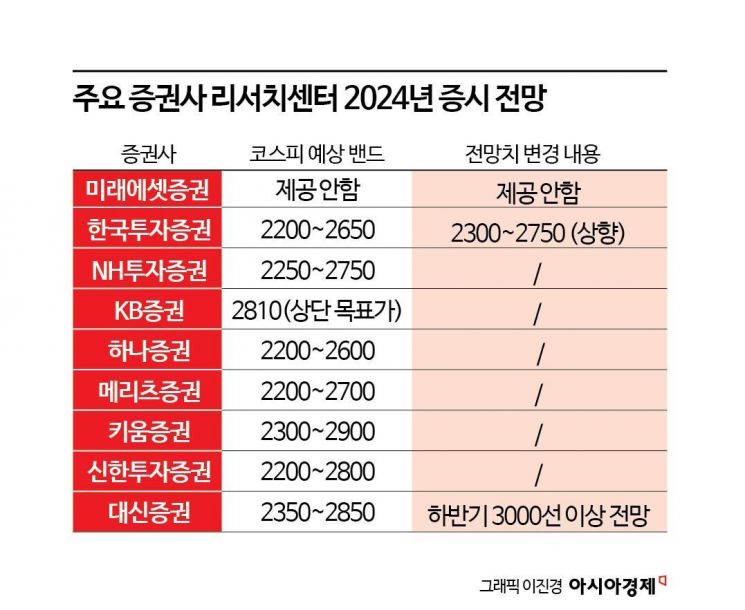
Major securities firms presented the 2024 annual KOSPI upper range between 2600 and 2850 during October and November. The highest KOSPI target was set by Daishin Securities at 2850. Leading foreign investment banks (IBs) also forecast the upper range between 2670 and 2830. Although there is no clear momentum, opinions have converged on a box market similar to or slightly better than this year’s, often referred to as "Boxpi." The lower range estimates were between 1900 and 2300, with some firms expressing pessimism that the bottom could fall below 2000.
The mood among domestic research centers reversed after the December FOMC meeting, which sets the U.S. benchmark interest rate. The Federal Reserve (Fed) announced at the December FOMC its plan to initiate rate cuts in March next year. Chairman Jerome Powell’s statement that "we are considering when it is appropriate to reverse the tightening monetary policy" ignited the market. The Fed, which raised the benchmark rate from near 0% in March 2022 through 11 hikes, shifted its stance to rate cuts for the first time in over two years. The Fed projected a median benchmark rate of 4.6% for 2024, lower than the 5.1% forecast in September. This fueled expectations that the U.S. 10-year Treasury yield could drop as low as 3.5%, given that last year the 10-year yield was on average about 110 basis points (bp; 1bp=0.01%) below the benchmark rate.
Daishin Securities issued a bold forecast after the FOMC, suggesting that the KOSPI could break through the 3000 level in the second half of next year. Lee Kyung-min, a researcher at Daishin Securities, analyzed, "The Fed’s stance shift faster than expected and Chairman Powell’s remarks on starting rate cuts are favorable changes for the global stock market, including the KOSPI next year," adding, "Although the timing differs, an investment environment will be created where the economies and monetary policy momentum of major global countries improve simultaneously." However, he cautioned that short-term volatility could increase due to concerns over a U.S. recession in the first quarter, advising that there could be downward pressure above the current 2600 level in the short term.
Korea Investment & Securities revised its outlook entirely. It raised the 2024 annual KOSPI band from the previous 2200?2650 to 2300?2750, increasing both the upper and lower bounds by 100 points. Similar to its quick upward revision of the 2023 KOSPI band in February, it swiftly captured the market sentiment this time as well. Kim Dae-jun, a researcher at Korea Investment & Securities, explained, "The upper band assumes two rate cuts, and considers that the return on equity (ROE) did not decline as much as expected due to semiconductor profit improvements," adding, "It also reflects the assumption that the 3-year government bond yield will decrease as the rate hike cycle effectively ends next year, which was used to set the cost of equity (COE)."
A similar tone was detected in the short-term market outlook for January. NH Investment & Securities suggested a KOSPI band of 2450?2650 for January, 50 points higher than the previous lower bound of 2400. Kim Byung-yeon, head of investment strategy at NH Investment & Securities, noted, "The Fed adopted a more proactive stance on rate cuts for 2024 at the December FOMC," and added, "This will provide downside resilience to the stock market until the Fed changes its mind." He also emphasized that earnings must be secured to raise the upper bound.
Market Mixed with Optimism and Distrust
There are also opposing views warning against inflated expectations solely based on rate cuts. This is due to the significant gap between the market and the Fed’s stance. The Fed currently expects three rate cuts within next year, totaling 75?100 basis points. Some market participants even advocate for seven aggressive cuts. Regarding this, Samsung Securities stated that while the Fed’s attitude change is optimistic for the stock market, it is necessary to watch how volatility will affect the market. For January’s KOSPI, they forecast a neutral band of 2450?2650 without adjusting the existing range. There is also analysis that the year-end KOSPI rally, which has reached the 2600 level, has already priced in expectations.
Next year’s earnings outlook is equally uncertain. 2023 was a year marked by overlapping negative factors such as the U.S. rate hike trend, domestic economic downturn, and the prolonged Russia-Ukraine war. Among 285 KOSPI-listed companies in Q3, 110 reported earnings shocks, missing estimates by more than 10%. The consensus operating profit estimate for KOSPI-listed companies in 2023, as calculated by FnGuide, was only 154 trillion KRW. Unlike 2023, 2024 is expected to be a record year for earnings. The operating profit estimate for 2024 is 236 trillion KRW, more than 50% higher than the previous year. Sales are also expected to grow by 7.8%. Thanks to the strength of big tech companies such as Apple, Amazon, Microsoft (MS), and Google, it is analyzed that domestic semiconductor and utility sectors will benefit. Kim Dae-jun of Korea Investment & Securities noted, "Semiconductors are expected to improve earnings compared to 2023 due to demand recovery and price increases driven by advances in artificial intelligence (AI) technology," adding, "Given the absolute level of profits, their influence on the stock market could increase, acting as a force to lift the index."
The consensus is trending downward. The 2024 operating profit consensus volatility is -4.72% over six months and -2.02% over three months. Concerns have also emerged that KOSPI’s export-driven leading stocks may face cost pressures from rising international oil and raw material prices starting in Q1 next year. Jung Da-woon, a researcher at eBest Investment & Securities, said, "The feared decline in the 2024 consensus is now underway," adding, "There is still room for further downward revisions."
© The Asia Business Daily(www.asiae.co.kr). All rights reserved.
![Clutching a Stolen Dior Bag, Saying "I Hate Being Poor but Real"... The Grotesque Con of a "Human Knockoff" [Slate]](https://cwcontent.asiae.co.kr/asiaresize/183/2026021902243444107_1771435474.jpg)















