Related Documents Written by Army Regional Agencies Found
Criticism of the "Ignorant Crowd" Believing Rumors
A new official document has emerged regarding the massacre of Koreans immediately after the Great Kanto Earthquake in Japan. It is expected to serve as a record supporting the massacre of Koreans by Japanese people.
On the 25th, Mainichi Shimbun reported, “Journalist Watanabe Nobuyuki discovered the 'Kanto Region Earthquake Related Work Report' in the Defense Ministry’s Defense Research Institute archives, which records that about 40 Koreans were killed immediately after the Great Kanto Earthquake.”
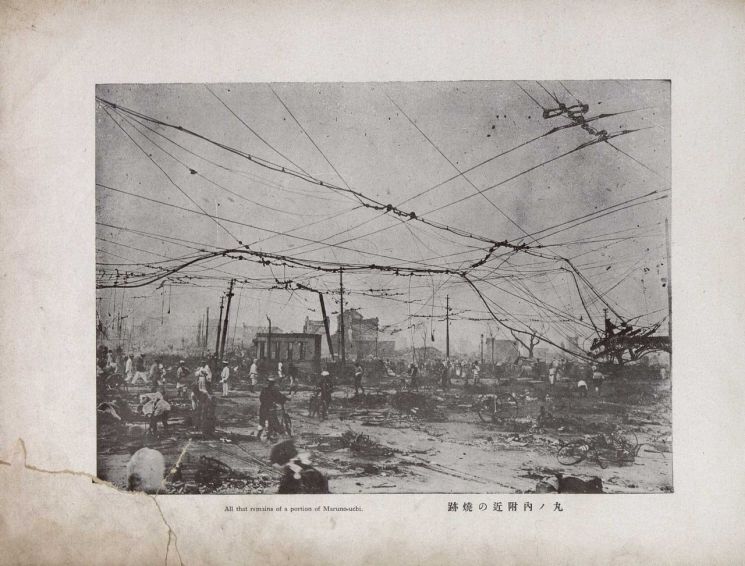
The Great Kanto Earthquake refers to the massive earthquake that struck the Kanto (關東) region of Japan at 11:58 a.m. on September 1, 1923, and the accompanying massacre incident. According to data from the Japan Meteorological Agency, there were significant casualties, including 99,331 deaths and 43,476 missing persons.
The massacre of Koreans occurred three days after the Great Kanto Earthquake, on September 4, 1923, when police officers were transporting about 200 Koreans from Urawa in Saitama Prefecture toward the Fukaya and Honjo police stations.
The Japanese army and police exploited the earthquake to spread fabricated rumors such as “Koreans poisoned wells,” resulting in the massacre of thousands of innocent Koreans.
Despite the publication of a book analyzing massacre materials from Kanagawa Prefecture last September and the emergence of records detailing the massacre circumstances in Saitama Prefecture, the Japanese government has consistently avoided specific mentions and responsibility by stating that “no records have been found to verify the facts” regarding the Korean massacre.
The document discovered by Mr. Watanabe was created by the Kumagaya Regiment District Headquarters, a local army agency, and submitted to the superior institution, the Army Ministry, on December 15, 1923. At that time, the Kumagaya Regiment District Headquarters was responsible for conscription and veteran management in the western part of Saitama Prefecture near Tokyo.
The document recorded, “As night fell, a crowd filled with murderous intent killed all 40 or so Koreans who could not move during the day.” It also described the incident as a ‘Seonin (鮮人, a derogatory term for Koreans) massacre,’ ‘unfortunate incident,’ and ‘illegal act.’
Furthermore, it stated, “There were no Korean attacks or arson, and we did not hear of any poisoning of wells,” indicating that the rumors of Korean attacks and arson circulating in Japanese society at the time were at least untrue in that region.
The Kumagaya branch chief of the Veterans Association even criticized those who were deceived by the baseless rumors related to Koreans as “a foolish group lacking discernment.”
The headquarters also noted the fact that the massacre occurred at night, commenting, “If Koreans are transported at night, one might witness the horrific scene of people being killed in dark places, so it is necessary to avoid nighttime.”
Mr. Watanabe added advice, saying, “It is certain that the Korean massacre occurred, but there are parts that cannot be explained by existing views such as collective mental disorder or oppression by authorities. It is necessary to reveal the full picture from a different perspective.”
© The Asia Business Daily(www.asiae.co.kr). All rights reserved.
![Clutching a Stolen Dior Bag, Saying "I Hate Being Poor but Real"... The Grotesque Con of a "Human Knockoff" [Slate]](https://cwcontent.asiae.co.kr/asiaresize/183/2026021902243444107_1771435474.jpg)
















